AR-PRO – AC LINE VOLTAGE REGULATOR
resonant transformers, the AR-PRO is not sensitive to
small errors in line frequency, making it ideal for use
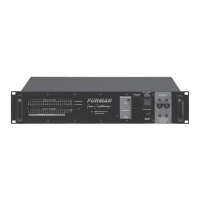
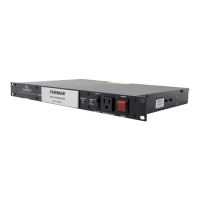
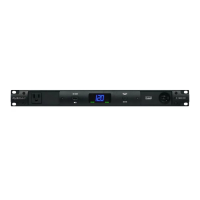
The AR-PRO has twelve convenience outlets on its
rear panel, and two on the front panel. All outlets are
regulated, spike-suppressed, and fi ltered against
RFI with a 3-pole fi lter. There are no controls except
a master circuit breaker, which serves as an on-off
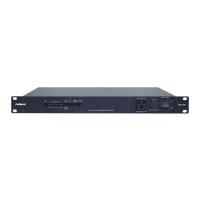
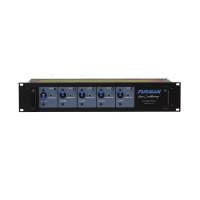
switch. Two bar-graph meters, each comprised of 21
LEDs indicate input voltage and output current. Three
other LEDs indicate proper function (i.e., the output
voltage is either within ±5% of desired output, or above
or below that range). One or more units may be turned
on remotely, either simultaneously or in sequence, by
switching an internally-derived DC control line.
The AR-PRO is housed in a double space (3.5” high
and 17” deep) rack-mount chassis, and weighs only
50 lbs (23 kg). It is made of extremely rugged heavy-
gauge black powder coat steel. Adjustable rear rack
ears (RPM-2, sold separately) allow it to be secured
in both front and rear. It comes equipped with a
125/250V-30A twist-lock input connector and a mating
female cable-mount connector, ready to terminate your
To precisely monitor the AR-PRO’s output voltage,
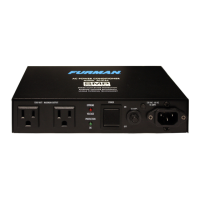
you may want to use one or more Furman
Power Conditioner and Light Modules.
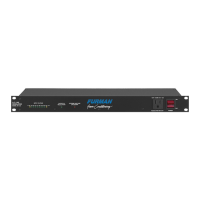
PL-Series is the perfect complement to the AR-PRO
for rack power distribution. Voltage meters monitor the
incoming line (the AR-PRO’s output), twin slide-out
lights with a dimmer control illuminate your equipment,
and eight additional outlets provide spike/surge protec-
AC power is, to some extent, unpredictable. The
available voltage may vary from place to place and
from moment to moment. The waveform may not be
a perfect sine wave, and high or low frequency noise
may be present. AC power also varies from country to
country in terms of voltage and frequency.
The AR-PRO is intended to reduce to the greatest
extent possible, the impact of these irregularities. How-
ever, you should be aware that there are certain things
it cannot do. These include, but are not limited to:
1. Protecting against direct lightning strikes.
2. Protecting from complete loss of power (blackouts).
3. Performing frequency conversion to 60 Hz.
4. Isolating ungrounded equipment.
5. Handling multiple-phase power.
Because of the myriad differences in electrical code
requirements around the world, plus the varying cable
length needs in individual installations, it is not pos-
sible to include a complete supply cable with your
AR-PRO. A cable-mount connector that mates with the
AR-PRO’s twist-lock connector is supplied, but it is up
to the user to connect it to a cable with the appropriate
gauge, number of conductors, length, and source-end
connector. This section is intended to assist in deter-
mining the kind of cable to use, and in attaching it to
the twist-lock connector.
For nominal 120 VAC operation, 3 conductor cable of
(.101”/2.56mm diameter) should be
used, depending on distance from the power source.
For nominal 220-240 VAC operation, 3 conductor
should be used, depending on distance from the pow-
Rubber-jacketed cable is highly recommended for best
fl exibility and abrasion resistance. It is permissible to
use 4 conductor cable, but it is not necessary to do so


 To Next Page
 Loading...