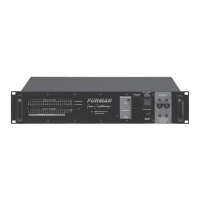
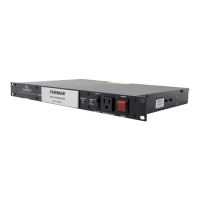
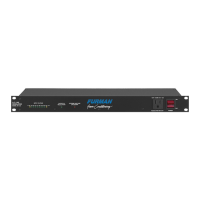
AR-PRO – AC LINE VOLTAGE REGULATOR
power it through a different circuit.
Q. Why is there a 3 second delay before power goes on?
A. This built-in delay allows the internal sensing cir-
cuitry to stabilize and provides a means of turning on a
group of AR-PROs in a delayed sequence.
Q. I connected the AR-PRO through a Ground Fault
Interrupt (GFI), and it keeps tripping. What can I do?
A. Some European countries are using GFI circuits
that will disconnect the load on sensing approximately
3 mA of ground current. This relatively small current
can be created by the fi lters whose purpose is to clean
up the power by shunting noise and interference to
ground. In doing so, these fi lters can create the very
leakage currents that cause the GFIs to trip! If use of
the GFI is unavoidable, the only way to alleviate this
problem is to reduce the amount of fi ltering by remov-
ing some of the capacitors that shunt the noise to
ground. If this becomes necessary, consult the factory
In North America, the GFIs we have tested trip at
closer to 5 mA and are therefore generally not a prob-
lem. Also, running on the lower voltage range cuts the
Q. Are there any special considerations for using the AR-
PRO with equipment containing switching power supplies?
A. Switching power supplies are frequently used in
video gear, lighting controllers, computers, and a
variety of programmable logic controllers for controlling
industrial equipment. Such supplies generate harmon-
ics in the AC current waveform because they work
by switching on and off at high speed. The amount
of current being drawn by equipment using switching
supplies may appear well under the AR-PRO’s 30 amp
limit when measured by a conventional average or
RMS reading meter, but the heating effects in the wir-
ing (both hot and neutral) can cause the wiring to be
severely overloaded for its rating. If your load appears
well within limits yet things are running hot, breakers
are tripping, and/or transformers are buzzing, you may
be experiencing high harmonic content in your power
line. In such a situation, reduce your load by unplug-
ging some equipment and power it through a different
Even if you are not running this type of equipment, you
may experience the same effects if someone else on
your line is doing so. Your utility company may be able
to help you determine the cause.
It is possible to control one or a group of remotely
located AR-PROs using wiring carrying only a low
control voltage. This can be very convenient in cer-
tain situations; for example, turning on amplifi ers on
a stage from a sound booth in the rear of a hall. The
control signal can be safely routed through wiring no
heavier than an unused microphone line. The control
signal is DC, so it will not cause noise in adjacent
audio lines. The necessary voltages are generated
internally in the AR-PRO; all that is needed is wiring
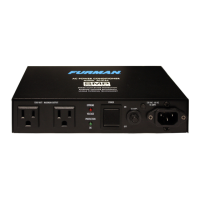
All connections for remote operation are made
through the screw terminal strip on the rear panel.
There are three recommended confi gurations:
Single AR-PRO, local turn-on only:
with the Power switch on the front panel. No wires
or jumpers should be connected to the terminal
Single AR-PRO, remote turn-on:
switch between the Remote Out and Remote In
terminals. Leave the front panel Power switch in
the ON position. When the switch is open, the AR-
PRO is on; when closed, the AR-PRO, is off.
Multiple AR-PROs, remote turn-on in delayed
A built-in delay of approximately a
quarter second is automatically provided to stag-
ger the potentially large inrush currents that occur
when certain types of equipment are powered up
simultaneously. Using such a delayed sequence
can avoid blowing a house breaker when all the
AR-PROs are powered from the same circuit.
To create a remote delayed sequence, all front panel
Power switches must be left in the ON position. All
Ground terminals must be connected together. The
Delay Out of the fi rst AR-PRO (the one that will turn on
fi rst) is connected to the Remote Out of the second unit.
The Delay Out of the second AR-PRO is connected to
the Remote Out of the third unit, and so forth for addi-
The master on-off switch must be connected to the


 To Next Page
 Loading...