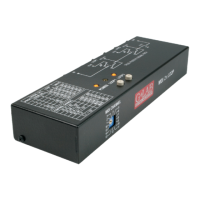
The G-LAB Line MIDI Switcher LMS-1 is a versatile, bidirectional, and passive audio signal switcher designed for guitarists and audio professionals. It offers galvanic separation between its A, B, C, and D outputs/inputs, ensuring a clean signal path free from ground loops. The LMS-1 can be controlled via a MIDI interface or through its top-mounted buttons, providing flexible operation in various setups.
Function Description
The LMS-1 operates in two primary working modes, configured by the DS1 switch:
- One Input / Four Outputs (Y IN / ABCD OUT): In this mode (DS1=OFF), the device allows a single input signal (e.g., from a guitar) to be routed to one of four outputs (A, B, C, D). This is ideal for selecting which amplifier a guitar is connected to.
- Four Inputs / One Output (ABCD IN / Y OUT): When DS1 is set to ON, the LMS-1 functions as a mixer or selector for multiple input sources (A, B, C, D) to a single output (Y). This mode is useful for choosing which signal source (e.g., different guitars) feeds into a single amplifier or processing unit.
Within the "one input / four outputs" mode, the DS2 switch further refines the switching behavior:
- "One of Four" Mode (DS2=OFF): Pressing any of the four manual control buttons establishes a connection between the Y input and the corresponding output. Only one output can be active at a time, ensuring exclusive routing.
- "One or More" Mode (DS2=ON): In this mode, pressing a button toggles the state of the chosen output (turning it on or off). This allows the signal to be sent to multiple devices simultaneously. However, it's important to note that using this mode with a guitar and two or more amplifiers is generally not recommended, as it can create ground loops, potentially leading to audible hum in speakers, especially with high-gain tones.
The device features a fully passive signal path, meaning it contains no active components or separating transformers. This design choice ensures that the switcher has no discernible influence on the guitar's sound, preserving the original tone integrity. Switching is handled by electro-mechanical relays with a "silent switching system," minimizing any audible clicks or pops during transitions.
Usage Features
The LMS-1 offers both manual and MIDI control for maximum flexibility:
- Manual Control: Four dedicated buttons on the device's top panel allow for direct, hands-on control of connections. This is convenient for quick adjustments during practice or live performances.
- MIDI Control: The LMS-1 can be integrated into a larger MIDI-controlled setup. A rotatable MIDI CHANNEL knob allows users to select the specific MIDI channel on which the device receives commands. This knob is adjusted using a small screwdriver, with an arrow-head indicating the set channel. The LMS-1 responds to both Program Change and Control Change commands, enabling complex routing changes to be automated and recalled as part of MIDI presets.
- Program Change Commands: These commands allow for the recall of specific output configurations. The manual provides a detailed table mapping Program Change numbers to various combinations of active outputs (A, B, C, D). For instance, Program Change 1 activates output A, Program Change 2 activates output B, and so on, up to combinations like Program Change 19, which activates all outputs. The formula
Prog Ch No = 4+1(when A=ON)+2(when B=ON)+4(when C=ON)+8(when D=ON) helps in understanding how these numbers correspond to output states.
- Control Change Commands: The LMS-1 also responds to specific Control Change messages. Control Change number 113, with different value ranges, can activate individual outputs (0-31 for A, 32-63 for B, 64-95 for C, 96-127 for D). Control Change number 114, with a value of 0, activates output A, while a value of 127 activates output B. Other values for CC 114 can correspond to Program Change numbers, offering another layer of control.
Maintenance Features
Proper power supply and ground management are crucial for optimal performance and to prevent issues like hum and noise.
- Power Supply: The LMS-1 requires a regulated 9V DC power source with a capacity of 100 mA or more. Users are advised to check the pin polarization before plugging in the power supply. The device includes protection against reverse polarity. If this protection is triggered, the power supply should be disconnected, and a few minutes should pass before attempting to reactivate the device. Damages resulting from improper power supply will void the warranty.
- Control Ground Lift (CTRL GND) Switch: This switch helps manage ground connections related to the 9V power supply.
- If the 9V power supply is fully isolated (not connected to the signal ground or chassis ground), the CTRL GND switch should be set to ON.
- If the 9V negative wire is connected to other signal grounds or chassis grounds, the CTRL GND switch should be set to OFF to prevent ground loops.
- AB GND and ACD GND Ground Switches: These switches are vital for optimizing ground connections, particularly in the "one input / four outputs" mode (Y IN / ABCD OUT), to eliminate ground loops and minimize hum or switching noises.
- It is strongly recommended to always use output A first. The amplifier connected to output A should have a connection between its signal ground and chassis ground.
- If all connected amplifiers have a signal ground to chassis ground connection, both the AB GND and ACD GND switches should be set to OFF.
- If an amplifier connected to a specific output (B, C, or D) lacks a signal ground to chassis ground connection, the corresponding ground switch should be set to ON. The AB GND switch connects the A output ground with the B output ground, while the ACD GND switch connects the A output ground with the C and D outputs ground.
- In the "four inputs / one output" mode (ABCD IN / Y OUT), if guitars or other signal sources not connected to ground are used with the ABCD inputs, the AB GND and ACD GND switches should be set to ON.
- G-LAB provides resources on their website (www.glab.com.pl) with tips on building guitar systems free of ground loops.
The LMS-1 is designed for durability and ease of integration into professional and home studio setups, providing a reliable solution for complex audio routing needs.

 Need help?
 General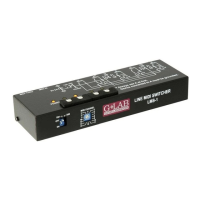

 To Next Page