09/25/02 GPS_field_guide 8:19 A9/P9
5
The receiver:
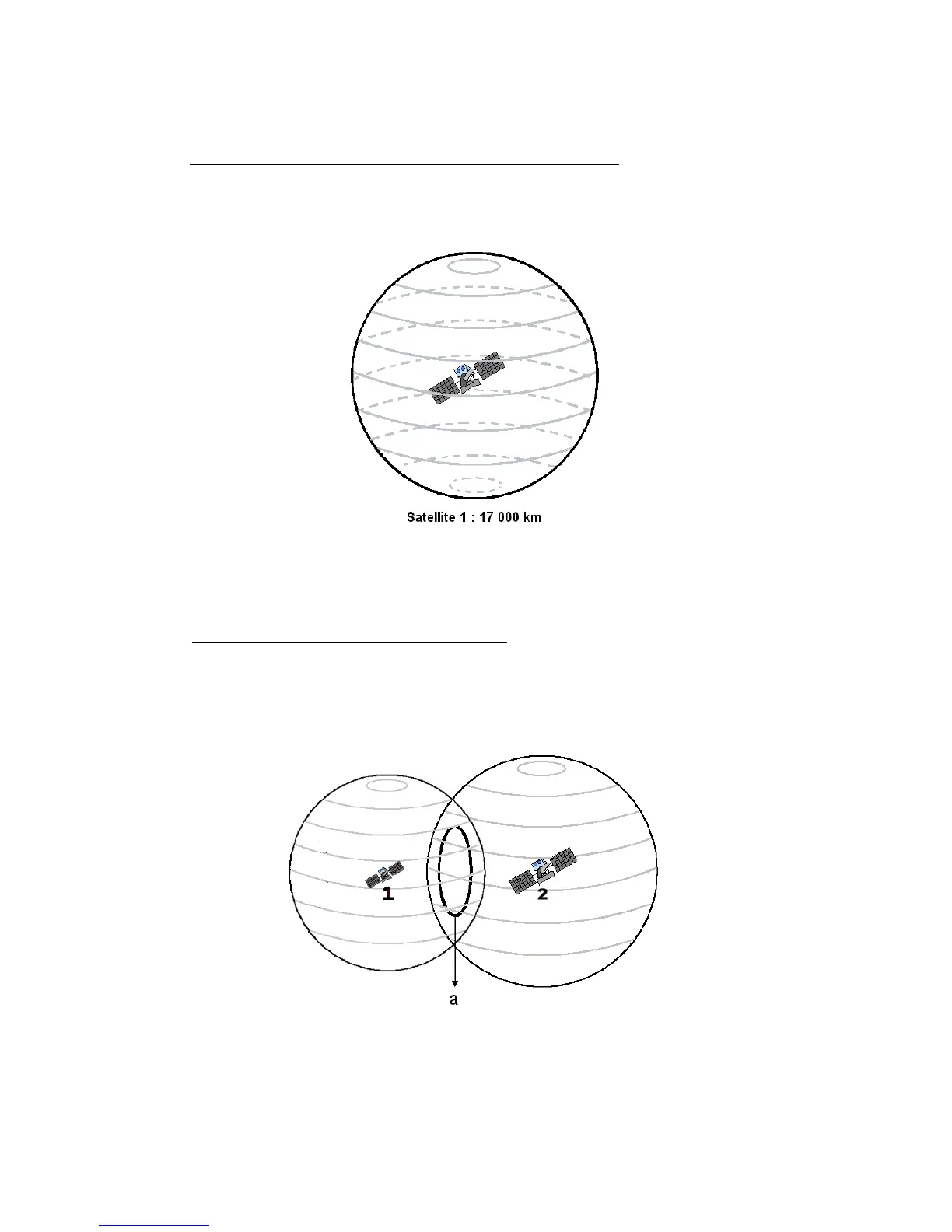
1. Calculates the distance to the first satellite he is able to catch. Let's suppose that the
receiver calculates a distance of 17'000 km between this first satellite and the receiver.
This will mean that the receiver is located somewhere on a sphere that is centred on this
first satellite and that has a radius of 17'000 km (Figure 3).
Figure 3 - Sphere indicating the potential location of the GPS receiver with one
satellite signal
2. Calculates the distance to a second satellite for which it is able to catch a signal
(19'000 km for example). This tells the receiver that it is not only located on the first
sphere (Figure 3) but also on a second sphere centred on the second satellite and that has
a radius of 19'000 km. Or in other words, that the receiver is somewhere on the circle
where these two spheres intersect (Figure 4 point a).
Figure 4 - Circle indicating the potential location of the GPS with two satellite signals
(a)



 To Next Page