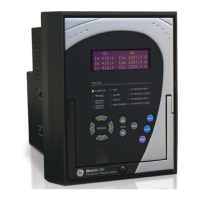
SETPOINTS MODE
5-1
All the messages displayed by the 565 Relay in the setpoints
mode are shown and explained in this section. As for actual
values, the messages are laid out in book form with a number
of pages. Each page contains lines displaying a message.
The setpoints section has several pages, the contents of
which are as follows:
Page Contents
1. User Level setpoints.
2. Phase Current setpoints.
3. Ground Current setpoints.
4. Configuration setpoints.
5. Analog Input setpoints.
6. Analog Output setpoints.
7. Communications setpoints.
8. Calibration Mode setpoints.
9. Voltage setpoints.
10. Demand Metering setpoints.
11. MTM Metering setpoints.
The numbers in the “Location” column to the left of each
message in this section give the page and line of that
message in the 565 Relay’s memory. For example, the
message to the right of the number S 1.2 in the “Location”
column will appear on page 1 and line 2 when the Relay is in
setpoints mode. The “Message Line” column shows the
actual message which can be read from the LCD display on
the front panel of the unit. The 565 Relay has two user levels,
“basic” and “advanced”. The messages seen depend on this
user level, which is chosen in page one of setpoints. The
basic level allows the user to operate the relay using the
minimum of the features necessary. The advanced level
allows the user to use all the 565 Relay features.
The messages which will only be seen by the advanced user
and not the basic user, are marked “
L
A
”, for “Level-ad-
vanced” in the Location column.
Quantities shown in display boxes are typical values only.
Different quantities will be displayed in each particular appli-
cation.
Relay Selection
The 565/575 Relay has six internal relays. They are called
Trip, Close, Aux. 1, 2, 3, and 4. The following are the combi-
nations of relays which you can select to have activated by
any alarm or trip condition. This selection must be made in
the setpoints mode.
ALARM RELAY TRIP RELAY
SELECTION SELECTION
1. Aux 1 1. Trip
2. Aux 2 2. Aux 1 (565 only)
3. Aux 1&2 (565 only) 3. Aux 2 (565 only)
4. Trip & Aux 1
5. Trip & Aux 2 (565 only)
6. Aux 1&2
7. Trip & Aux 1&2
The relay(s) to be activated can be displayed by pressing the
NEXT CHOICE key. The display will show one of the options
above, each time the key is pressed. When the last item is
reached, the display will go back to the first item the next time
the NEXT CHOICE key is pressed.
For example, say a combination of relays is being assigned
to the undervoltage trip condition in setpoints. If the Trip relay
and Auxiliary 1 relay need to be activated by this condition,
the NEXT CHOICE key is pressed until the display shows
UNDERVOLT TRIP
RELAY TRIP&AUX1
The STORE key is then pressed to store the selected relay or
combination of relays in the 565/575 Relay’s memory. The
following message will appear for two seconds to verify that
this has been done.
NEW SETPOINT
STORED
When more than one relay is selected as shown, all the
selected relays will be energized simultaneously. The con-
tacts of the selected relay(s) can then be used to provide
remote alarms or trips. These contacts are available at the
rear of the 565 Relay panel. See the wiring diagram for
terminal numbers.
Setpoint Message Abbreviations
The following abbreviations are used in the messages in the
setpoints pages:
A Ampere
AL’M Alarm
AUX Auxiliary
COMM Communications
CT Current Transformer
CURR Current
CYC Cycles
DISCREP. Discrepancy
EXTREM Extremely
FREQ Frequency
GND Ground
Hz Hertz
INST Instantaneous
INV Inverse
KA Kiloamps
KV Kilovolts
KVAR Kilovars
KW Kilowatts
LCD Liquid Crystal Display
mA Milliamps


 To Next Page