MOBilE INSTAllATION INSTRUCTIONS
1
I
i
f
..1
I
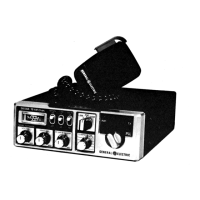
Your transceiver is designed primarily as a base station, but is ver-
satile enough to function as a mobile unit in vans, campers, or other
recreational vehicles. The bracket and hardware packed in the carton
allow you to install the unit for mobile operation yourself.
The bracket may be used to install the unit under a kitchen cabinet or in
some other desirable location selected by you.
MOBilE INSTAllATION
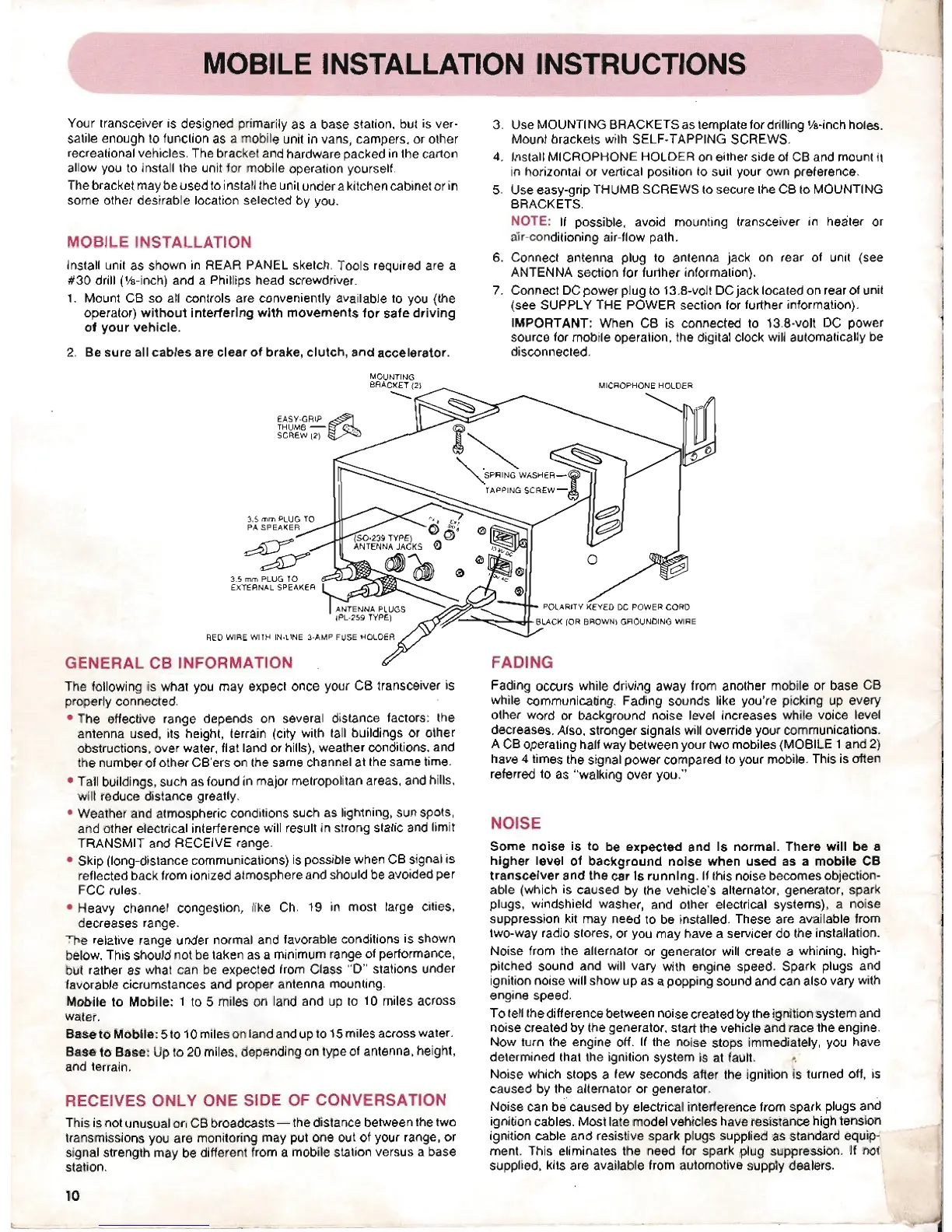
Install unit as shown in REAR PANEL sketch. Tools required are a
#30 drill (Vs-inch) and a Phillips head screwdriver.
1. Mount CB so all controls are conveniently available to you (the
operator) without interfering with movements for safe driving
of your vehicle.
2. Be sure all cables are clear of brake, clutch, and accelerator.
3.5 mm PLUG TO
EXTERNAL SPEAKER
GENERAL CB INFORMATION
The following is what you may expect once your CB transceiver is
properly connected.
. The effective range depends on several distance factors: the
antenna used, its height, terrain (city with tall buildings or other
obstructions, over water, flat land or hills), weather conditions, and
the number of other CB'ers on the same channel at the same time.
. Tall buildings, such as found in major metropolitan areas, and hills,
will reduce distance greatly.
. Weather and atmospheric conditions such as lightning, sun spots,
and other electrical interference will result in strong static and limit
TRANSMIT and RECEIVE range.
. Skip (long-distance communications) is possible when CB signal is
reflected back from ionized atmosphere and should be avoided per
FCC rules.
. Heavy channel congestion, like Ch. 19 in most large cities,
decreases range.
The rel2tive range under normal and favorable conditions is shown
below. This should not be taken as a minimum range of performance,
but rather as what can be expected from Class "D" stations under
favorable cicrumstances and proper antenna mounting.
Mobile to Mobile: 1 to 5 miles on land and up to 10 miles across
water.
Base to Mobile: 5 to 10 miles on land and up to 15 miles across water.
Base
to Base: Up to 20 miles, depending on type of antenna, height,
and terrain.
RECEIVES ONLY ONE SIDE OF CONVERSATION
This is not unusual on CB broadcasts - the distance between the two
transmissions you are monitoring may put one out of your range, or
signal strength may be different from a mobile station versus a base
station.
10
3. Use MOUNTINGBRACKETSastemplatefor drillingVs-inchholes.
Mount brackets with SELF-TAPPING SCREWS.
4. Install MICROPHONE HOLDER on either side of CB and mount it
in horizontal or vertical position to suit your own preference.
5. Use easy-gripTHUMB SCREWS to securethe CBto MOUNTING
BRACKETS.
NOTE: If possible, avoid mounting transceiver in heater or
aIr-conditioning air-flow path.
6. Connect antenna plug to antenna jack on rear of unit (see
ANTENNA section for further information).
7. Connect DC powerplug to 13.8-voltDCjack locatedon rear of unit
(see SUPPLY THE POWER section for further information).
IMPORTANT: When CB is connected to 13.8-volt DC power
source for mobile operation, the digital clock will automatically be
disconnected.
FADING
Fading occurs while driving away from another mobile or base CB
while communicating. Fading sounds like you're picking up every
other word or background noise level increases while voice level
decreases. Also, stronger signals will override your communications.
A CB operating half way between your two mobiles (MOBILE 1 and 2)
have 4 times the signal power compared to your mobile. This is often
referred to as "walking over you."
NOISE
Some noise is to be expected and is normal. There will be a
higher level of background noise when used as a mobile CB
transceiver and the car is running. If this noise becomes objection-
able (which is caused by the vehicle's alternator, generator, spark
plugs, windshield washer, and other electrical systems), a noise
suppression kit may need to be installed. These are available from
two-way radio stores, or you may have a servicer do the installation.
Noise from the alternator or generator will create a whining, high-
pitched sound and will vary with engine speed. Spark plugs and
ignition noisewill show up as a popping soundand can alsovary with
engine speed.
To tellthedifference between noisecreated bytheignitionsystem and
noise created bythe generator, start the vehicle andrace the engine.
Now turn the engine off. If the noise stops immediately, you have
determined that the ignition system is at fault. ..
Noise which stops a few seconds after the ignition is turned off, is
caused by the alternator or generator.
Noise can be caused by electrical interference from spark plugs and
ignition cables. Mostlatemodelvehicles have resistancehightension
ignition cable and resistive spark plugs supplied as standard equip"
ment. This eliminates the need for spark plug suppression. If not\
supplied, kits are available from automotive supply dealers.


 To Previous Page
 Loading...