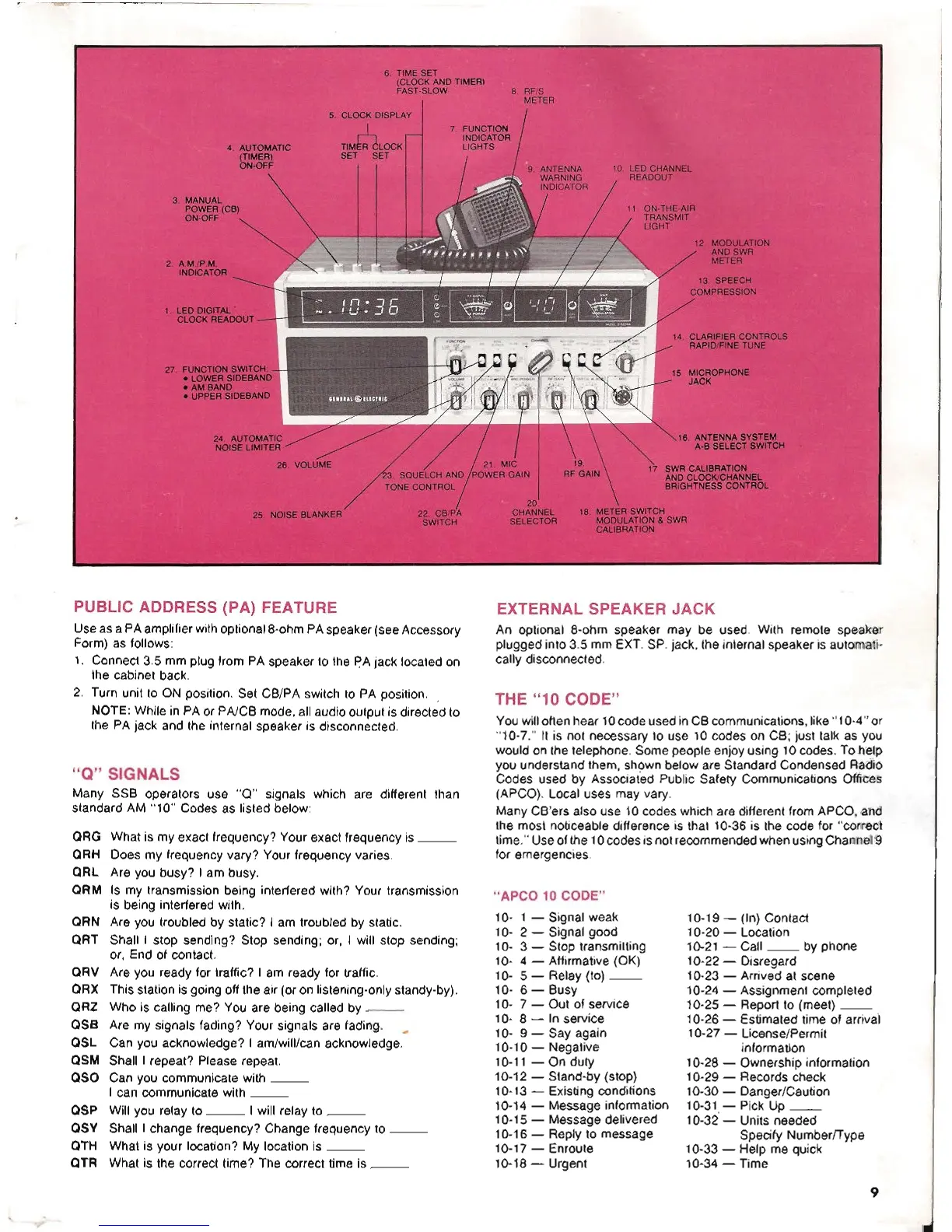
PUBLIC ADDRESS (PA) FEATURE
Use as a PAamplifier withoptional8-ohm PAspeaker (see Accessory
Form) as follows:
1. Connect 3.5 mmplugfromPAspeaker to the PAjack locatedon
the cabinet back.
2.
Turn unitto ONposition.Set CB/PAswitch to PAposition. .
NOTE: While in PA or PNCB mode, all audio output is directed to
the PA jack and the internal speaker is disconnected.
"Q" SIGNALS
Many SSB operators use "Q" signals which are different than
standard AM"10" Codes as listed below:
QRG What is myexact frequency? Yourexact frequency is -
QRH Does my frequency vary? Yourfrequency varies.
QRL Are you busy? I am busy.
QRM Is my transmission being interfered with? Yourtransmission
is being interferedwith.
QRN Are you troubled by static? I am troubled by static.
QRT ShallI stopsending?Stopsending;or,I willstopsending;
or, End of contact.
QRV Are you ready fortraffic?Iam ready fortraffic.
QRX Thisstationis goingoffthe air (oron listening-onlystandy-by).
QRZ Who is callingme? Youare being called by
-
QSB Are my signals fading? Yoursignals are fading. ..
QSL Can you acknowledge? Iam/will/canacknowledge.
QSM Shall I repeat? Please repeat.
QSO Can you communicatewith
-
I can communicate with-
QSP Willyou relay to - Iwillrelayto -
QSY Shall Ichange frequency? Change frequency to
-
QTH What is your location?Mylocationis -
QTR What is the correcttime? The correct time is -
EXTERNAL SPEAKER JACK
An optional 8-ohm speaker may be used. With remote speaker
plugged into 3.5 mm EXT.SP. jack,the internalspeaker is automati-
cally disconnected.
THE "10 CODE"
You will often hear 10 code used in CB communications, like "10-4" or
"10-7." It is not necessary to use 10 codes on CB; just talk as you
would on the telephone. Some people enjoy using 10 codes. To help
you understand them, shown below are Standard Condensed Radio
Codes used by Associated Public Safety Communications Offices
(APCO). Local uses may vary.
Many CB'ers also use 10 codes which are different from APCO, and
the most noticeable difference is that 10-36 is the code for "correct
time." Use of the 10 codes is not recommended when using Channel 9
for emergencies.
"APCO 10 CODE"
10- 1 - Signal weak
10- 2 - Signal good
10- 3 - Stop transmitting
10- 4 - Affirmative (OK)
10- 5 - Relay (to) -
10- 6 - Busy
10- 7 - Out of service
10- 8 - In service
10- 9 - Say again
10-10 - Negative
10-11 - On duty
10-12 - Stand-by (stop)
10-13 - Existing conditions
10-14 - Message information
10-15 - Message delivered
10-16 - Reply to message
10-17 - Enroute
10-18 - Urgent
10-19 - (In)Contact
10-20 - Location
10-21 - Call- by phone
10-22 - Disregard
10-23 - Arrived at scene
10-24 - Assignment completed
10-25 - Report to (meet)-
10-26 - Estimated time of arrival
10-27 - Ucense/Permit
information
10-28 - Ownership information
10-29 - Records check
10-30 - Danger/Caution
10-31 - Pick Up-
10-3i - Units needed
Specify Number/Type
10-33 - Help me quick
10-34 - Time
9


 To Next Page