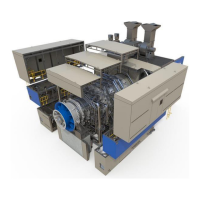
GEK 116862 Inspection and Maintenance Instructions for 7FA.05 Gas Only and Dual Fuel Gas Turbines
7. Excessive distortion of exhaust inner diffuser
8. Improper positioning of cooling and sealing air valves
9. For 3rd stage aft wheelspace, malfunctioning exhaust frame blowers.
Check wheelspace temperatures very closely on initial startup. If consistently high, and a check
of the external cooling air circuits reveals nothing, it is permissible to increase the size of the
cooling air orifices slightly. Consult with a GE Company field representative to obtain
recommendations as to the size that an orifice should be increased. After a turbine overhaul, all
orifices should be changed back to their original size, assuming that all turbine clearances are
returned to normal and all leakage paths are corrected.
CAUTION
Wheelspace temperatures are read on the HMI. Temperatures in excess of the maximum
are potentially harmful to turbine hot-gas-path parts over a prolonged period of time.
Excessive temperatures are annunciated but will not cause the turbine to trip. High
wheelspace temperature readings must be reported to the GE technical representative as
soon as possible.
XXII. FLAME DETECTION AND PROTECTION SYSTEM
A. Flame Detectors
The flame detection system has two basic functional requirements:
1. It must detect the “presence-of-flame” during startup. A “presence-of-flame” signal is a
prerequisite to continuation of the startup sequence.
2. During operation, the system must detect the “absence-of-flame” to trip the gas turbine. The
“absence-of-flame” signal is very critical to the protection of the gas turbine and of associated
heat-recovery equipment (when furnished).
3. The system is designed to detect the presence of ultraviolet radiation which is emitted by a
hydrocarbon flame and to provide a signal when the radiation is sensed for a sufficient time
period.
CAUTION
The flame detection system is composed of 4 to 20mA sensors.
4. With the system connected, place an ultraviolet source in front of the sensors and check that the
internal relays operate as indicated by using an ohmmeter or equivalent at the contacts. Note that
a paper match flame should be detected at approximately 18 in. (45.7 cm) and the sensor should
provide an orange flickering glow. If the flickering glow persists after removal of the flame, the
sensor has failed and should be replaced. If no flickering glow occurs in the presence of flame,
the sensor may have failed but proper operation of the electronics should be assured.
36
© General Electric Company, 2011. GE Proprietary Information. All Rights Reserved.


 To Next Page