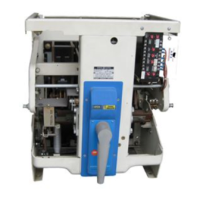
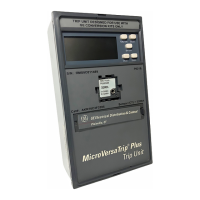
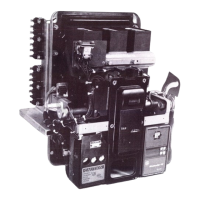
This document describes the installation and maintenance of MicroVersaTrip Plus™ and MicroVersaTrip PM™ Conversion Kits for GE Types AK-50, AKU-50, AKS-50, AKT-50, AK-75, and AK-100 Low Voltage Power Circuit Breakers. These kits are designed to upgrade existing GE Low Voltage Power Circuit Breakers by replacing older trip systems (EC, Power Sensor, ECS, or SST) with enhanced solid-state MicroVersaTrip Plus or PM Trip Units, which represent the latest technological advancements in GE trip systems.
Function Description:
The primary function of these conversion kits is to modernize existing GE Low Voltage Power Circuit Breakers. Instead of replacing the entire breaker, the kits allow for an upgrade of the trip devices to more advanced solid-state units. These new trip units provide enhanced protection and control capabilities, ensuring the breaker conforms to modern standards like ANSI Standard C37.59. The conversion process involves several key steps, including the separation of front and back breaker frames (for certain models), relocation and remounting of W and X relays, installation of a flux shifter and trip paddle, and the integration of a programmer mounting bracket, wire harnesses, and phase sensors. For breakers requiring ground fault protection on 4-wire systems, an additional neutral sensor is installed.
Important Technical Specifications:
- Breaker Compatibility: Designed for GE Types AK-50, AKU-50, AKS-50, AKT-50, AK-75, and AK-100 Low Voltage Power Circuit Breakers.
- Trip Unit Upgrade: Replaces existing GE Type EC, Power Sensor, ECS, or SST trip systems with MicroVersaTrip Plus™ or MicroVersaTrip PM™ Trip Units.
- Standard Conformance: Conversion Kits are designed and breaker tested to conform with ANSI Standard C37.59.
- Flux Shifter: The installation procedure for the flux shifter varies by breaker type and trip device. Mounting holes may need to be added, terminal blocks relocated, or breaker side rails removed. For AKU-50 breakers, the Open Fuse Lock Out (OFLO) device may need to be separated.
- Programmer Mounting: Programmers mount to the left side of the front channel using a shock-mounted bracket. For AK-50 manual breakers, the manual indicator assembly bushing may interfere, requiring modification of the bracket.
- Phase Sensors:
- For AK-50, AKS-50 breakers with EC or Power Sensor trip systems, existing trip devices and harnesses are removed, and MicroVersaTrip phase sensors are installed with lower and upper adapter connectors.
- For AK-50, AKS-50 breakers with SST trip systems, existing SST phase sensors are replaced with new MicroVersaTrip phase sensors.
- For AK-75, AKS-100 breakers with EC or Power Sensor trip systems, MicroVersaTrip® RMS-9 sensors mount on the upper breaker studs, secured with locking rings.
- For AK-75, AKS-100 breakers with SST trip systems, SST sensors are replaced with MicroVersaTrip phase sensors.
- Phase sensors are visually identical to SST sensors.
- Resistance Values (Ohms between Common and Tap Terminals):
- AK-50/AKS-50: 300A (20-24), 400A (27-32), 600A (42-50), 800A (58-68), 1200A (93-109), 1600A (130-154)
- AK-75: 1200A (20-24), 1600A (28-34), 2000A (37-44), 3000A (61-72)
- AK-100: 1600A (36-43), 2000A (47-55), 3000A (75-88), 4000A (108-127)
- Ground Fault Option (4-wire systems): Requires an additional neutral sensor, which is inserted into the neutral lead of the equipment (bus or cable compartment). The neutral sensor must have the same rating and tap setting as the phase sensors.
- Communications Harness: Can be installed on either side of the breaker, depending on compartment door swing. For AKU-50 breakers, it must be on the right side. Requires drilling two 0.228" diameter holes.
Usage Features:
- Upgrade vs. Replacement: Offers a cost-effective solution to upgrade existing breakers rather than full replacement.
- Enhanced Protection: Integrates advanced solid-state trip units for improved protection and control.
- Standard Compliance: Ensures the upgraded breaker meets current industry standards for performance and safety.
- Programmer Installation: The programmer unit is easily installed and secured to a mounting bracket, with guide pins ensuring correct alignment for connector engagement. A locking lever secures the programmer.
- Ground Fault Protection: Provides an option for ground fault protection on 4-wire systems with the addition of a neutral sensor.
Maintenance Features:
- Pre-installation Verification: Installers should verify appropriate current sensors and programmer unit are furnished. For ground fault elements, a neutral sensor (CT) is required.
- Breaker Maintenance Opportunity: The installation provides an excellent opportunity to perform normal maintenance on the breaker, especially when front and back frames are separated.
- Testing and Troubleshooting:
- Pre-energization Testing: After conversion but before energizing, the breaker must be tested. This includes verifying programmer installation, meggering the primary circuit (1,000-Volt Megger), measuring resistance across line/load terminals and CT assembly, and performing a primary injection test on each phase.
- Ground Fault Testing: If ground fault is installed, testing can be done by wiring two adjacent poles in series.
- False Tripping Troubleshooting (Ground Fault): If nuisance tripping occurs, check for false ground signals. This involves verifying phase sensors are the same type and ampere range, ensuring identical tap settings on all three-phase sensors, and confirming harness connections meet polarity constraints. For 4-wire loads, check neutral sensor connection, continuity, and ensure it carries only the breaker's load current.
- Resistance Measurement: If other steps fail, measure sensor resistances; phase and neutral sensors should have closely agreeing resistance values.
- Safety Precautions: Emphasizes critical safety procedures before, during, and after installation, including turning off and locking out power, discharging stored energy springs, and working in a well-lighted area. Only qualified persons familiar with low voltage power circuit breakers and switchgear should perform work.
- Caution on Tap Changes: Users are warned not to change taps on current sensors or adjust programmer unit set knobs while the breaker is carrying current.
- Caution on Secondary Disconnect: A caution label reminds users to disconnect secondary before removing the breaker.

 Need help?
 General

 To Next Page