31
Instruction manual
GB
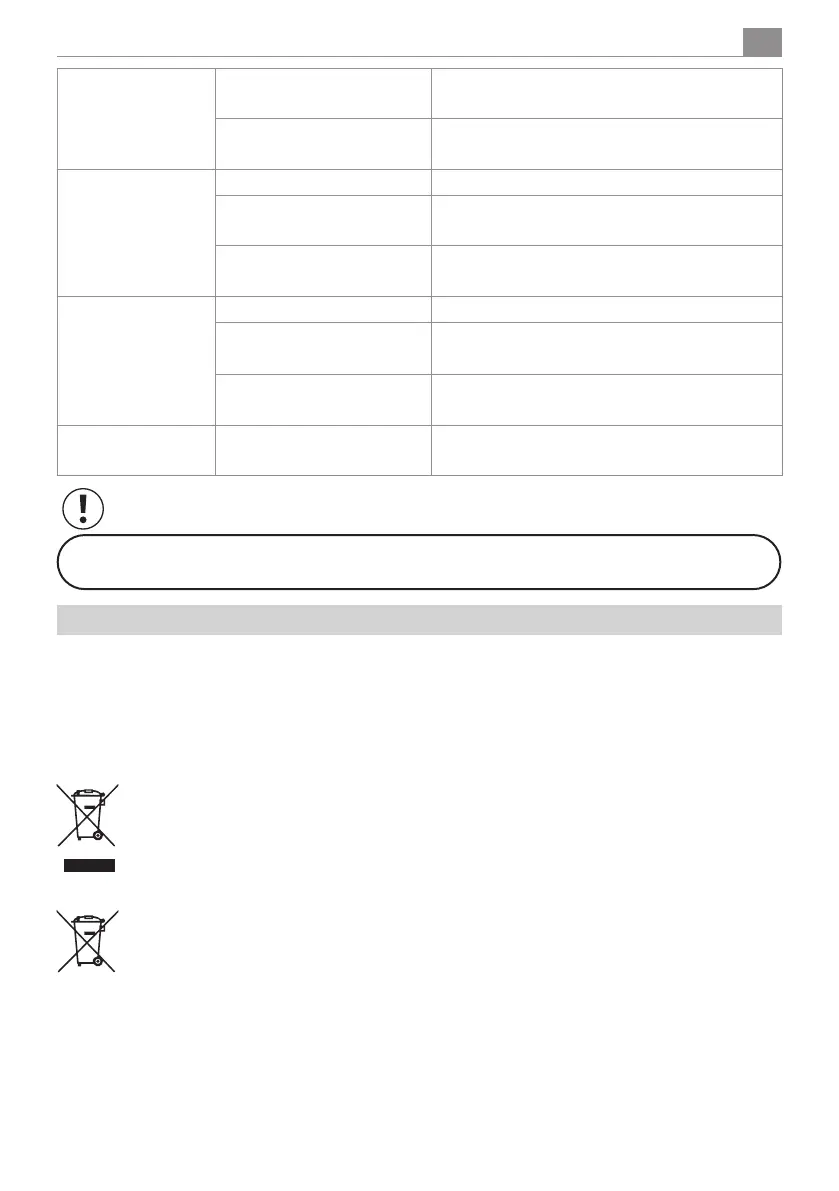
Noise from the water
pump
Fresh water tank is not inserted
correctly
Check the correct t of the fresh water tank
Lack of water in the fresh water
tank
Check the fresh water tank and ll with water if
necessary
Floor brush is not
moistened
The appliance is in drying mode Press the mode button as needed to change mode
Lack of water in the fresh water
tank
Check the fresh water tank and ll with water if
necessary.
Fresh water tank is not inserted
correctly
Check the correct t of the fresh water tank
Water leaks from the air
outlet (below the waste
water tank)
Filter unit is blocked Clean the lter unit and remove blockages if necessary
Sponge lter has not been dried Allow sponge lter to dry completely before reinsertion
Water is in the housing below
the tank
When the waste water tank is removed, dry the recess
in the housing with a cloth
Water leakage from the
oor brush
Waste water tank or lter are not
inserted correctly or completely
Check that the waste water tank and the lters are
correctly tted
If the fault cannot be rectied, please contact our customer service.
Never open up the appliance!
NOTE!
Disposal
(Applicable in the European Union and other European states with systems for the separate collection of waste and
recyclables).
Packaging
The packaging material can be recycled. Dispose of the packaging in an environmentally friendly way for recycling.
Electrical appliances
The symbol with the crossed out dustbin means that this product cannot be disposed of in the household
waste. Electrical waste should be taken to a local acceptance point.
You can obtain further information about the disposal and recycling of this appliance from your municipal
utility company, the retailer where you purchased it or the manufacturer.
Before disposing of the appliance remove the batteries because they have to be disposed of separately. To
protect the environment, batteries and rechargeable batteries must not be disposed of alongside normal
household waste, regardless of whether they contain harmful substances* or not, and should instead be
taken to the relevant collection point. Contact your local authority to nd out where you can dispose of
batteries in your area.
Even empty batteries have a residual charge. Before you dispose of them, cover the poles with insulating
tape to prevent them short circuiting, which could cause re or an explosion.
*marked with: Cd = Cadmium, Hg = Mercury, Pb = Lead


 To Next Page