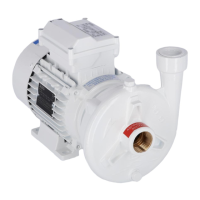
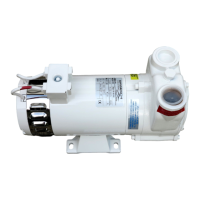
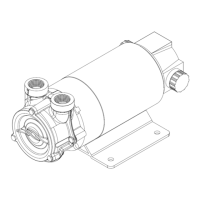
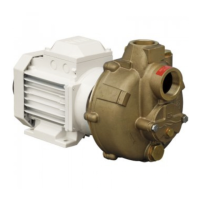
Gianneschi Pumps and Blowers s.r.l.
Tel: +39 0584 365101 Fax: +39 0584 969411
www.gianneschi.net
1. Operating conditions
For clean liquids without abrasives, non-explosive, non-aggressive for the pump materials, with a maximum
temperature of 90 °C.
Maximum permissible working pressure: 10 bar
Installation in well ventilated location protected from the weather, with a maximum ambient temp. of 50 °C
Sound pressure: ≤ 70 dB (A);
Maximum admitted storage temperature -20°C ÷ +50°C
2. Installation
These pumps must be installed with the rotor axis horizontal and feet downwards.
The pumps can be installed in other positions, if supported by rigid and stable pipes and if filling and draining
of the pump casing and drainage of condensation from the motor remain possible.
For safety reasons avoid the position with the motor under the pump.
Place the pump as close as possible to the suction source.
3. Pipes
The inside diameter of the pipework depends on the desired flow.
Provide a diameter assuring a liquid flow not greater than 1.5 m/s for suction and 3 m/s for delivery.
The pipe diameters must never be smaller than the pump connections.
Ensure the inside of pipes are clean before connection.
Secure all pipes to rests and connect them so that they are not under stress, and do not transmit vibration or
flexing strain to the pump.
The suction pipe must be perfectly airtight and be led upwards in order to avoid air pockets. For suction lift
operation fit a foot valve with strainer which must always remain immersed. For suction from a storage tank
fit a check valve. For positive suction head operation fit a gate valve.
Follow local specifications if increasing network pressure.
Fit a gate valve into the delivery pipe to adjust delivery, head, and absorbed power. Install a pressure gauge.
With a geodetic head outlet over 15 m fit a check valve between the pump and the gate valve in order to
protect the pump from water hammering.
4. Electrical connection
Electrical connection must be carried out only by a qualified electrician and in accordance with local
regulations.
Follow all safety standards.
The unit must be properly earthed(grounded). Connect the earthing (grounding) conductor to the terminal
with the marking.
Compare the frequency and mains voltage with the name-plate data and connect the supply conductors to
the terminals in accordance with the appropriate diagram inside the terminal box cover.
ATTENTION: never allow washers or other metal parts to fall into the internal cable opening between the
terminal box and stator. If this occurs, dismantle the motor to recover the object which has fallen inside.
The motors with supply current directly switched by thermally sensitive switches can start automatically.
Install a device for disconnection from the mains (switch) with a contact separation of at least 3 mm on all
poles. With a three-phase motor install an overload protection device appropriate for the rated current of the
pump. Single-phase pumps, are supplied with a capacitor connected to the terminals (for 220-240 V - 50 Hz)
5. Starting
ATTENTION: never run the pump dry - not even for a short trial run. Start the pump after filling it
completely with liquid.
When the pump is located above the water level (suction lift operation) fill the suction pipe and the pump
through the priming hole.
When the liquid level on the suction side is above the pump (inflow under positive suction head), fill the
pump by opening the suction gate valve slowly and completely, keeping the delivery gate valve open to
release the air.



 To Next Page
 Loading...