Need help?
Do you have a question about the GME TX675 and is the answer not in the manual?
Explains potential interference and volume issues between old and new radios.
Emphasizes reading the manual and provides general operating guidelines.
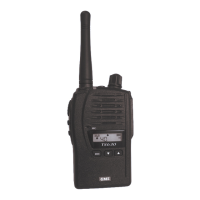
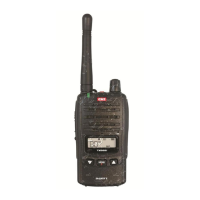
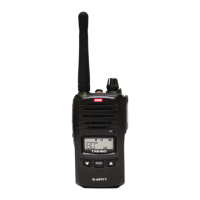
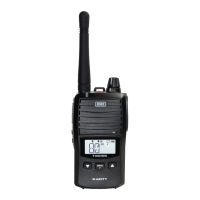
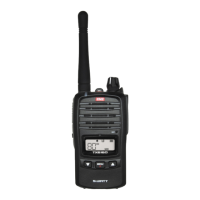
Lists the items included in the TX675 and TX675TP packages.
Describes transmit power and duplex function features.
Details receive features like power save and signal indicators.
Covers frequency synthesis, scan function, and dual watch.
Explains CTCSS & DCS for quiet channel operation.
Lists keypad lock and backlit LCD as user interface features.
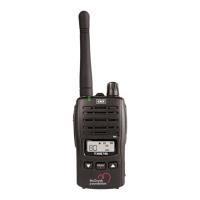
Describes the Push-to-Talk button for transmission.
Identifies the volume adjustment control.
Key functions for accessing menus and changing channels.
Identifies the Liquid Crystal Display screen.
Battery, channel, transmit/receive icons for operational status.
Icons for Dual Watch, VOX, Key Lock, Scan, Duplex, etc.
Icons for Roger Beep, Button Beep, and Monitor functions.
Step-by-step instructions on how to detach the battery pack.
Step-by-step instructions on how to attach the battery pack.
Details the charging process, LED indicators, and battery icon display.
Instructions for charging a single TX675 radio.
Instructions for charging the TX675 Twin Pack.
Explains the battery low indicator and action.
Provides tips to maximize battery life using power saving features.
Describes the automatic power-saving standby mode.
How low power settings conserve battery during transmission.
Instructions for turning the radio on and off.
How to control the audio volume level.
How the radio indicates received signals and audio adjustment.
Steps for transmitting, including PTT use and distance.
How to change channels using the up/down keys.
Managing background noise with Squelch open/closed states.
How to lock and unlock the keypad to prevent accidental presses.
Using Duplex for repeater communication and extended range.
Steps to add or remove channels from the scan list.
Instructions on how to initiate and control channel scanning.
Details how scanning pauses on signals and the impact on battery.
Explains CTCSS/DCS systems for quiet channel operation.
How to activate and deactivate Silent mode on channels.
Overview of menu selections like Duplex, CTCSS/DCS, and Power.
How to access and navigate menu options.
Enabling Duplex on repeater channels via the menu.
Selecting CTCSS tones and DCS codes for quiet operation.
Guide to selecting CTCSS tones (01-50) and DCS codes (001-104).
Steps to turn off CTCSS/DCS tones.
Activating/deactivating Silent mode on channels.
How to select transmitter power for optimal range or battery.
How to set up VOX for hands-free transmission.
How to set the Squelch level from 1 to 5 or Auto.
How to turn the Roger Beep tone on or off.
How to enable or disable the button beep confirmation tone.
How to choose a favorite Call Alarm melody.
How to transmit the Call Alarm melody to alert others.
Instructions to set up monitoring two channels simultaneously.
How Dual Watch handles signals and allows talking.
How to disable the Dual Watch mode.
A table listing CTCSS tones and their corresponding frequencies.
A chart listing DCS tones and their corresponding codes.
A table detailing channel numbers and their operating frequencies.
Explains special uses for specific channels (emergency, telemetry, etc.).
Lists general specifications like frequency range, channel spacing, dimensions.
Details power source and operating time.
Lists receiver performance specifications.
Lists transmitter power specifications.
Outlines consumer rights and guarantees under Australian law.
Details the warranty against defects and liability limitations.
Information on how and where to send a warranty claim.
Lists conditions and damages not covered by the warranty.
Specifies the warranty period for radios and battery packs.
 General
| Type | Handheld UHF CB Radio |
|---|---|
| Channels | 80 |
| Modulation | FM |
| Water Resistance | IP67 |
| Operating Voltage | 7.4V DC |
| Battery | 1800mAh Li-ion |
| Frequency Range | 476.4250 - 477.4125 MHz |

 To Next Page