Need help?
Do you have a question about the GME TX4500 and is the answer not in the manual?
Lists the included accessories for the TX4500 radio, such as the radio unit, mounting kit, and cables.
Includes the instruction manual, microphone, clip, DC lead, and screw pack for operation and installation.
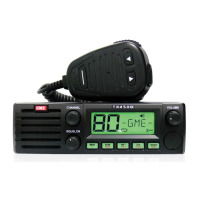
Highlights the radio's Australian design, advanced features, and DIN-sized case for easy installation.
Details licensing requirements in Australia and New Zealand, and the 80-channel standard.
Discusses potential interference and audio differences between narrowband and wideband radios.
Identifies channels 5 and 35 as primary simplex and repeater channels for emergency use.
Channels 22 and 23 are reserved for telemetry; speech transmission is inhibited.
Includes synthesiser, DSP, ASM, DVC, scrambler, scan, duplex, and filters for optimal performance.
Features high-contrast LCD, dual microphone inputs, and adjustable backlighting.
Covers CTCSS/DCS for silent channels, Selcall, and Receive-Only Channels.
Details programmable scan functions and priority channel recall.
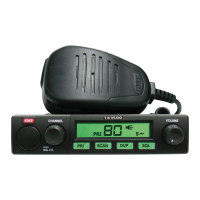
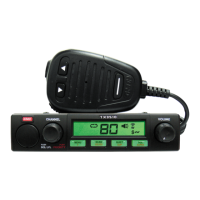
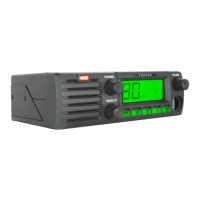
Identifies and explains the function of front panel buttons, knobs, and displays.
Details the icons and information displayed on the liquid crystal display.
Shows the location of rear panel connectors and ports for external devices.
Explains microphone controls (PTT, Skip/Call) and keypad function access.
Covers adjusting audio level and navigating through operating channels.
Details setting squelch for noise reduction and understanding the signal meter.
Steps for initiating transmission, including pre-checks and PTT usage.
Explains the automatic transmission limiting feature and its indication.
How to customize display brightness and colour settings for personal preference.
Guidance on selecting narrow or wide receiver filters for optimal signal reception.
Automatic audio level compensation for consistent output during varying signal strengths.
How to activate or deactivate the voice scrambling feature for private communications.
Explains duplex operation for repeater communication and compares simplex/duplex coverage.
Details on storing and recalling priority channels for quick access.
Introduction to Open Scan and Group Scan modes for monitoring channels.
Explains how Open Scan and Group Scan modes function and their differences.
Steps to add or remove channels from the scan list for custom monitoring.
Details on how scanning behaves in Open Scan and Group Scan modes, including working channels.
Explains how priority channels affect scanning behavior during Group Scan.
Steps to set up, initiate, and manage Group Scan mode.
Details how CTCSS/DCS enables silent channel reception, muting unwanted signals.
Compares CTCSS and DCS, and explains how to switch between CTCSS tone sets.
Step-by-step guide to choose a CTCSS or DCS tone for the radio.
Instructions for enabling and disabling Silent Mode on specific channels.
How to briefly hear signals on channels set to Silent Mode.
Explanation of the Selcall system for direct, private communication.
Using the radio's unique ID and adding labels to stored Selcall numbers.
How Quiet Mode mutes all signals until your Selcall ID is received.
Instructions for saving frequently used Selcall numbers into memory.
How to retrieve and send previously stored Selcall numbers.
Assigning custom 5-character names to Selcall entries for easier identification.
How the radio alerts to incoming Selcalls and displays caller information.
How to reply to an incoming Selcall and how to stop the Selcall alarm.
Instructions for tagging channels and activating Quiet Mode for selective monitoring.
How to turn off Quiet Mode and manage signals received in this mode.
Guidance on how to scan channels while Quiet Mode is enabled.
Explains how to call multiple radios simultaneously for group communications.
Steps for programming, sending, and receiving group calls.
Details the five banks (A-E) available for storing Receive-Only channels.
How to select one of the five RX-only channel banks (RX-A to RX-E).
Enables the mode required for programming RX-only channels and frequencies.
Setting the frequency increment for tuning RX-only channels (12.5 kHz or 25 kHz).
Step-by-step guide to entering custom frequencies for RX-only channels.
How to exit the channel editor and return to normal radio operation.
Steps to remove a programmed RX-only channel and reset it to an inactive state.
Configuring the display to show frequency or Alpha label for selected RX-only channels.
How to assign custom 5-character names to RX-only channels for easier identification.
Settings for silent channel operation and voice privacy features.
Adjusting beep volume, RX-only frequency steps, and receiver filter bandwidths.
Enabling automatic audio level compensation for consistent output.
Configuring display for signal strength (S-MET/S-LIN) or battery voltage.
Setting the display to show frequency or Alpha label for RX-only channels.
Prevents transmission on a busy channel to avoid interference.
Step-by-step guide for mounting the radio bracket into a standard DIN slot.
Wiring options for constant power or ignition-switched power.
Details for connecting microphones to front and rear sockets.
Importance of antenna quality and routing the cable for optimal performance.
How the radio indicates and reacts to overvoltage conditions.
Visual representation of power and antenna connections to the radio unit.
Tips for reducing interference through proper installation and wiring.
Table listing CTCSS tones and their corresponding frequencies in Hz.
Table listing DCS tones and their associated numerical codes.
A table of operating frequencies for each UHF CB channel, including special channel notes.
Covers compliance, frequency range, channel count, spacing, and operation modes.
Details RF output, spurious emission, frequency error, modulation, and deviation.
Covers intermediate frequencies, sensitivity, selectivity, immunity, and audio output power.
Physical dimensions, weight, power supply, and port types.
Details consumer rights and entitlements under Australian Consumer Law.
Outlines the terms and conditions of the product's warranty against defects.
Lists conditions and damages not covered by the product warranty.
Specifies the warranty duration for 477 MHz UHF CB mobile transceivers.
Provides contact details and address for GME's head office.
Lists contact details and addresses for GME branches in Australia and New Zealand.
 General
| Channel Capacity | 80 Channels |
|---|---|
| Display | LCD |
| Dimensions | 36 mm |
| Operating Voltage | 7.4V |
| Output Power | 5W |
| Microphone | Included |

 To Next Page