Need help?
Do you have a question about the GME TX6600PRO and is the answer not in the manual?
Legal disclaimer regarding document reproduction and use.
Essential safety precautions for operating the radio transmitter.
Details on Australia's UHF CB radio service and channel standards.
Designated channels for emergency use and telemetry applications.
Crucial guidelines for safe and proper operation of the radio.
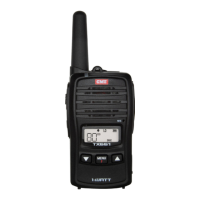
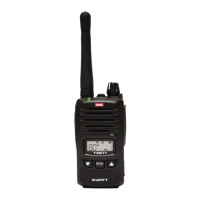
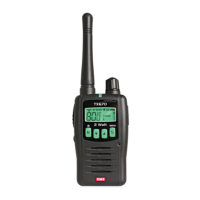
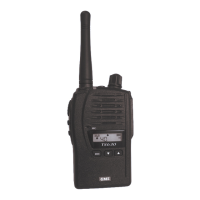
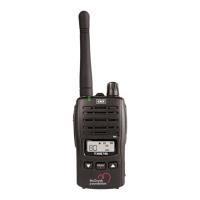
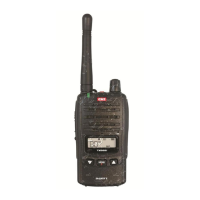
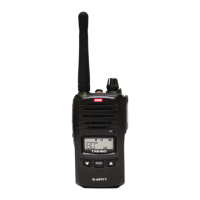
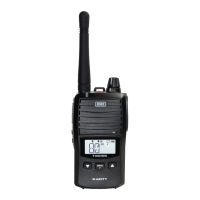
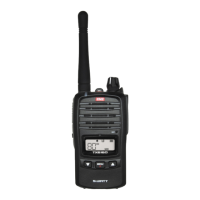
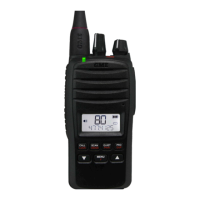
Overview of the TX6600PRO's features and design.
List of items supplied with the TX6600PRO radio.
Details on selectable power levels and duplex function.
Information on channels, power saving, and signal display.
Overview of scanning capabilities and memory functions.
Features like voice inversion scrambler and CTCSS/DCS.
Details on water/dust proofing, construction, and battery.
Description of the LCD display, keypad, and buttons.
Explanation of Digital Signal Processing (DSP) and ASM.
Diagram and labels for all radio controls and buttons.
Explanation of icons and indicators on the LCD display.
Initial setup steps including battery installation and charging.
Understanding battery level indicators and low battery warnings.
Instructions for attaching the belt clip to the radio.
Basic operational procedures and key functions.
How to use keys, key beeps, and function key operations.
Instructions for turning the radio on/off and adjusting volume.
How to select channels and understand channel announcements.
Procedures for transmitting and receiving signals.
How the radio behaves when receiving signals.
Understanding the busy channel icon and its implications.
Using the digital signal strength meter.
How to switch between logarithmic and linear signal meter displays.
Using squelch to eliminate background noise.
Details on adjusting squelch sensitivity via knob or menu.
How to store and recall priority channels.
Scanning between selected and priority channels.
Scanning selected, priority 1, and priority 2 channels.
How to cycle through different scan groups.
Enabling and using duplex mode for repeater communication.
Assigning functions to the programmable PRO key.
How to lock and unlock the radio's keypad.
Adjusting transmitter power for battery conservation.
Preventing transmission on busy channels.
Enabling or disabling the Roger Beep tone.
How to adjust microphone sensitivity for clear voice input.
Using the voice scrambler for secure communication.
Selecting a filter for compatibility with older radios.
Removing the squelch tail noise burst.
Automatic adjustment of received audio levels.
Adjusting backlight behavior for visibility and power saving.
Configuring beep feedback for key presses and alerts.
Enabling audible voice announcements for channel changes.
Choosing information displayed on the LCD screen.
Enabling or disabling verbose messages on the display.
Extending battery life by putting the radio to sleep.
Viewing hardware, firmware, and identity details.
Restoring radio to default out-of-the-box settings.
Overview of scanning capabilities and groups.
Selecting and managing different scan groups.
Scanning channels sequentially from lowest to highest.
Scanning channels while monitoring a priority channel.
Group communication using shared CTCSS/DCS and channels.
Using tone codes for silent channel operation.
Enabling silent mode for selective reception based on codes.
Overview of Selective Calling features and quiet mode.
Tagging channels and activating quiet mode.
Scanning while in quiet mode for selected channels.
Making simultaneous calls to multiple radios in a group.
Tips and features for maximizing battery life.
How to access and navigate the radio's menu system.
List of available menu functions and their settings.
Managing additional private and receive-only channels.
Overview and functions of programmable keys.
List of operating frequencies for UHF CB channels.
Technical details of the radio's general, transmitter, and receiver.
Details on consumer guarantees and warranty against defects.
 General
| Frequency Range | 403 - 520 MHz |
|---|---|
| Power Output | 5W |
| Channel Capacity | 80 channels |
| Battery | Li-ion 2000mAh |
| IP Rating | IP67 |

 To Next Page