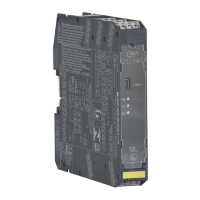
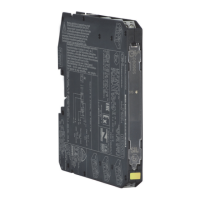
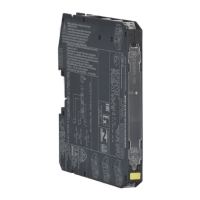
The D5290S is a single-channel SIL 3 Relay Output Module designed for switching safety-related circuits in high-risk industries, compliant with IEC 61508:2010 Ed.2 up to SIL 3. It provides isolation between input and output contacts and is suitable for mounting on standard DIN-Rail or customized Termination Boards in Safe Area/Non-Hazardous Locations or Zone 2/Class I, Division 2 or Class I, Zone 2 environments.
Function Description:
The module operates in a low demand mode as a Type A module with a Hardware Fault Tolerance (HFT) of 0. In its normal state, the relay module is energized, with a Normally Energized (NE) load. Upon an alarm or process request, the module de-energizes (safe state), thereby de-energizing the load. The D5290S offers three mutually exclusive monitoring circuits, selectable via DIP-switches:
- Line input monitoring: Enables DCS/PLC line monitoring functions, including pulse testing, without causing relay or LED flickering.
- Low voltage input monitoring: When enabled, the module presents a high impedance state to the control unit if the driving voltage falls below a specified threshold.
- Short circuit fault detection: Allows the DCS/PLC to detect short circuit faults within the module.
The D5290S provides two Normally Open (NO) contacts for the NE load and one Normally Closed (NC) contact for service purposes, enabling the switching of the NE load on both supply lines. The relay contacts are shown in the de-energized position in the function diagram, where terminals 13-21 and 14-22 are open, and terminal 13-15 is closed.
Important Technical Specifications:
- Input: 24 Vdc nominal (21.6 to 27.6 Vdc), reverse polarity protected, with ripple ≤ 5 Vpp.
- Current Consumption @ 24 V: 60 mA (typical) with relay energized.
- Power Dissipation: 1.5 W (typical) with 24 V input voltage, relay energized.
- Isolation (Test Voltage): Input/All Outputs 2.5 KV; Out 1/Out 2: 500V.
- Output:
- One voltage-free SPDT relay contact (Out 1) with terminals 13-21 (NO) and 13-15 (NC for Service Load, not SIL).
- One voltage-free SPST relay contact (Out 2) with terminals 14-22 (NO).
- Terminals 13-21 (Out 1) and 14-22 (Out 2) are open when de-energized and closed when energized.
- Service load output (13-15) is normally closed when de-energized and open when energized.
- Contact Material: Ag Alloy (Cd free) or AgSnO2.
- Contact Rating: 10 A 250 Vac 2500 VA, 10 A 250 Vdc 300 W (resistive load).
- Contact Inrush Current: 16 A at 24 Vdc, 250 Vac.
- Mechanical/Electrical Life: 10 x 10^6 / 5 x 10^4 operations (typical).
- Operate/Release Time: 8/4 ms (typical).
- Bounce Time NO/NC Contact: 4/6 ms (typical).
- Frequency Response: 10 Hz maximum.
- Environmental Conditions:
- Operating Temperature: -40 to +60 °C, relative humidity 95%, up to 55 °C.
- Storage Temperature: -45 to +80 °C.
- Safety Description:
- ATEX: II 3G Ex nA nC IIC T4 Gc
- IECEx/INMETRO/NEPSI: Ex nA nC IIC T4 Gc
- FM: NI/1/2/ABCD/T4, 1/2/AEx nA nC/IIC/T4
- FMC: NI/1/2/ABCD/T4, 1/2/Ex nA nC/IIC/T4
- EAC-EX: 2ExnAnCIICT4 X
- UKR TR n. 898: 2ExnAnCIICT4 X
- Non-sparking electrical equipment. -40 °C ≤ Ta ≤ 70 °C.
- Functional Safety: SIL 3 according to IEC 61508:2010 Ed. 2 for Tproof = 14/20 yrs (≤10%/>10% of total SIF). PFDavg (1 year) 7.01 E-06, SFF 99.17% for NE Load. Systematic capability SIL 3.
- Mounting: T35 DIN-Rail (EN50022) or customized Termination Board.
- Weight: About 165 g.
- Connection: Polarized plug-in disconnect screw terminal blocks for up to 2.5 mm² terminations.
- Protection Class: IP 20.
- Dimensions: Width 22.5 mm, Depth 123 mm, Height 120 mm.
Usage Features:
- Simplified Installation: Utilizes standard DIN-Rail and plug-in terminal blocks or customized Termination Boards.
- Flexible Configuration: An eight-position DIP Switch on the PCB allows selection of four mutually exclusive configurations: line input monitoring, low voltage input monitoring, short circuit fault detection, and T-proof relay testing. Factory settings default to line input monitoring.
- Visual Status Indicator: A "RELAY STATUS" yellow LED indicates when the input is powered and the relay is energized.
- Broad Compatibility: Designed for compatibility with various DCS/PLC systems.
- Robust Design: Complies with EMC standards (EN61000-6-2, EN61000-6-4, EN61326-1, EN61326-3-1) for safety systems.
- Marine Applications: DNV Type Approval Certificate for maritime applications.
Maintenance Features:
- Proof Test Procedure: A detailed proof test procedure is provided to reveal dangerous undetected faults. This involves verifying input-to-output functionality, checking ohmic continuity of contacts, and using internal DIP-switches to test individual relay coils. The proof test reveals almost 99% of all possible Dangerous Undetected failures.
- Non-Repairable Unit: The unit cannot be repaired by the end user and must be returned to the manufacturer or an authorized representative for servicing.
- Cleaning: The enclosure should be cleaned only with a damp or antistatic cloth to avoid electrostatic hazards. Penetration of cleaning liquid must be avoided.
- Safety Precautions:
- Always de-energize the power source and disconnect terminal blocks before opening the enclosure in hazardous areas or when connected to live hazardous potential to prevent electrical shock and explosion hazards.
- Ensure proper installation and wiring according to national/international standards (e.g., IEC/EN60079-14).
- Connect an external protection (fuse or similar) according to the relay breaking capacity diagram to prevent relay contact damage.
- Avoid unauthorized modifications to the unit.
- Ensure conductors are well isolated to prevent unintentional connections.
- The relay output contact must be connected to loads not exceeding category II overvoltage limits.

 Need help?
 General

 To Next Page