2
I
NSTALLATION
C
LEARANCES
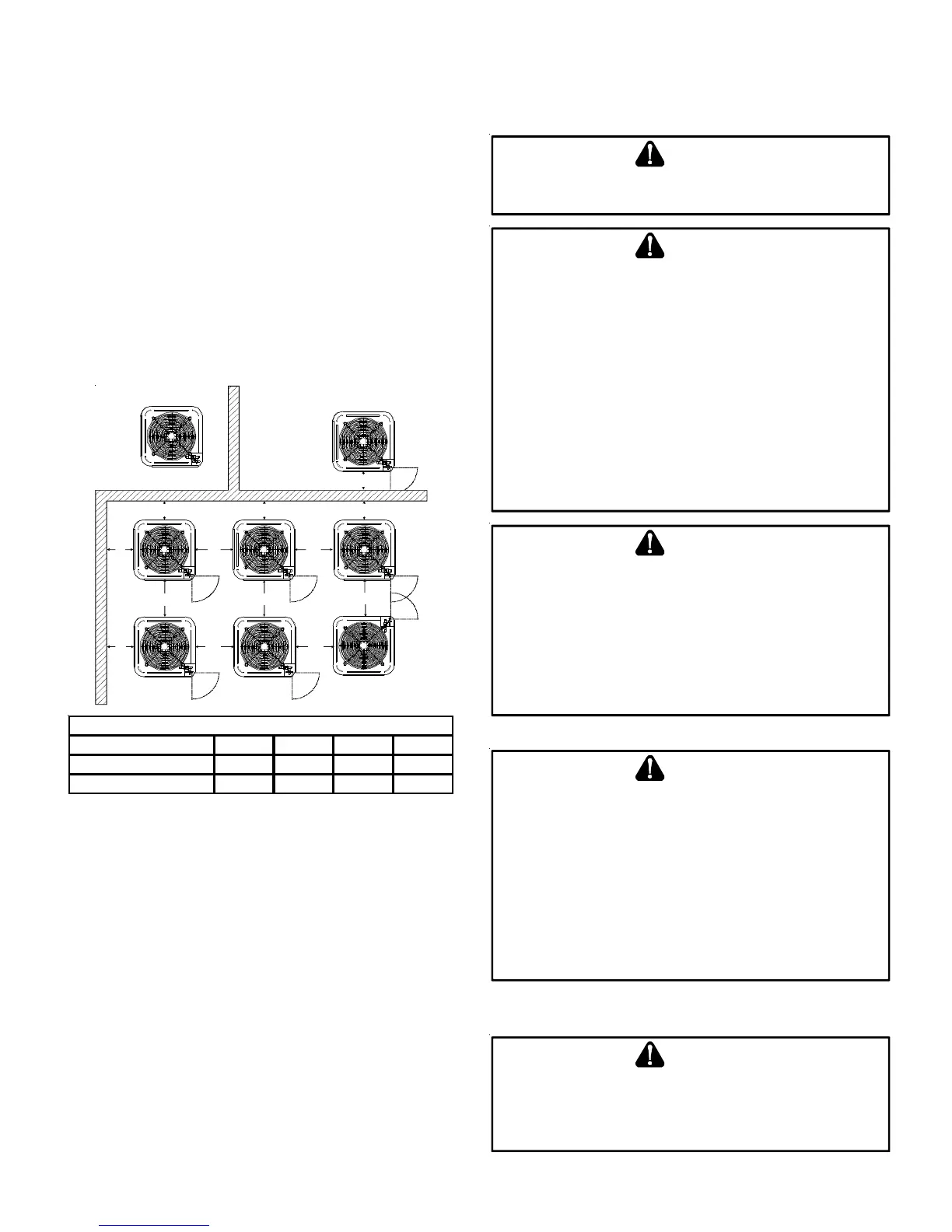
Special consideration must be given to location of the con-
densing unit(s) in regard to structures, obstructions, other units,
and any/all other factors that may interfere with air circulation.
Where possible, the top of the unit should be completely unob-
structed; however, if vertical conditions require placement be-
neath an obstruction there should be a minimum of 60
inches between the top of the unit and the obstruction(s).
The specified dimensions meet requirements for air circulation
only. Consult all appropriate regulatory codes prior to deter-
mining final clearances.
Another important consideration in selecting a location for the
unit(s) is the angle to obstructions. Either side adjacent the
valves can be placed toward the structure provided the side
away from the structure maintains minimum service clearance.
Corner installations are strongly discouraged.
OK!
OK!
AA AAA
A
CC
C
C
OK!
OK!
OK!
OK!
NOT
RECOMMENDED
AA
AA
AA
AA
AA
B B B
B
Model Type A B C AA
Residential
10" 10" 18" 20"
Light Commercial
12" 12" 18" 24"
Minimum Airflow Clearance
This unit can be located at ground floor level or on flat roofs. At
ground floor level, the unit must be on a solid, level foundation
that will not shift or settle. To reduce the possibility of sound
transmission, the foundation slab should not be in contact with
or be an integral part of the building foundation. Ensure the
foundation is sufficient to support the unit. A concrete slab
raised above ground level provides a suitable base.
R
OOFTOP
I
NSTALLATIONS
If it is necessary to install this unit on a roof structure, ensure
the roof structure can support the weight and that proper con-
sideration is given to the weather-tight integrity of the roof. Since
the unit can vibrate during operation, sound vibration transmis-
sion should be considered when installing the unit. Vibration
absorbing pads or springs can be installed between the con-
densing unit legs or frame and the roof mounting assembly to
reduce noise vibration.
S
AFE
R
EFRIGERANT
H
ANDLING
While these items will not cover every conceivable situation,
they should serve as a useful guide.
T
O
AVOID
POSSIBLE
INJU R Y
,
EXPLOSION
OR
DEATH
,
PRACTICE
SAFE
HANDLING
OF
REFRIGERANTS
.
WARNING
R
EFRIG ERAN T S
ARE
HEAVIER
THAN
AIR
.T
HEY
CAN
“
PUSH
OUT
”
THE
OXYGEN
IN
YO UR
LUNGS
OR
IN
ANY
ENC LOSED
SPACE
.T
O
AVOID
POSSIBLE
DIFFICULTY
IN
BREATHING
OR
DEATH
:
•N
EVER
PURGE
REFRIGERANT
INTO
AN
ENC LOSED
ROOM
OR
SPACE
.B
Y
LAW
,
ALL
REFRIGERANTS
MUST
BE
RECLAIME D
.
•I
F
AN
IND OO R
LEAK
IS
SUSPECTED
,
THOROUGHLY
VENT I LATE
THE
AREA
BEFORE
BEGINNING
WORK
.
•L
IQU ID
REFRIGERANT
CAN
BE
VE RY
COLD
.T
O
AVOID
POSSIBL E
FROS T
BITE
OR
BLINDNESS
,
AVO I D
CONTAC T
AND
WEAR
GLOVES
AND
GOGGLE S
.I
F
LIQU ID
REFRIGERANT
DOES
CONTAC T
YO UR
SKIN
OR
EYES
,
SEEK
MEDICAL
HELP
IMMEDIATELY
.
•A
LWAYS
FOLL OW
EPA
REGULA TI ONS
.N
EVER
BURN
REFRIGERANT
,
AS
P
OISONOUS
GAS
WILL
BE
PRODUCED
.
WARNING
T
O
AVOID
POSSIBLE
EXPLOSION
,
USE
ONLY
RETURNABLE
(
NOT
DISPO SABLE
)
SERVICE
CYLINDERS
WHEN
REM OV ING
REFRIGERANT
FROM
A
SYSTEM
.
•E
NSURE
THE
CYLINDER
IS
FREE
OF
DAMAGE
WHICH
COU L D
LEA D
TO
A
LEA K
OR
EXPLOSION
.
•E
NSURE
THE
HYDRO STATIC
TEST
DATE
DOES
NOT
EXCEED
5
YEARS
.
•E
NSURE
THE
PRESSURE
RATING
MEET S
OR
EXCEED S
400
PSIG
.
W
HEN
IN
DOUBT
,
DO
NOT
USE
CYLINDER
.
WARNING
T
O
AVOID
POSSIBLE
EXPLOSION
:
•N
EVER
APPLY
FLA ME
OR
STEAM
TO
A
REFRIGERANT
CYLINDER
.I
F
YO U
MUST
HEAT
A
CYLINDER
FOR
FASTER
CHARG ING
,
PARTIALLY
IMMERSE
IT
IN
WARM
WATER
.
•N
EVER
FILL
A
CYLINDER
MORE
THAN
80%
FULL
OF
LIQU ID
REFRIGERANT
.
•N
EVER
ADD
ANYTHING
OTHER
THAN
R‐22
TO
AN
R‐22
CYLINDER
OR
R‐
410A
TO
AN
R‐410A
CYLINDER
.T
HE
SERVICE
EQU IP MENT
USED
MUST
BE
LISTED
OR
CERTIFIE D
FOR
THE
TYPE
OF
REFRIGERANT
USED
.
•S
TORE
CYLINDERS
IN
A
COOL
,
DRY
PLACE
.N
EVER
USE
A
CYLINDER
AS
A
P
LATFORM
OR
A
ROLLER
.
WARNING
R
EFRIGERANT
L
INES
T
HE
COM PRESS OR
POE
OIL
FOR
R‐410A
UNITS
IS
EXTREMELY
SUSCEPTIBLE
TO
MOISTURE
ABSORPTION
AND
COU L D
CAUSE
COM PRESS OR
FAILURE
.D
O
NOT
LEAVE
SYSTEM
OPEN
TO
ATM OSPHERE
ANY
LON G ER
THAN
NECESSARY
FOR
INSTALLA TIO N
.
CAUTION



 To Next Page