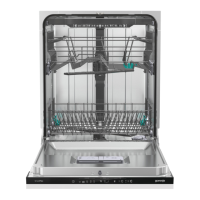
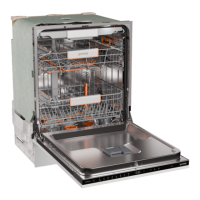
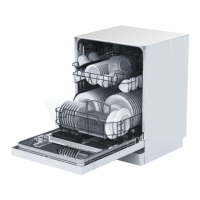
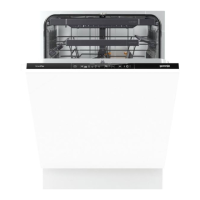
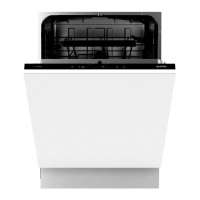
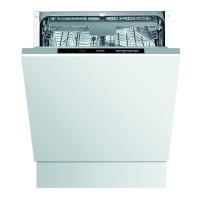
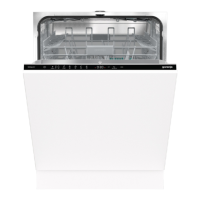
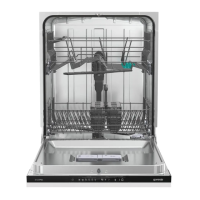
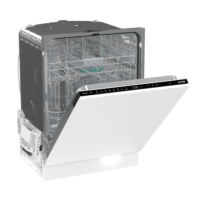
This document provides operating instructions for the Gorenje GV66261 dishwasher, covering its functions, usage, and maintenance.
Function Description
The Gorenje GV66261 is a dishwasher designed for household use, offering various programs and options to ensure efficient and hygienic cleaning of dishes. It features a built-in water softener to combat hard water, which can leave white coatings on dishes and the machine. The water softener automatically adjusts to the local water hardness, requiring the user to fill a salt compartment with large grain or special dishwasher salt. The dishwasher also utilizes rinse aid to improve drying results and achieve clear, spotless dishes.
The appliance includes an overflow guard function that automatically pumps out water and shuts off the supply if the water level exceeds normal, preventing potential leaks. For safety, the dishwasher is equipped with a door lock functionality and a status light that indicates when a program has started or if a fault has occurred.
Several programs are available to suit different cleaning needs:
- Auto wash (45-65°C): This program intelligently measures dish dirtiness and adjusts water consumption and temperature accordingly. It requires a few initial runs to adapt for optimal performance.
- Intensive wash (70°C): Ideal for very dirty dishes, pans, casserole dishes, and oven dishes.
- Eco wash (55°C): A standard cleaning cycle designed for normally dirty dishes, optimized for combined energy and water consumption.
- Quick wash (35°C): Suitable for lightly soiled items like glasses and porcelain, such as coffee cups.
- Rinse: A program for rinsing dishes while waiting for a full load.
Additional options enhance the cleaning process:
- SpeedWash: Shortens program time, though it may increase energy and water consumption.
- Auto open: Automatically opens the dishwasher door at the end of a program to improve drying.
- Extra hygiene: Increases temperature during main wash and final rinse for situations requiring high hygiene, such as baby bottles or cutting boards.
- Delayed start: Allows the user to set a delayed start for 1-24 hours.
The dishwasher also features a self-cleaning program for antibacterial cleaning of the tub, spray arms, and pipes, which can be run with normal detergent, citric acid, or specialized dishwasher cleaners.
Usage Features
Operating the dishwasher is straightforward. To begin, press and hold the main power switch until the display lights up. Programs are selected by pressing the program button until the desired symbol is activated. Options like SpeedWash, Auto open, Extra hygiene, and Delayed start can be chosen by pressing their respective buttons. The display shows the time remaining for the selected program.
Loading the dishwasher correctly is crucial for economic and effective dishwashing. Users are advised to:
- Load the dishwasher fully to save energy.
- Scrape off large food particles instead of rinsing under running water.
- Place glasses, cups, bowls, side plates, and saucers in the upper basket with dirty surfaces facing inwards and downwards. Wine glasses can be placed on the wine glass shelf, and knives in the knife stand.
- Place plates, serving dishes, pots, and cutlery in the lower basket. Cutlery should be placed with handles facing down, except for knives, and spread out to prevent stacking.
- Foldable tines in the lower basket can be adjusted to accommodate pots.
- Ensure spray arms can rotate freely after loading.
The upper basket can be adjusted to three different height positions by lifting it with both hands.
Detergent is added to a dedicated compartment with sections for prewash and main wash. The dosage should be adjusted according to water hardness. For 3-in-1/all-in-one detergents, a specific setting can be activated, which disables rinse aid dispensing and reduces salt usage, though salt still needs to be present in the compartment. Dishwasher tablets are not recommended for short programs.
To achieve optimal drying results, users should fully load the dishwasher, ensure rinse water can run off dishes (especially plastic), and top up or increase rinse aid dosage. Activating the Auto open option and allowing dishes to cool before unloading also contribute to better drying.
The dishwasher stops automatically if the door is opened during a program, allowing for additional dishes to be added. If a program is interrupted by a power cut or manual shutdown, it resumes when power is restored.
Maintenance Features
Regular maintenance ensures the dishwasher's longevity and optimal performance. Key maintenance tasks include:
- Coarse filter cleaning: The coarse filter, which traps large food particles, should be emptied as needed. It is lifted by its handle, emptied, and then replaced.
- Fine filter cleaning: The fine filter and its pipe section should be cleaned a couple of times a year, even though debris is automatically rinsed away during washes. This involves turning the handle anticlockwise, lifting the filter, cleaning it, and replacing it securely.
- Drainage pump inspection: If drainage issues occur, the drainage pump can be accessed from inside the dishwasher. This requires cutting power, removing the coarse and fine filters, and then removing a colored stop to inspect and clear any blockages from the pump blade.
- Spray arm cleaning: The holes and bearings of the spray arms can become blocked. Debris can be removed with a pin. For thorough cleaning, the lower spray arm can be pulled straight up, and the upper spray arm can be unscrewed counterclockwise from its bearings after pulling out the upper basket.
- Door cleaning: The edge around the door should be cleaned with a slightly damp cloth.
- Limescale removal: For hard water areas, limescale deposits may build up. Running a self-cleaning program with citric acid or dishwasher cleaners can help.
- Front panel cleaning: Buttons and the front panel should be kept clean and free from grease using a dry or slightly damp cloth. The main power switch should be turned off before cleaning the buttons to avoid unintentional activation.
- Drainage hose check: Ensure the drainage hose is not blocked or kinked.
The manual also provides a troubleshooting guide for common issues, including fault codes displayed on the machine, and suggests actions to resolve them, such as checking water supply, filters, spray arms, and door lock. For persistent problems, contacting the service department is recommended.


 To Next Page
 General