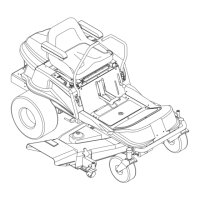
This document is an Owner/Operator Manual for the Gravely ZT XL series of zero-turn mowers, specifically models 915076-ZT1840XL, 915078-ZT2044XL, 915080-ZT2348XL, and 915082-ZT2552XL. It provides comprehensive instructions for the safe operation, assembly, maintenance, and troubleshooting of these units.
The Gravely ZT XL is a riding lawn mower designed for efficient grass cutting, featuring a zero-turn radius for enhanced maneuverability. The unit is equipped with steering levers for directional control, a PTO (Power Take-Off) switch to engage and disengage the mower blades, and a throttle lever to adjust engine speed. An ignition switch with four positions (Stop, Headlight, Run, Start) controls the engine, and a parking brake ensures the unit remains stationary when needed. Fuel tanks are located on the unit, and a fuel shut-off valve controls fuel flow. For cold starts, a choke control is available on some models. An hour meter tracks the total operating hours of the engine, which is useful for scheduling maintenance. Headlights are included for visibility, and an axle lock feature allows for either a pivoting or locked front axle depending on the terrain and desired stability. The mower deck height is adjusted using a mower lift pedal and an adjustment pin.
Safety is a paramount concern, and the manual emphasizes various precautions. The unit is capable of amputating hands and feet and throwing objects, necessitating strict adherence to safety instructions and decals. Operation on slopes requires extra caution due to the risk of loss-of-control and tip-over accidents. The manual warns against operating near children, handling gasoline carelessly, and leaving the operator's position without disengaging attachments, stopping the unit and engine, removing the key, and engaging the parking brake. Safety alert symbols are used throughout the manual to highlight important safety messages, including DANGER, WARNING, and CAUTION levels. Decals on the unit itself provide visual reminders of critical safety information, such as avoiding rotating parts, keeping clear of the discharge area, not operating without guards or bagger, reading the manual, keeping people away, shutting off the engine before adjustments, and not stepping on certain areas.
The manual details several usage features to optimize performance and safety. When starting the engine, the PTO must be disengaged, the parking brake engaged, and steering levers in neutral. For cold engines, the choke is used, while a warm engine requires only partial throttle. The manual advises against operating the starter for more than 15 seconds per minute to prevent damage. Once started, the throttle should be set to fast, and the choke disengaged. When stopping, the unit should be brought to a halt, PTO disengaged, throttle set to slow, ignition turned off, key removed, and parking brake set. For mowing, the engine should be at full throttle, and the PTO engaged to start the blades. The parking brake must be disengaged before moving the steering levers. The manual provides guidance for best performance, including cutting dry grass, keeping blades sharp, leveling the mower deck, adjusting anti-scalp rollers, and varying cutting patterns. It also advises against mowing too low, traveling too fast, or allowing grass and debris to accumulate in the mower deck.
Maintenance features are extensively covered to prolong the unit's life and ensure safe operation. A maintenance schedule outlines tasks to be performed at each use, every 25 hours/season, 50 hours/season, and 100 hours/season. These tasks include checking the safety interlock system, parking brake, tires, and mower blades, cleaning the unit, lubricating zerks, checking fasteners, and inspecting belts. The manual provides instructions for tipping the seat forward and opening the hood to access the battery and engine for maintenance. Detailed procedures are given for leveling and adjusting the pitch of the mower deck, which involves using an adjustment pin and rotating blades to measure distances from the ground. Instructions for removing and installing mower blades are provided, along with guidelines for sharpening or discarding blades based on wear. Adjusting anti-scalp rollers to prevent lawn scalping is also explained. Battery servicing includes removal, installation, cleaning terminals, and charging, with warnings about frozen batteries and proper jump-starting procedures. Adjusting steering lever height and forward/reverse speed is also covered to ensure comfortable and straight-line travel. Finally, procedures for replacing the PTO and hydrostatic belts are included, emphasizing caution when releasing idler spring tension. The manual also includes short-term and long-term storage instructions, such as cleaning the unit, removing and charging the battery, draining fuel, and touching up paint.



 To Next Page
 General