This document is a Service Manual for Gree GMV6 HR DC Inverter VRF Units.
Function Description:
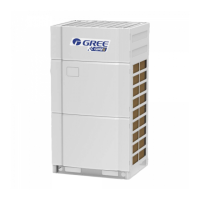
The GMV6 HR DC Inverter VRF Units are designed for air conditioning systems, offering both cooling and heating functionalities. The system utilizes DC inverter technology for efficient operation. It supports various configurations, including basic outdoor units, combined outdoor modules, mode exchange boxes, hydro boxes, and water tanks, allowing for flexible system designs to meet diverse project requirements. The units are capable of centralized control and can integrate with external fire alarm systems for safety.
Important Technical Specifications:
- Capacity: Ranges from 22.4kW to 246.0kW.
- Rated Frequency: 50Hz / 60Hz.
- Operation Range:
- Cooling: -10°C to 55°C DB (Dry Bulb).
- Heating: -25°C to 24°C DB.
- Outdoor Unit Parameters (Basic Modules):
- HP: 8 to 22.
- Cooling Capacity (Rated): 22.4 kW (8 HP) to 61.5 kW (22 HP).
- Heating Capacity (Rated): 16.2 kW (8 HP) to 33.0 kW (22 HP).
- Max Heating Capacity: 25 kW (8 HP) to 69 kW (22 HP).
- Outdoor Static Pressure: 0-110 Pa.
- Sound Pressure Level (Cooling): 60 dB(A) to 64 dB(A).
- Sound Power Level (Cooling): ducted 80-91 dB(A), cassette 80-94 dB(A).
- Power Supply: 380-415V 3N~ 50/60Hz.
- Rated Power Input: 12.87 kW (8 HP) to 27.41 kW (22 HP).
- Rated Current: 23.0 A (8 HP) to 49 A (22 HP).
- Compressor Type: Inverter scroll.
- Compressor Quantity: 1 or 2 depending on HP.
- Refrigeration Oil Type: FV68H.
- Refrigerant Type: R410A.
- Refrigerant Charge: 8.2 kg (8 HP) to 13.3 kg (22 HP).
- Maximum Drive IDU No.: 13 (8 HP) to 36 (22 HP).
- Pipe Diameters: High pressure gas (Φ15.9-Φ25.4 mm), Low pressure gas (Φ19.05-Φ28.6 mm), Liquid (Φ9.52-Φ15.9 mm).
- Outline Dimensions (W×D×H): 930×775×1690 mm or 1340×775×1690 mm.
- Net Weight: 243 kg to 385 kg.
- Outdoor Unit Parameters (Combined Modules):
- HP: 24 to 88.
- Cooling Capacity (Rated): 68 kW (24 HP) to 246 kW (88 HP).
- Heating Capacity (Rated): 39.7 kW (24 HP) to 132 kW (88 HP).
- Max Heating Capacity: 76.5 kW (24 HP) to 276 kW (88 HP).
- Refrigerant Charge: Sum of individual module charges (e.g., 8.5+11.1 kg for 24 HP).
- Pipe Diameters: High pressure gas (Φ25.4-Φ41.3 mm), Low pressure gas (Φ28.6-Φ44.5 mm), Liquid (Φ15.9-Φ22.2 mm).
- Mode Exchange Box Parameters:
- Models: NCHS1D, NCHS2D, NCHS4D, NCHS8D.
- Numbers of Branches: 1, 2, 4, 8 respectively.
- Max Connectable IDUs (Per Branch): 8.
- Max Connectable IDUs (Total): 8, 16, 32, 64 respectively.
- Max Capacity of Connectable IDUs (Per Branch): 16 kW.
- Max Capacity of Connectable IDUs (Total): 16, 28, 45, 85 kW respectively.
- Power Supply: 220-240V~ 50/60Hz.
- Piping Connections (ODU): Liquid (Φ9.52-Φ15.9 mm), High pressure gas (Φ19.05-Φ22.2 mm), Low pressure gas (Φ22.2-Φ28.6 mm).
- Piping Connections (IDU): Liquid (Φ6.35/9.52 mm), Gas (Φ12.7/15.9 mm).
- Outline Dimensions (W×D×H): 340×388×250 mm (NCHS1D, NCHS2D), 460×388×250 mm (NCHS4D), 784×388×250 mm (NCHS8D).
- Hydro Box Parameters:
- Models: NRQR16L/A-T, NRQR30L/A-T.
- Hot Water Heating Capacity: 4.5 (3.6~16) kW, 4.5 (3.6~30) kW.
- Max Setting Temperature of Domestic Hot Water: 55 (35~55) °C.
- Floor Heating Capacity: 16 kW, 30 kW.
- Max Setting Temperature of Floor Heating: 45 (25~45) °C.
- Power Supply: 220-240V~ 50Hz, 208-230V~ 60Hz.
- Heat Exchanger Type: Plate heat exchanger.
- Rated Water Flow: 46 L/min, 86 L/min.
- Water System Connection: Diameter Φ25 mm, Thread G1.
- Refrigerant System Connection: Gas pipe (Φ15.9-Φ22.2 mm), Liquid pipe (Φ9.52 mm).
- Outline Dimensions (W×D×H): 515×330×606 mm.
- Net Weight: 36 kg, 40 kg.
- Water Tank Parameters:
- Model: SXTVD300LCJ2/A-K.
- Capacity: 300 L.
- Electric Heating Power Consumption: 3 kW.
- Max. Allowable Pressure: 0.7 MPa.
- Liner Material: Hot rolled steel plate (enamel) Q330TC1, Thickness 2.5 mm.
- Insulation Material: Foam rubber, Thickness 42 mm.
- Outer Layer Material: Color coated plate hot-dip galvanized sheet, Thickness 0.6 mm.
- Circular Water Pipe Diameter: 19.05 mm, Screw Thread Spec 3/4″Female BSP.
- Outline Dimensions (Outer Diameter × Height): Φ620×1725 mm.
- Net Weight: 135 kg.
Usage Features:
- Commissioning Process: Includes preparation, installation verification, unit checking, and commissioning. Debugging can be done via buttons on the outdoor unit's main board, proprietary PC software, or a multi-functional debugger.
- Safety Requirements: Emphasizes strict adherence to national/local safety regulations, requiring qualified personnel for operations and ensuring power cutoff during maintenance.
- Function Settings: DIP switches on outdoor units and hydro boxes allow for configuration of capacity, centralized control addresses, master/slave module settings, static pressure, and various operational modes (e.g., cooling/heating, silence mode, energy saving, forced defrosting, emergency operation for components).
- Parameter Query: Users can query fault history, real-time operating parameters, indoor unit engineering numbers, and online indoor unit quantities.
- Hydro Box Control: Wired controller for hydro box allows setting of hot water and floor heating temperatures, scheduling, high-temp sterilization, rapid heating, and clean functions. It also provides status displays for various operational conditions like anti-freeze, E-heater, child lock, defrost, and invalid operation.
- Refrigerant Charging: Detailed procedures for pre-charging and start-up charging of refrigerant, including calculations based on pipe length and module capacity.
- Vacuum Pumping: Specific methods for vacuum pumping the complete system or parts of it, with requirements for vacuum pump specifications and procedures for water removal by vacuum destruction if necessary.
Maintenance Features:
- Outdoor Unit Maintenance: Regular cleaning of the heat exchanger (every two months) to remove dust and impurities.
- Seasonal Notices:
- Beginning of Use Season: Check for blockages, grounding reliability, remote controller batteries, air filter installation, and preheat crankcase for 8 hours after long-term shutdown.
- End of Use Season: Cut off power, clean filters and unit cases, remove dust, and apply paint to rusty areas.
- Hydro Box Maintenance: Drain water from the hydro box, floor heating pipeline, and water tank if not used for a long time or in power-off status, or add anti-freeze fluid.
- Component Inspection: Detailed mechanical and electrical inspection procedures for key parts including power supply, temperature sensors, solenoid valves, 4-way valves, electronic expansion valves, fans, compressors, compressor drive boards, and main boards. This includes checking connections, resistance values, and physical condition.
- Parts Replacement: Step-by-step instructions for removing and installing various components such as unit panels, electric box covers, ODU main board, electric heating belt, compressor, gas-liquid separator, oil separator, fan blades, condenser, 4-way valve coil, 4-way valve and pipeline, electronic expansion valve, plate heat exchanger, pressure sensor, temperature sensor, pressure switch, and solenoid valve. These procedures often involve specific tools, welding techniques, nitrogen protection, and post-replacement checks.
- Restoration to Default Settings: Options to clear all settings, clear settings except commissioning status, or clear only function settings of the outdoor unit.
- Troubleshooting: Comprehensive fault codes and corresponding troubleshooting flowcharts for both indoor and outdoor units, covering issues like communication faults, sensor faults, protection alarms (high/low pressure, over-current, over-temperature), and operational errors.

 Need help?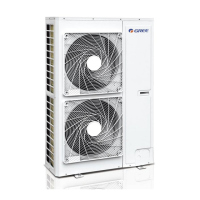



 To Next Page
 General