EasyManua.ls Logo

Greenheck ECV-20 - User Manual

Greenheck ECV-20
28 pages
Print Icon
To Next Page IconTo Next Page
Loading...
®
Document 480955
Model ECV
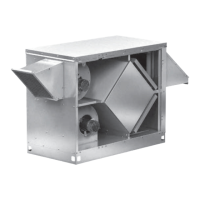
Energy Core Ventilator
Energy Core Ventilator 1
®
Installation, Operation and Maintenance Manual
Please read and save these instructions for future reference. Read carefully before attempting to assemble, install,
operate or maintain the product described. Protect yourself and others by observing all safety information. Failure
to comply with these instructions will result in voiding of the product warranty and may result in personal injury
and/or property damage.
Energy Recovery & Make-Up Air Technical Support
Call 1-800-240-0870, press 1 for Service
Only qualified personnel should install this system.
Personnel should have a clear understanding of these
instructions and should be aware of general safety
precautions. Improper installation can result in electric
shock, possible injury due to coming in contact with
moving parts, as well as other potential hazards. Other
considerations may be required if high winds or seismic
activity are present. If more information is needed,
contact a licensed professional engineer before moving
forward.
1. Follow all local electrical and safety codes, as well as
the National Electrical Code (NEC), the National Fire
Protection Agency (NFPA), where applicable. Follow
the Canadian Electrical Code (CEC) in Canada.
2. All moving parts must be free to rotate without
striking or rubbing any stationary objects.
3. Unit must be securely and adequately grounded.
4. Do not spin fan wheel faster than maximum
cataloged fan RPM. Adjustments to fan speed
significantly effects motor load. If the fan RPM is
changed, the motor current should be checked to
make sure it is not exceeding the motor nameplate
amps.
5. Do not allow the power cable to kink or come in
contact with oil, grease, hot surfaces or chemicals.
Replace cord immediately if damaged.
6. Verify that the power source is compatible with the
equipment.
7. Never open access doors to the unit while it is
running.
General Safety Information
DANGER
Always disconnect power before working on or near
this equipment. Lock and tag the disconnect switch or
breaker to prevent accidental power up.
CAUTION
When servicing the unit, the internal components may
be hot enough to cause pain or injury. Allow time for
cooling before servicing.
CAUTION
Precaution should be taken in explosive atmospheres.


Questions and Answers

  • M
    Michael WhitakerAug 19, 2025
    Why does my Greenheck Fan blower fail to operate?
    • A
      aaronmaddoxAug 19, 2025
      If the blower on your Greenheck Fan isn't operating, several issues could be the cause. A blown fuse or open circuit breaker is a common problem, so replace the fuse or reset the circuit breaker and check the amps. A defective motor or capacitor could also be the reason, requiring replacement. Other potential causes include a motor starter overload (reset the starter and check the amps), electrical issues (check for On/Off switches and correct supply voltage), or drive problems (check for broken or loose belts and tighten loose pulleys).
  • J
    James MillerAug 21, 2025
    What to do if the Greenheck Fan blower fails to operate?
    • Q
      qcabreraAug 21, 2025
      If the Greenheck Fan blower isn't working, there are several things to check: * **Blown fuse or open circuit breaker:** Replace the fuse or reset the circuit breaker, and check the amps. * **Defective motor or capacitor:** Replace the defective component. * **Motor starter overloaded:** Reset the starter and check the amps. * **Electrical issues:** Check for On/Off switches and verify the correct supply voltage.
  • C
    Cory CookAug 23, 2025
    How to reduce excessive noise or vibration in my Greenheck ECV-20 Fan?
    • R
      Rebecca StevensonAug 23, 2025
      If your Greenheck Fan is producing excessive noise or vibration, try the following: * **Fan wheel rubbing on inlet:** Adjust the wheel and/or inlet cone and tighten the wheel hub on the shaft. * **Loose motor base or blower:** Tighten the mounting bolts. * **Noise transmitted by duct:** Ensure the ductwork is properly supported, the metal thickness is adequate, and the air velocities are not too high.
  • A
    Ashley DavisAug 26, 2025
    What to do if my Greenheck Fan has low airflow (cfm)?
    • V
      vhodgeAug 26, 2025
      If you're experiencing low airflow (CFM) with your Greenheck Fan, here's what to check: * **Unit damper not fully open:** Adjust the damper linkage or replace the damper motor. * **System static pressure too high:** Improve ductwork to reduce losses. * **Fan wheels operating backwards:** Consult the Unit Start-Up section for instructions on Direction of Fan Wheel Rotation (for 3-phase systems). * **Dirty filter or energy core:** Follow cleaning procedures in the Routine Maintenance section. * **Leaks in ductwork:** Repair any leaks. * **Elbows or obstructions obstructing fan outlet:** Correct or improve the ductwork.
  • C
    charles59Aug 27, 2025
    Why is there low airflow (CFM) in my Greenheck ECV-20 Fan?
    • S
      Samuel NguyenAug 28, 2025
      Low airflow in your Greenheck Fan can stem from several causes. The unit damper might not be fully open, in which case you should adjust the damper linkage or replace the damper motor. High system static pressure can also be a culprit, so improving ductwork to eliminate losses is recommended. Other potential causes include a blower speed that's too low (check for correct drives and RPM with catalog data), fan wheels operating backwards (consult the Unit Start-Up section for 3-phase systems), a dirty filter or energy core (follow cleaning procedures in the Routine Maintenance section), leaks in the ductwork (repair them), obstructions at the fan outlet (correct or improve ductwork), or belt slippage (adjust belt tension).
  • A
    Amy MillerAug 29, 2025
    Why is my Greenheck ECV-20 Fan motor over amping?
    • B
      bhuberAug 30, 2025
      If your Greenheck Fan motor is over amping, consider these potential causes and solutions: * **CFM too high:** Verify and adjust the CFM. * **Static pressures higher or lower than design:** Improve ductwork if pressures are too high, or lower fan RPM if pressures are too low. * **Incorrect blower rotation:** Check and reverse the rotation if necessary. * **Incorrect motor voltage:** Compare the motor nameplate voltage with the supplied voltage. * **Motor horsepower too low:** Refer to the specifications and catalog for fan curves to determine if the horsepower is sufficient. * **Shorted windings in motor:** Replace the motor.
  • C
    Carmen MooreAug 31, 2025
    Why does my Greenheck Fan have high airflow (cfm)?
    • A
      Ana AcostaSep 1, 2025
      If your Greenheck Fan has high airflow (CFM), consider the following: * **Blower fan speed too high:** Check and decrease the fan RPM if necessary. * **Filter(s) not in place:** Install filters. * **Insufficient static pressure (Ps):** Induce Ps into the system ductwork, ensure grilles and access doors are installed, and decrease fan speed if necessary.
  • M
    matthew28Sep 3, 2025
    Why do the motor starters “chatter” or not pull in on my Greenheck Fan?
    • R
      Rebecca Smith PhDSep 3, 2025
      If the motor starters on your Greenheck Fan “chatter” or don't pull in, it could be due to: * **Control power wiring too long:** Shorten the wiring run or install a relay. Consult the factory for relay information. The resistance should not exceed 0.75 ohms. * **Incoming supply power too low:** Increase the supply power or use a special control transformer sized for the actual supply power. The voltage supplied to the starter coil must be within +10% / -15% of the nominal voltage stated on the coil.
  • C
    charleskingSep 5, 2025
    What to do if alarms signify a faulty sensor on my Greenheck ECV-20?
    • W
      William ChapmanSep 5, 2025
      Alarms on the Greenheck Fan signify a faulty sensor. Verify that all connections to the sensor and controller are secure. Press enter twice to clear the alarm. If the issue continues, consult the factory.
  • C
    csmithSep 7, 2025
    What to do if my Greenheck Fan motor over amps?
    • D
      Danny WagnerSep 7, 2025
      If your Greenheck Fan motor is over amping, several factors could be responsible. The CFM might be too high, so check and adjust the drives if needed. Static pressures could be higher or lower than the design specifications; improve ductwork if higher, or lower the fan RPM if lower. Also, check the blower rotation and reverse it if incorrect. Other potential causes include incorrect motor voltage (check the motor nameplate versus supplied voltage), insufficient motor horsepower (consult specifications and catalog for fan curves), or shorted windings in the motor (replace the motor).

Summary

General Safety Information

DANGER and CAUTION Statements

Highlights critical safety warnings like disconnecting power and hot components.

Key Safety Instructions

Outlines essential safety practices for installation and operation, including code compliance.

Unit Overview

Basic Unit Description

Explains the unit's function and operation for both supply and exhaust fans.

Summer and Winter Operation Modes

Details how the unit pre-conditions air in summer and winter using the energy recovery core.

Receiving and Storage

Product Receiving and Initial Checks

Instructions for checking the unit upon delivery for damage and completeness.

Storage and Handling Guidelines

Guidelines for storing the unit indoors or outdoors to prevent deterioration.

Pre-Installation Preparation

Steps for inspecting and preparing the unit after storage before installation.

Installation - Mounting Options

Outdoor and Indoor Configurations

Illustrates different ways the unit can be mounted, showing air intake/discharge.

Dimensional Data and Weights

Provides specific measurements and weight information for different unit sizes.

Intake and Discharge Options

Tables and diagrams showing available configurations for air intake and discharge.

Installation - Service Clearances and Access

Required Service Clearances

Specifies minimum space needed around the unit for maintenance.

Access Panel Locations

Identifies the location of access panels for maintenance and component access.

Installation - Handling and Lifting

Safe Handling Practices

Emphasizes care during handling to prevent damage and ensure proper installation.

Lifting Warnings and Instructions

Details the critical safety precautions and methods for lifting the unit using provided lugs.

Installation - Roof Curb Mounting

Curb Installation and Unit Setting

Guides on installing the roof curb and setting the unit onto it for proper alignment.

Curb Dimensions and Weights

Provides dimensions and weights for factory-supplied roof curbs for various unit sizes.

Installation - Ductwork and Rail Mounting

Ductwork Connection Best Practices

Illustrates good and poor fan-to-duct connections and provides recommended sizes.

Rail Mounting and Layout Guidelines

Advises on positioning rails to support the unit and avoid interference with openings.

Electrical Information

System Power and Grounding

Outlines electrical code compliance, fused power, and grounding for safe operation.

Voltage Supply and Imbalance Tolerances

Explains acceptable voltage ranges and how to calculate voltage imbalance.

Field Control Wiring Guidelines

Provides specifications for control wiring length, gauge, and conduit requirements.

Control Center Components

Typical and Optional Components

Lists and describes the standard and optional components found in the control center.

Accessory Wiring Schematics

Illustrates wiring for remote panels, timers, and switches for unit control.

Motor Control and Indicators

Dirty Filter Indicator Wiring

Explains the wiring for the dirty filter indicator, powered by others.

Fan Motor Potentiometer Control

Details the wiring and operation for 0-10 VDC control of supply and exhaust fan motors.

Optional Component Functions

Economizer and Frost Control Options

Describes how economizer modes and frost control features alter unit operation.

Variable Frequency Drives (VFD)

Explains the use of VFDs for modulating fan speed and integration with CO2 sensors.

CO2 Sensor and Dirty Filter Sensor

Details the function and application of CO2 sensors for DCV and dirty filter sensors for monitoring.

Start-Up Procedures

Pre Start-Up Checklist

Lists essential checks and safety precautions to perform before initial unit energization.

Unit Start-Up Checklist

Provides a comprehensive checklist for verifying operational parameters like voltage and amperage.

Optional Accessories Checklist

Accessory Configuration Summary

A table listing optional accessories and their operational status, including Frost Control, Economizer, sensors, VFDs, and dampers.

Fan Start-Up Components

Fan Belt Drive Installation and Adjustment

Covers fan belt checks, installation, alignment, and tensioning procedures.

Fan Wheel Rotation and RPM

Explains how to check fan rotation direction and adjust fan RPM, including safety notes.

Sensor and Economizer Setup

Dirty Filter Switch Adjustment

Details the procedure for adjusting the dirty filter switch for accurate filter status indication.

Economizer Set Points and Keypad Use

Outlines relevant economizer set points and how to navigate the control keypad.

Test Procedures and Motor Information

Frost Control Test Procedures

Provides test steps for timed exhaust and electric preheat frost control features.

Vari-Green EC Motor Features and Operation

Describes the features and wiring of the EC motors, including soft start and overload protection.

CO2 Control and VFD Information

Explains CO2 sensor wiring for speed control and VFD usage for ECV-20/30.

Variable Frequency Drive Configuration

VFD Setup and Modes

Details factory settings and modes (modulating, multi-speed, CO2) for VFDs.

Changing VFD Set Points

Instructions on how to access and modify VFD parameters for optimal performance.

VFD Drive Operation and Reset

Covers drive operation modes, control signals, and resetting VFDs to factory defaults.

VFD Parameter Settings

Modulating and CO2 Control Parameters

Lists parameter settings for modulating and CO2 proportional control of fan speed.

CO2 and Multi-Speed Control Parameters

Details parameter configurations for CO2 sensor control and multi-speed fan operation.

Routine Maintenance

Lubrication and Damper Checks

Outlines procedures for lubricating components and checking damper operation.

Fan Belt and Motor Maintenance

Covers inspection of fan belts for wear and tension, and motor cleaning.

Component Maintenance Procedures

Fan Wheel, Bearings, and Filters

Details maintenance for fan wheels, bearings, and both external/internal filters.

Energy Recovery Core Cleaning

Provides instructions for inspecting, removing, and cleaning the energy recovery core.

Troubleshooting - Economizer Alarms

Alarm Addressing and Clearing

Explains how to identify, address, and clear economizer system alarms.

Troubleshooting - Airflow

Test and Balance Report Analysis

Guides on gathering information for airflow issues before contacting the factory.

Troubleshooting - Unit Malfunctions

Blower and Motor Starter Issues

Addresses problems like blower failure, starter chatter, and motor overloads.

Airflow and Intermittent Operation Problems

Covers low/high airflow, obstructions, and blowers shutting off intermittently.

Noise and Vibration Issues

Details causes and corrective actions for excessive noise and vibration from the unit.

Maintenance Log

Maintenance Activity Recording

A log for recording dates, times, and notes for maintenance activities performed on the unit.

Our Commitment

Greenheck ECV-20 Specifications

General IconGeneral
Wheel Diameter20 in
TypeCentrifugal
DriveDirect
Phase1 or 3
Voltage115/230/460 V

Related product manuals