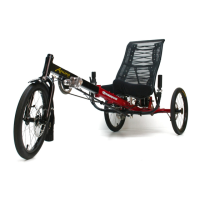
Trikes are inherently stable but can be tipped over if cornered
hard, without leaning into the corner. Remember to always lean
into the corners on faster corners. We find riding in a large car
park, basketball court etc around in circles, slowly increasing
speed, to find the limits of stability and your abilities works best.
Note wear protective gloves. With practice you might be able
to ride on two wheels! Just remember once you start to fall,
turn to the direction you are falling which will simultaneously
correct your balance. You may also use the brake as a device to
correct your balance. Note, try to resist taking your hands off the
handlebars if you feel yourself falling. This skill can be useful
for mounting gutters, avoiding obstacles or showing off - skilled
riders can perform figures of eight on two wheels!
Remember braking in a corner with only the inside brake will not
slow you down as it is unweighted and will lock up. Try and use
both brakes in an emergency situation. We have heard stories
of people cornering at speed with their drink bottle in one hand,
having to brake mid-corner, and finding they have very little
brakes to slow them down.
Sliding can be great fun when mastered. Weight distribution is
an important tool in achieving your goal of the perfect slide. By
leaning further forward you unweight the rear tyre causing the
back to slide more. If you lean back the front will slide causing
the rear to regain grip. On long corners, gravel or wet road
etc, a combination of leaning forward and back you can achieve
awesome three wheeled slides.
Try not to carry heavy loads high on the rear of your trike, as
it will make the trike unstable. If you have no choice, take it
very slow around corners. Your trike is not designed for people
carrying on the back. Child trailers etc should be no problem,
but as always, find the limit of stability before you leave on that
riding
Having many gears can be daunting at first. The key to using
the gears is to change down before you have to! To make a
change with the rear derailleur, push the right handlebar end
shifter forward to change into a higher/harder gear and pull back
to change into a lower/easier gear. Note make sure you reduce
the load on the pedals while making the gear change. UNDER
NO CIRCUMSTANCES allow the trike to roll back while changing
the rear cluster, or even pull the trike backwards when the gear
lever has been moved, as this may result in damage to the rear
derailleur. The bar end lever on the left handle controls the front
derailleur in the opposite way. It is moved forward to drop the
chain onto the smaller chainring to lower the gearing and make
hill climbing easier. Again REDUCE the load on the pedals as the
change is made.
steering
gears
journey be it short or long.
Changes in road conditions can also effect how the trike will
react. For example turning on an off camber corner or halfway
down a steep hill will make your trike more likely to tip up than
a banked corner or turning part way up an incline. Just think
of a velodrome as the ultimate cornering situation because it is
already leaning you into the corner, but riding along a slope and
turning suddenly up the slope you are already leaning outward.
Potholes are best avoided by placing the pothole between the
front wheel and the centre of the frame. If unavoidable potholes
are best hit with the front wheels rather than the back, as it
transmits less shock back to you, and the frame.
15


 To Next Page