EasyManua.ls Logo

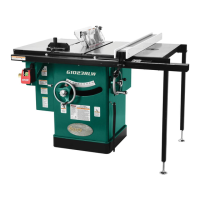
Grizzly G1023RLX - User Manual

Grizzly G1023RLX
96 pages
Print Icon
To Next Page IconTo Next Page
Loading...
COPYRIGHT © MAY, 2010 BY GRIZZLY INDUSTRIAL, INC. REVISED OCTOBER, 2014 (BLMN)
WARNING: NO PORTION OF THIS MANUAL MAY BE REPRODUCED IN ANY SHAPE
OR FORM WITHOUT THE WRITTEN APPROVAL OF GRIZZLY INDUSTRIAL, INC.
#BL12898 PRINTED IN TAIWAN
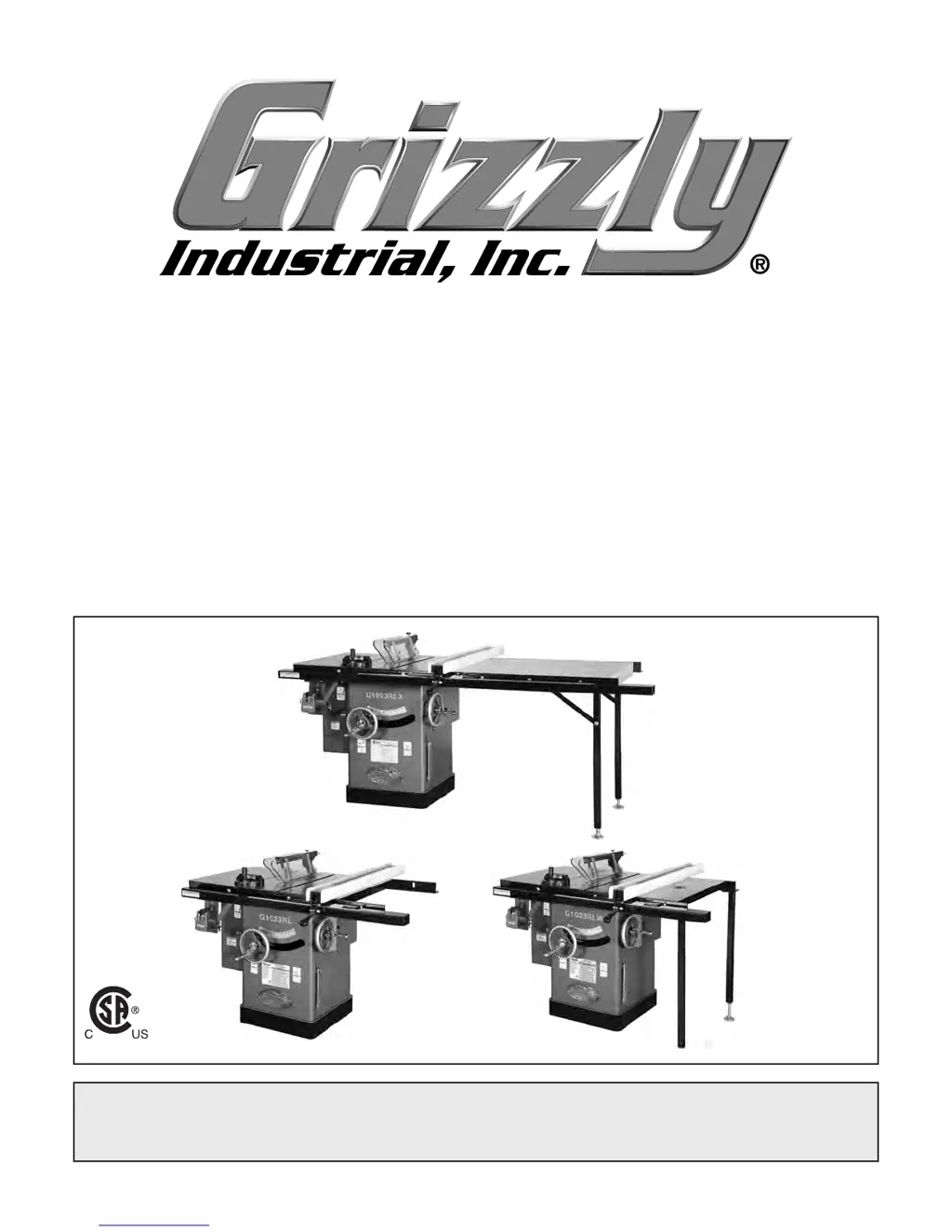
G1023RL
G1023RLX
G1023RLW/RLWX
177335
MODEL G1023RL SERIES
10" LEFT-TILT TABLE SAW
WITH RIVING KNIFE
OWNER'S MANUAL
(For RL/RLW/RLX models manufactured since 12/11)
(For RLWX models manufactured since 10/14)
V3.10.14

Table of Contents

Questions and Answers

  • K
    Katie Good MDAug 22, 2025
    What to do if workpiece burns or binds when feeding with my Grizzly G1023RLX?
    • R
      Richard JohnsonAug 22, 2025
      If the workpiece burns or binds when feeding your Grizzly Saw, it could be due to several reasons. The riving knife or spreader may not be correctly aligned with the blade; adjust them accordingly. The fence may not be parallel with the blade, causing pressure at the blade's backside; adjust the fence to be parallel. The blade might be warped or damaged, requiring replacement. Finally, the blade may have too many teeth for the cutting type, so changing to a blade with fewer teeth might be necessary.
  • L
    Lynn DavisAug 25, 2025
    Why is too much sawdust blown back toward operator using Grizzly G1023RLX Saw?
    • K
      Kathryn BurchAug 26, 2025
      If too much sawdust is blown back toward the operator while using your Grizzly Saw, consider the following: Ensure the blade guard is re-installed for maximum safety and dust control. Seal any air leaks in the cabinet or around the dust chute to improve dust collection. Check if the dust collection system is clogged or too weak, and remove any clogs or revise the ducting layout for improved suction. Adjust the fence to be parallel with the blade to prevent pressure at the blade's backside. Lastly, adjust the table/trunnions so the miter slot is parallel with the blade at 90° and 45°.
  • B
    Brad EllisonAug 28, 2025
    How to fix a Grizzly Saw handwheel that binds or is difficult to move?
    • C
      Christopher StevensAug 28, 2025
      If the handwheel binds or is difficult to move on your Grizzly Saw, check if the lock knob is engaged and loosen it. If the handwheel shaft pins are wedged, remove the handwheel and adjust the shaft pins. If the handwheel is inserted too far, remove it and adjust the key. Lastly, if there is too much engagement between the worm gear and trunnion, adjust the worm gear engagement.
  • A
    Andrew SanchezAug 30, 2025
    Why is the arbor movement sloppy or difficult on my Grizzly G1023RLX?
    • T
      Teresa BurtonAug 30, 2025
      If the arbor movement on your Grizzly Saw is sloppy, inconsistent, difficult to move, or binds, it could be due to the elevation slide gib being too tight or too loose; adjust it accordingly. Another possible cause is a worn-out gas strut, which would need to be replaced.
  • R
    rodriguezkellySep 2, 2025
    What to do if the blade does not reach 45 degrees on my Grizzly Saw?
    • J
      Jorge SalazarSep 2, 2025
      If the blade of your Grizzly Saw does not reach 45 degrees, it could be due to the pointer or scale being calibrated incorrectly, so calibrate the pointer/scale at true 45 degrees. Another reason might be that the 45 degree stop bolt is out of adjustment, so adjust the 45 degree stop bolt. Also, sawdust buildup in the front trunnion can be the cause, so check for sawdust in the trunnions, clean, and re-lubricate as necessary.
  • E
    Emily JohnsonSep 5, 2025
    Why doesn't the blade on my Grizzly Saw reach 90 degrees?
    • T
      tchristianSep 5, 2025
      If the blade of your Grizzly Saw does not reach 90 degrees, it could be because the pointer or scale is calibrated incorrectly; calibrate the pointer/scale at a true 90 degrees. Alternatively, the 90 degree stop bolt may be out of adjustment; adjust the 90 degree stop bolt.
  • K
    Katherine StewartSep 7, 2025
    What causes the blade to be too close to the insert on my Grizzly G1023RLX?
    • R
      Rachel MooreSep 7, 2025
      If the blade is too close to the insert on your Grizzly Saw, it could be because the blade position on the arbor is incorrect; verify that the blade arbor washers are correct and in the required position. Another reason could be that the table mounting position is not centered; loosen the table mounting bolts, adjust the table position, then realign the blade.
  • W
    wallacedavidSep 10, 2025
    Why won't the blade go beneath the table surface on my Grizzly G1023RLX?
    • B
      brandonmorrisonSep 10, 2025
      If the blade will not go beneath the table surface on your Grizzly Saw, the handwheel shaft pins may be wedged; remove the handwheel and adjust the shaft pins. Alternatively, a roll pin/setscrew in the worm gear may be contacting the geared trunnion; tighten the roll pins and set screws in the worm gear. Another possibility is that the handwheel key is inserted too far; remove the handwheel and adjust the key.
  • S
    Shane ParkSep 13, 2025
    What to do if the blade will not move up or down on my Grizzly G1023RLX?
    • K
      Kevin JohnsonSep 13, 2025
      If the blade will not move up or down on your Grizzly Saw, it could be due to a loose or missing set screw on the worm gear; tighten or replace the set screw. Alternatively, the handwheel shaft key may be missing; replace the key.
  • S
    Scott MorganNov 16, 2025
    Why does my Grizzly Saw have excessive vibration or noise?
    • M
      michellemitchellNov 16, 2025
      Several factors can cause excessive vibration or noise in your Grizzly Saw. A slight blade wobble can be fixed using a blade stabilizer. If the arbor nut is loose or obstructed by debris, remove and clean it, then tighten the arbor nut. A loose arbor pulley should be retightened or replaced with shaft and thread locking liquid. If the tilt handwheel is loose, tighten the tilt handwheel lock knob. If the casting is at fault, the trunnion/geared bearing housing may be loose or cracked and needs to be tightened or replaced. If the motor fan is rubbing on the fan cover, fix or replace the fan cover and replace any loose or damaged fans. Tighten the motor mounting bolts/nuts, using thread locking fluid if the motor mounting is loose. If the flat belt is worn or damaged, it should be replaced. I...

Summary

Introduction to the Grizzly Table Saw

Manual Accuracy and Content

Details on the manual's accuracy and potential differences from the machine, with instructions for updates.

Contact Information for Support

Information for contacting Grizzly Technical Support and Documentation Manager for assistance.

Machine Description and Features

Overview of the table saw's features, including cabinet, table, dust collection, and main components.

Machine Data Sheet

Section 1: Safety

Read Manual Before Operating

Emphasizes reading the manual before operation to prevent serious injury and ensure safe use.

Machinery Safety Instructions

Provides critical safety guidelines for operating machinery safely, including electrical and environmental risks.

Additional Safety for Table Saws

Preventing Kickback

Details common causes of kickback and precautions to avoid it, such as workpiece handling and fence alignment.

Protecting Yourself from Kickback

Provides safety measures to protect the operator if kickback occurs, including body positioning and safety devices.

Glossary of Terms

Section 2: Power Supply

Power Supply Requirements

Covers circuit requirements, voltage, grounding, and extension cords for safe machine operation.

Grounding and Extension Cords

Explains grounding requirements and provides recommendations for using extension cords with the machine.

Section 3: Setup

Setup Overview and Requirements

Covers needed items, unpacking, hardware, inventory, cleanup, and site considerations before assembly.

Assembly Process

Step-by-step instructions for assembling the table saw and its components, including wings, rails, and controls.

Section 4: Operations

Basic Controls

Identifies and explains the basic controls of the table saw, including ON/OFF switch and handwheels.

Operation Overview and Switch Safety

Provides an overview of typical operation and instructions for disabling the switch for safety.

Blade Management

Covers blade requirements, selection, installation, guard assembly, and riving knife use.

Cutting Operations

Details procedures for ripping, crosscutting, miter cuts, dado, rabbet, and blade tilt/bevel cuts.

Resawing Procedures

Safety warnings and detailed steps for performing resawing operations, including barrier construction.

Section 5: Shop Made Safety Accessories

Featherboards

Instructions for making and mounting featherboards for improved safety and workpiece control.

Push Sticks and Push Blocks

Guides for using and making push sticks and push blocks for safe cutting operations.

Auxiliary Fence and Support Jigs

Details on creating specialized jigs like auxiliary fences and crosscut sleds for safety and accuracy.

Section 6: Accessories

Table Saw Enhancements

Describes accessories like zero clearance inserts, extension kits, and mobile bases for improved functionality.

Cutting and Alignment Aids

Details accessories for improving cutting accuracy and machine alignment, such as power feeders and alignment tools.

Section 7: Maintenance

Maintenance Schedule

Outlines ongoing, weekly, and monthly tasks for optimal machine performance and longevity.

Cleaning and Lubrication

Procedures for cleaning the machine, protecting cast iron surfaces, and lubricating moving parts.

Section 8: Service

Troubleshooting Common Issues

Guide to diagnosing and resolving common machine symptoms and their possible causes.

Blade and Miter Adjustments

Instructions for adjusting blade tilt stops, miter slot parallelism, and blade alignment for accuracy.

Spreader;Riving Knife and Fence Adjustments

Procedures for aligning the spreader/riving knife and adjusting the fence for proper operation.

Section 9: Wiring

Wiring Safety and Component Identification

Crucial safety precautions and identification of electrical components for all models.

Wiring Diagrams

Wiring diagrams for both 3HP and 5HP models, illustrating electrical connections.

Section 10: Parts

Main Assembly Parts

Exploded view and list of parts for the main table saw assembly.

Arbor & Motor Assembly Parts

Exploded view and list of parts for the arbor and motor components.

Blade Guard & Miter Gauge Parts

Exploded view and list of parts for blade guard and miter gauge assemblies.

Fence Rails and Router Table Parts

Exploded views and parts lists for fence rails and router table/guard components across models.

Grizzly G1023RLX Specifications

General IconGeneral
BrandGrizzly
ModelG1023RLX
CategorySaw
LanguageEnglish

Related product manuals