4
© Guldmann GB/US-1688/12/2011 • # 553658_4.01
© Guldmann GB/US-1688/12/2011 • # 553658_4.01
© Guldmann GB/US-1688/12/2011 • # 553658_4.01
© Guldmann GB/US-1688/12/2011 • # 553658_4.01
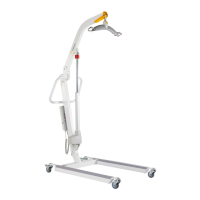
Turning the lifter should be carried out by two persons, otherwise, stand
alongside the lter and push on the side of the mast thereby minimising the
centre of rotation. It is a good idea to make the heaviest point of the lifter the
centre of rotation. If there is limited space, you can use your foot to push on
the chassis of the lifter in the direction you wish to turn.
Fittingtheliftingsling
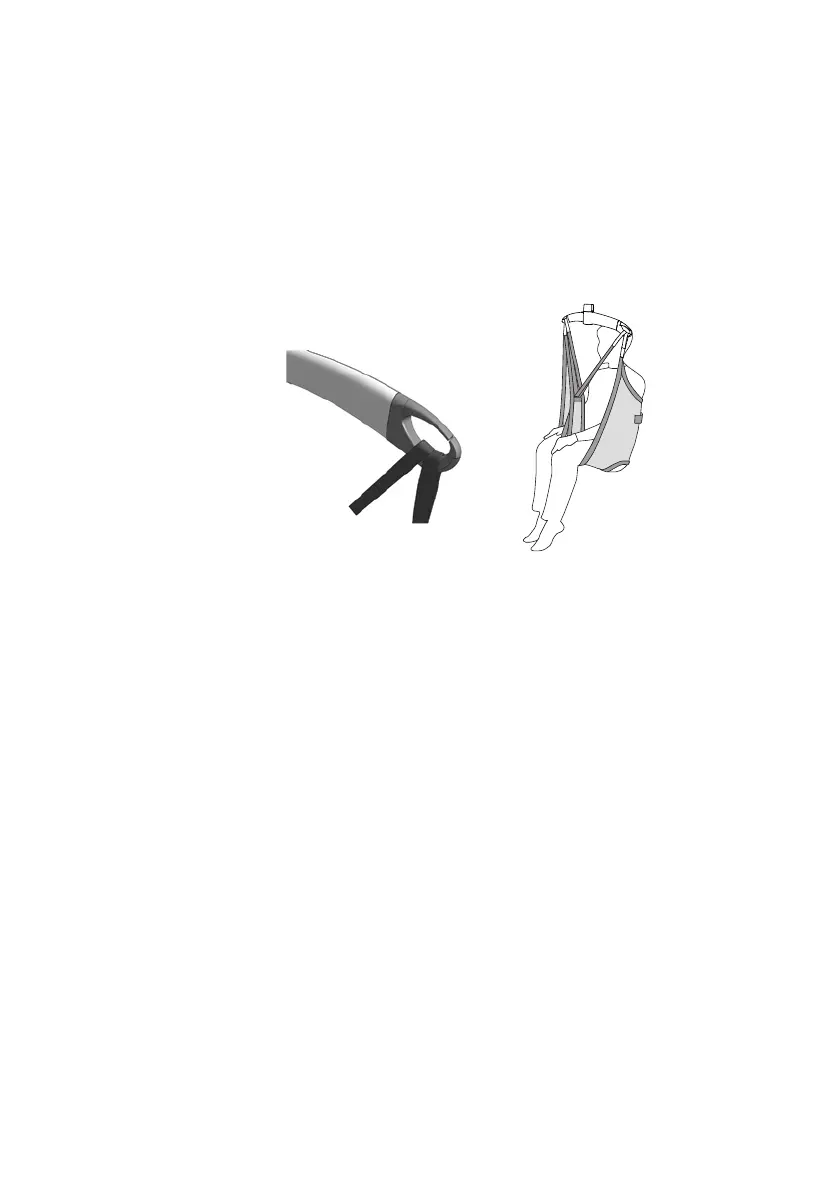
Hook the top set of straps (from the back) to the hooks facing the user. Hook
the lower set of straps (from the legs) to the hooks facing away from the user.
Important!
Be careful when applying the lifting sling. Check that the straps have been
pulled completely through the rubber safety catch and into place in the lifting
hanger’s hooks before starting lifting the user.
Fromachair,wheelchairorothersittingpositions
Place lifting sling behind user’s back e.g. between the back of the chair and
the user’s back.
The centre band of the lifting sling should follow the user’s spine. As for the
slings type Active the strap showing the size of the sling should be opposite
the spine. Bring the leg straps along the outer thigh and then under the thigh
between the back of the knee and the hip.
Now cross the leg straps in front of the user.
All four straps are now ready to be mounted onto the lifting hanger.
Lyingpositioninbed,onamattressorontheoor
Turn the user on his side. Place the high back sling so that its upper edge is
ush with the top of the user’s head. Put the sling on the user so that the cen-
tre band follows the spine. Turn the user on his back and pull the sling out.
Bring the leg straps under the thigh and cross them over.
All four straps are now ready to be mounted onto the lifting hanger.
If in doubt about how to use the sling, please contact your supplier.
Guldmann cannot be held responsible for any faults or accidents that may
occur due to incorrect positioning of the lifting hanger, or for reasons of inade-
quate attention paid by helpers or the user.


 To Next Page