45
Lifting and supporting ashore
Please note that weight figures given in this manual are for an empty standard boat with empty water-
and fuel tanks. The individual boats are not weighed. For this reason the weight figures are
approximate. If lifting by crane, ensure that it has a safe over-capacity for extra equipment, personal
equipment tank contents and more.
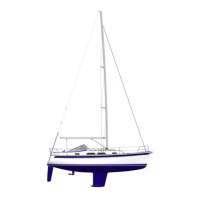
All Hallberg-Rassy yachts are designed to stand safely on the keel, supported on two cross beams under
the keel. The hull laminate is so dimensioned that load from the keel when resting in winter storing
ashore will not cause any damage. The foremost beam under the keel should be placed as far forward as
possible. It is also important that these supports do not compress over the time of storage. If the
supports under the keel compresses, that will lead to too much load on the side supports with a high
risk of damaging the hull laminate in that area. The four side supports are to be onto the hull, but at the
same time not to put pressure onto the hull. The side supports have to be at least 25 x 25 cm for boats
31-37 ft and 30 x 30 cm on yachts over 37 ft. The supporting area towards the hull shall not be just a
flat surface but covered with rubber or carpet, so that these shape after the hull shape, thus distributing
the possible loads over a larger area. At least on yachts 31-37 there additionally need to be a forward and
aft support This in order to prevent that the boat may fall forward or aft due to the weight of people
moving on deck, but also to distribute vertical loads from the side supports. Forward and aft supports
are to be dimensioned as the side supports.
All lifting and slipping, especially of sail boats involve risks of life and must
be made by competent people.
Details of the keel configuration and the best positioning of the slings are found on attached sketch. If
the boat is lifted by crane in slings, these must be very long or spread out by bars, to eliminate heavy
load on the cap rails. As always, the person who lifts the boat need to ensure that the slings are
positioned in such a way that the slings do no come in conflict with any vulnerable parts of the boat.
Radar pole lift
The maximum static load is 60 kg. Static means that if the goods starts to move, it is less than 60 kg. The radar pole
lift is definitely not intended for man over board recovery.
Extra steps outside transom (HR 55 and HR 64)
If you have a Hallberg-Rassy 54, 55 or 64 with additional steps outside the transom lid, it is important to point out
that the stop pin is only to be kept in stop place when the steps are used. If you leave the pin in stop-position, that
would prevent the platform to be used in emergency.
Danger !



 To Next Page