20
5.3
DOMESTIC HOT WATER FLOWRATE
5.4
FINAL CHECKS
31
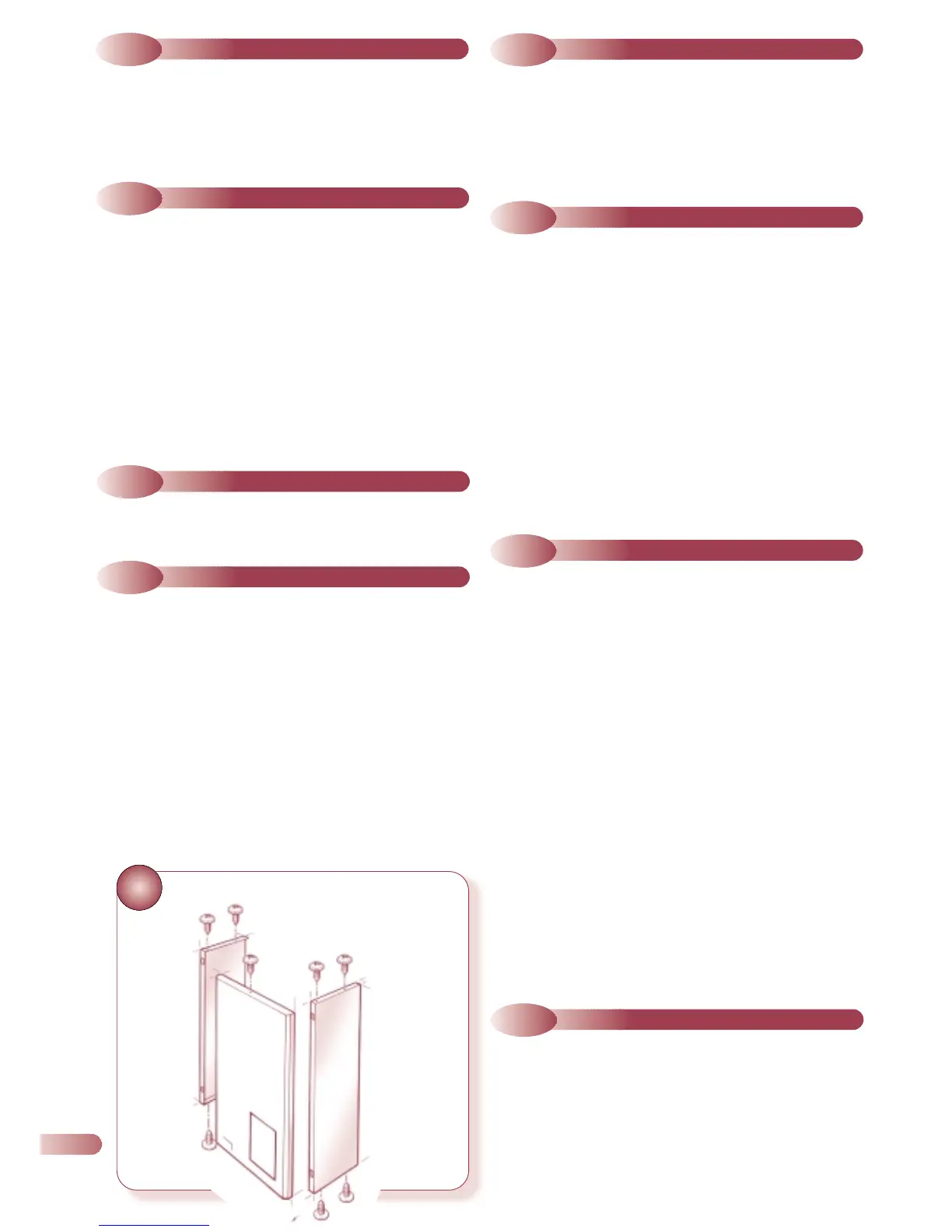
FITTING THE CASING PANELS
5.7
FROST PROTECTION
5.8
OTHER FEATURES
5.9
USERS INSTRUCTIONS
A flow regulator is supplied factory fitted to the appliance to ensure
that no adjustment is necessary. Should the mains flow rate be below
the minimum required it is possible to remove the flow regulator from
the appliance as instructed in section 9 (Fig. 37).The nominal pre-
adjusted flow rate may vary by ± 5% due to factory tolerances and
mains water pressure fluctuation.
a) Turn the appliance off and remove the manometer and tighten
the burner pressure test point screw. Re-light burner and test for
gas soundness.
b) Fit the boiler casing as described and illustrated in Figure 31: Fit
each side panel (both are identical) with two screws at the top
and bottom of each panel. Fit the front panel in position and
locate by gently sliding it downwards over the supporting tabs.
Screw into position using the single fixing screw at the top of the
casing.
c) Set the heating and hot water controls (Fig. 30) to the required
settings. Ensure that the clock override switch is in the timed
position, and check that the time clock is set at the desired time
periods. Set the room thermostat (if fitted) to the required setting.
This appliance is fitted with an overheat thermostat. In the event of
overheating, the appliance will shut down and the safety lockout
LED will light. If an overheat condition occurs, allow the appliance
to cool, then press the overheat reset button once (located
underneath the appliance at the left hand side). The Ignition safety
lockout LED will also be illuminated and require re-setting. To re-set,
turn the main switch through to the Reset position (spring return).
5.5
IGNITION LOCKOUT
5.6
OVERHEAT THERMOSTAT
In the event of an ignition failure, the safety lockout LED will be
illuminated. To re-set, turn the main switch through to the Reset
position (spring return).
This appliance is fitted with a frost protection device. In the event of
very cold conditions the pump may operate and the boiler may light
for a few minutes to protect the appliance and system from potential
frost damage. This can only function if the gas and electricity
supplies are maintained and the main switch on the appliance is left
either in the Hot Water or Heating & Water mode. The clock can be
switched to the off setting.
The following additional features are included in the appliance
specification:
ANTI-CYCLE DEVICE: When the appliance cycles on it’s central
heating control setting, a slow cycle device operates. The timer (set to
3 mins) is activated after the end of burn cycle to prevent rapid cycling
of the burner.
ANTI PUMP SEIZURE DEVICE:
Providing that a power supply is maintained and the Main Switch is
either in the Hot Water or Heating & Water mode, the pump will
operate for at least 20 seconds every 23 hours (regardless of heat
demand) to prevent pump seizure during periods where the appliance
is not used.
WATER FLOW SWITCH:
This device prevents the burner from firing if there is inadequate water
flow through the main heat exchanger.
Upon completion of commissioning and testing the system, the
installer should draw the user's attention to the following.
a) Give the 'Users Instructions' to the householder and emphasise
their responsibilities under the 'Gas Safety (Installation and Use)
Regulations 1996' (as amended).
a) Explain and demonstrate the lighting and shutdown procedures.
b) Advise the householder on the efficient use of the system,
including the use and adjustment of all system controls for both
DHW and CH.
c) Advise the user of the precautions necessary to prevent damage
to the system, and to the building, in the event of the system
remaining inoperative during frost conditions.
d) Explain the function of the boiler overheat thermostat, and how
to re-set it. Emphasise that if cut-out persists, the boiler should be
turned off and the installer or service engineer consulted.
e) Stress the importance of an annual service by a registered
heating engineer.
f) The electrical mains supply to the appliance must remain ON
and the Main Switch must left either in the Hot Water or
Heating & Water mode for the frost protection circuit to
operate.
5.10
BOILER LOGBOOK
A logbook is supplied with this appliance to record installation and
commissioning details and make future servicing of the appliance
easier.
This logbook forms part of the industry's Benchmark code of practice
for the installation, commissioning and servicing of central heating
systems.
Please ensure that the logbook is fully completed and left with the
customer for future reference along with Users Instructions and this
Installation and Servicing Instruction manual.



 To Next Page