EN
82
• Several charge controllers of the same type can be connected in parallel to the same group of
batteries to increase the charging current, but each controller must have its own solar panel or
group of solar panels.
• The cross-sectional area of the conductors should have a current density of max 5 A/mm2 (if
lower current density limit is stipulated in local electrical installations this should be applied).
PANEL TYPE REQUIREMENTS
Series connection of solar panels
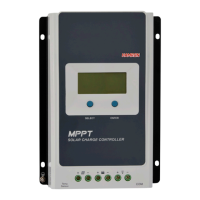
The charge controller is the main component in the solar panel system and maximises the output of
energy from dierent types and arrangements of solar panels. On the basis of the MPPT controller’s
open circuit voltage (Uoc) and voltage in the maximum power point (Umpp) it is possible to calculate
the number of solar panels to connect in series. The table below is only intended for reference.
System voltage
36 cells
U
oc
< 23 V
48 cells
U
oc
< 31 V
54 cells
U
oc
< 34 V
60 cells
U
oc
< 38 V
Max.
Most
suitable
Max.
Most
suitable
Max.
Most
suitable
Max.
Most
suitable
12 V 4 2 2 1 2 1 2 1
24 V 4 3 2 2 2 2 2 2
System voltage
72 cells
U
oc
< 46 V
96 cells
U
oc
< 62 V
Thin lm panel
U
oc
< 80 V
Max. Most suitable Max. Most suitable
12 V 2 1 1 1 1 1
24 V 2 1 1 1 1 1
NOTE:
The above values are calculated for the standard test condition (STC): solar radiation intensity
1000 W/m2, panel temperature 25°C, AM (air mass) 1.5.
Highest panel type power
The MPPT controller has built in protection from overload and overcurrent. Unfavourable operating
conditions, connection of over powerful solar panels or other conditions, can result in dangerously
high power or charging current. The following four operating situations can occur.


 To Next Page