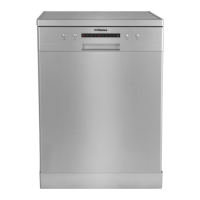
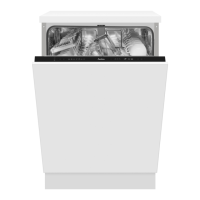
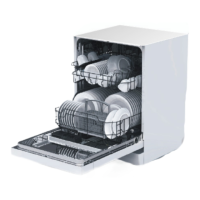
This document is the operating instructions for the Hansa ZWM 416 WH dishwasher.
Function Description
The Hansa ZWM 416 WH is a household dishwasher designed to clean dishes and utensils. It operates by spraying water and detergent onto the dishes, followed by rinsing and drying cycles. The appliance offers various programs to suit different levels of soiling and types of dishes. It incorporates features like a water softener to manage water hardness, a dispenser for detergent and rinse aid, and spray arms to ensure thorough cleaning. The dishwasher is designed for ease of use with a control panel that allows users to select programs, adjust settings, and monitor the appliance's status. It also includes safety features and recommendations for optimal performance and longevity.
Important Technical Specifications
Model: ZWM 416 WH
Energy Efficiency Class: A++
Annual Energy Consumption: 197 kWh/year (based on 280 standard cleaning cycles)
Energy Consumption in off-mode: 0.50 W
Energy Consumption in left-on mode: 0.50 W
Annual Water Consumption: 2520 litres/year (based on 280 standard cleaning cycles)
Drying Efficiency Class: A
Standard Programme: Eco
Standard Cleaning Cycle Duration: 185 minutes
Duration of the Left-on Mode: 1 minute
Sound Power Level: 49 dB(A) re1 pW
Equipment Designed for Fitting: Yes
Height: 845 mm
Height (without worktop): 815 mm
Width: 448 mm
Depth: 600 mm
Voltage/Frequency: 230 V / ~ 50 Hz / 10A
Water Supply Pressure: 0.4-10 bar = 0.04-1 Mpa
Total Power Consumption: 1930 W
Heating Element Power: 1800 W
Washing Pump Power: 65 W
Drain Pump Power: 30 W
Cut-off Device: 10 A
Net Weight: 33 kg
The dishwasher offers several programs:
- Normal: 55°C, for soiled dishes with dried food residue. Duration: 155 min. Energy: 1.07 kWh. Water: 13 L.
- Intensive: 60°C, for heavily soiled dishes with dried food residue. Duration: 135 min. Energy: 1.3 kWh. Water: 16 L.
- Glass: 40°C, for lightly soiled glass-ware and porcelain. Duration: 110 min. Energy: 0.7 kWh. Water: 13 L.
- ECO: 45°C, for lightly soiled glass-ware and porcelain. This is the standard program. Duration: 185 min. Energy: 0.69 kWh. Water: 9 L.
- 90': 65°C, for medium soiled dishes that require quick washing. Duration: 90 min. Energy: 1.1 kWh. Water: 10.5 L.
- Soak: Pre-wash only, to rinse dishes that plan to wash later that day. Duration: 8 min. Energy: 0.01 kWh. Water: 3.5 L.
Usage Features
Installation:
- Before installation, check for transport damage.
- Ensure proper grounding and connect to a qualified electrician.
- Use an extension cord only if it came with the appliance and is sufficiently safe.
- Connect the water supply hose to a cold water tap (min 0.04 MPa, max 1 MPa). If water pressure exceeds 1 MPa, install a pressure reducing valve.
- The drain hose can be connected to a drain or kitchen sink stub pipe, or directly into the sink. The drain hose connection should be made at least 50 cm and up to 110 cm from the floor.
- Adjust the appliance's height using adjustable legs to ensure it is level and stable.
Operation:
- Loading: Load dishes into the upper and lower baskets. The upper basket is suitable for delicate items like glasses, cups, and plates, while the lower basket is for heavily soiled items like pots, pans, and larger plates. The upper basket's height can be adjusted. Cutlery should be placed in the cutlery basket, ensuring items do not touch to prevent poor washing results.
- Detergent and Rinse Aid: Use only detergents and rinse aids designed for dishwashers. The detergent dispenser should be filled before each wash cycle. The rinse aid dispenser should be filled when the indicator light illuminates. The amount of rinse aid dispensed can be adjusted based on water hardness and desired drying results.
- Salt: The dishwasher requires special salt to soften hard water. The salt container should be filled when the indicator light illuminates. The water softener's setting should be adjusted according to the local water hardness level.
- Program Selection: Turn on the appliance by pressing the On/Off button. Select the desired program using the program button. The selected program indicator will light up. Press the Start/Pause button to begin the wash cycle.
- Changing a Program: A program can be changed within 3 seconds of pressing the Start/Pause button. If the program has already started, it can be cancelled by pressing and holding the Start/Pause button for more than 3 seconds. The machine will drain the water and reset.
- Child Safety: Do not allow children to play with the appliance. Keep them away from the open door and detergent.
- Daily Maintenance: Do not use solvents or abrasive cleaners. Do not open the door during operation.
Dishes and Utensils Not Suitable for Dishwashers:
- Not suitable: Ashtrays, candles, cleaning pastes, paints, chemicals, ferro-alloys; forks, spoons, and knives with a handle made of wood, ivory or Nacre; glued items; items contaminated with abrasive powders, acid or base.
- Not resistant to high temperature: Plastic dishes.
- May be stained or loose lustre: Aluminium and silver items.
- Delicate types of glass, porcelain with decorative prints: May fade after the first wash; some crystal dishes may lose their transparency; glued silverware sensitive to high temperatures; lead crystal glass; chopping boards; items made with synthetic fibres.
- Not suitable for the dishwasher: Absorbent objects such as a sponge or kitchen cloths.
Maintenance Features
Cleaning:
- General: Clean the dishwasher regularly to prevent grease and limescale accumulation.
- Filters: The filter system (main filter, coarse filter, fine filter) should be checked and cleaned regularly to remove food residue.
- Spray Arms: The spray arms should be checked and cleaned periodically to ensure the nozzles are not clogged. The lower spray arm can be removed by turning the nut counter-clockwise, and the upper spray arm can be removed by pulling it upwards.
- Door Seal: Clean the door seal to remove any accumulated residue.
- Exterior: Clean the exterior with a soft cloth and mild detergent. Do not use abrasive cleaners.
Troubleshooting:
- Error Codes: The manual provides a table of error codes (e.g., "The Soak light flicker fleetly" for longer inlet time, "The ECO light flicker fleetly" for overflow) and corresponding actions.
- Program Indicators: Flashing program indicators can signal issues like the dishwasher door being open or a program not starting.
- Common Problems: The manual addresses issues like the appliance not starting (check plug, fuses, water supply valve, door), clinking noises (dishes arranged incorrectly, spray arm hits dishes), food residue on dishes (improper loading, detergent, clogged filters), and white spots or streaks (low detergent, low rinse aid, incorrect salt usage).
- Water Softening System: Regularly check and refill the special salt dispenser. Ensure the special salt dispenser lid is closed properly.
- Drying Issues: If dishes aren't dry, check if a drying phase was selected, if special salt dosage is too low, or if dishes were removed too soon.
- Corrosion on Cookware: This can be due to low-quality stainless steel, too much salt in the rinse water, or an improperly closed salt dispenser lid.
Care for the Environment:
- Recycling: Packaging and appliance parts are made of recyclable materials. The appliance is marked with the symbol indicating it should not be disposed of with normal municipal waste. It should be taken to an electronic waste collection and recycling point.
- Disposal: Before disposing of the appliance, remove all packaging and dispose of it in accordance with regulations. Disconnect the plug and cut the power cord to prevent accidental use.
- Warning: Recyclable materials can be dangerous for children. Keep them away from the appliance during disposal.

 Need help?
 General

 To Next Page