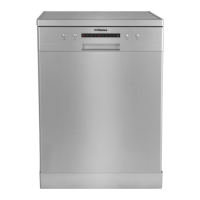
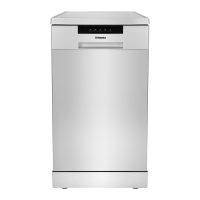
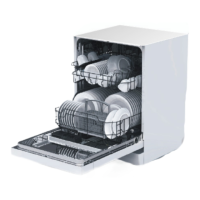
This document is the operating instructions for the Hansa ZWM 536 SH and ZWM 536 WH dishwashers.
Function Description
The Hansa ZWM 536 SH and ZWM 536 WH are dishwashers designed for household use, offering various programs to clean different types of dishes and soil levels. The appliance features a control panel with buttons for power, delay, rinse aid warning, salt warning, water failure indication, delay setting, program selection, and start/pause. It incorporates a water softening system to optimize washing performance, especially in areas with hard water, by using special salt. The dishwasher also includes a detergent dispenser and a rinse aid dispenser.
Important Technical Specifications
- Model: ZWM 536 SH / ZWM 536 WH
- Rated Capacity: 6 place settings
- Energy Efficiency Class: A+
- Annual Energy Consumption (AEC): 174 kWh/year
- Energy Consumption (Et) (kWh/cycle): 0.61 kWh
- Power Consumption in Off-mode (Po): 0.45 W
- Power Consumption in Left-on Mode (Pl): 0.49 W
- Annual Water Consumption (AWC): 1820 litres/year
- Drying Efficiency Class: A
- Standard Programme: Eco
- Standard Cleaning Cycle Duration: 180 minutes
- Duration of Left-on Mode (Tl): 1 minute
- Sound Pressure Level: 49 dB(A) re1 pW
- Dimensions (fitted):
- Height: 438 mm
- Height (without worktop): 438 mm
- Width: 550 mm
- Depth: 500 mm
- Voltage/Frequency: 230 V ~ 50 Hz / 10A
- Water Supply Pressure: 0.04-1 MPa
- Total Power Consumption: 1280 W
- Heating Element Power: 1200 W
- Washing Pump Power: 60 W
- Drain Pump Power: 30 W
- Cut-off Device: 10 A
- Net Weight: 21.5 kg
- Water Hardness Settings: Adjustable from 0-5 (H1: Rapid) to 35-45 (H6: Glass & 90Min) German degrees [dH].
- Aquastop Water Supply: Dangerous voltage could occur with Aquastop. Do not cut the Aquastop water supply. Do not allow it to bend or twist.
- Electrical Connection: Grounded plug connected to a grounded power outlet with a proper voltage. Supply voltage is 220-240 V AC. If the supply voltage is 110 V, use a 2200W, 110/220 V step up transformer.
Usage Features
The dishwasher offers a range of programs tailored for different needs:
- Intensive (70°C): For heavily soiled crockery, pots, pans, and dishes with dried-on soiling.
- Normal (60°C): For normally soiled loads, such as pots, plates, glasses, and lightly soiled pans.
- ECO (50°C): This is the standard program, suitable for cleaning normally soiled tableware. It is the most efficient program in terms of its combined energy and water consumption for that type of tableware.
- Glass (45°C): For lightly soiled glasses, crystal, and fine china.
- 90 min (65°C): For lightly soiled crockery and glass.
- Rapid (40°C): A shorter wash for lightly soiled loads and quick wash.
Loading Dishes: The upper and lower baskets are designed for specific items. The upper basket is for 6 place settings, while the lower basket is for the upper position. Cutlery is placed in a dedicated basket.
Detergent and Rinse Aid: The appliance requires 3+18g of detergent and a rinse aid dose of 6.
Water Softening System: The dishwasher has a water softening system that requires special salt. The salt dispenser level needs to be checked and refilled when the salt warning light illuminates. The water hardness setting should be adjusted according to local water hardness levels for optimal performance.
Rinse Aid Dispenser: The rinse aid dispenser has six or four settings (depending on the model) to adjust the amount of rinse aid dispensed, which helps with drying and prevents water spots.
Starting a Wash Cycle: To start, remove the basket, fill salt, detergent, and rinse aid, plug in the appliance, turn on the water supply, select a program, and press the Start/Pause button.
Changing a Program: A program can be changed if it has not been running for too long. If the door is opened during washing, the appliance will pause and resume after 10 seconds when the door is closed.
Ending a Program: The dishwasher will beep for 8 seconds at the end of a program. Turn off the appliance, shut off the water supply, and open the dishwasher door. Wait for a few minutes before unloading to allow dishes to cool and dry better.
Maintenance Features
Cleaning the Dishwasher:
- Regular cleaning prevents unpleasant odors and improves performance.
- Clean the spray arms and filters regularly to remove food particles.
- The door seal should be cleaned to remove any accumulated residue.
- The filter system (coarse, fine, and micro filters) needs to be cleaned regularly by removing and rinsing them under running water.
Water Supply Hose: The water supply hose filter should be cleaned periodically to prevent sediment accumulation.
Error Codes and Troubleshooting: The manual provides a table of error codes (e.g., Rapid program indicator flashing for long water filling time, Rapid and 90 min program indicators flashing for required temperature not reached, Glass program indicator flashing for overflow) and corresponding actions to resolve them.
Common Issues and Solutions:
- Dishwasher doesn't start: Check plug, fuses, water supply valve, door closure, program selection, and filters.
- Dishwasher stops during a wash program: Check for power failure, water supply, or if the program is paused.
- Clinking noises: Dishes may be arranged incorrectly, or spray arm hits dishes.
- Food residue on dishes: Dishes improperly loaded, basket overloaded, dishes touching one another, insufficient detergent, clogged filters, or improper fitting of filters.
- White spots or streaks on dishes: Insufficient detergent, low rinse aid, or not using special salt in areas with high water hardness.
- Dishes won't dry: Program does not include a drying phase, special salt dosage too low, or dishes removed too soon.
- Corrosion on cookware: Poor quality of stainless steel, too much salt in rinse water, or special salt dispenser lid not closed properly.
- Special salt spilled: If too much special salt is spilled when filling the dispenser, it can cause corrosion.
Recycling: The appliance and its packaging are made of recyclable materials. The product should not be disposed of with normal municipal waste but should be taken to an electronic waste collection and recycling point. The appliance is marked with the crossed-out waste container symbol. Disconnect the plug and cut the power cord before disposal.

 Need help?
 General

 To Next Page