Page 16 ;&(%$*4.8"4,7%<'*#$"&8#=%/7*,#*%4,77%>?@@@?@AA?BCDC1 Item 58703
EF;6GH IJ6KFGLIM NFLMG6MFMO6FEE6NPQH
I/*(,$"83%L8#$('4$"&8#
%K*,9%$.*%6MGLK6%LNJIKGFMG%EF;6GH%LM;IKNFGLIM%#*4$"&8%,$%$.*%+*3"88"83%&2%$."#%
5,8',7%"847'9"83%,77%$*Y$%'89*(%#'+.*,9"83#%$.*(*"8%+*2&(*%#*$%'/%&(%'#*%&2%$."#%G(,"7*(1
P*2&(*%*,4.%'#*
1. Check Tire condition and air pressure.
2. Make sure lug nuts are properly
tightened. Torque to 85 - 90 ft-lb.
3. Make sure hitch, coupler, tow bar, and other
equipment that connect the trailer and the tow
vehicle are properly secured and adjusted.
4. Make sure wiring is properly connected —
not touching the road, but loose enough to make
turns without disconnecting or damaging the wires.
5. Make sure all running lights, brake lights,
turn signals, and hazard lights are working.
6. Check that all items are securely
fastened on and in the Trailer.
7. Be sure the trailer jack, tongue support, and
any attached stabilizers (sold separately)
are raised and locked in place.
8. Check load distribution to make sure
the tow vehicle and Trailer are properly
balanced front to back and side to side.
9. Check side- and rear-view mirrors to
make sure you have good visibility.
10. Check routes and restrictions
on bridges and tunnels.
11. Make sure you have wheel chocks
and jack stands (sold separately) for
changing tires or stabilizing trailer.
12. Check Trailer for loose bolts and nuts,
structural cracks and bends, and any
other condition that may affect its safe
operation. Do not use the Trailer if
even minor damage appears.
O&88*4$"&8
RFKMLMSf%%GI%JK6!6MG%E6KLIWE%LMgWKH- Only
use a 2" ball hitch (not included) on the towing vehicle.
1. To reduce friction between the hitch ball
and Hitch Coupler, apply a thin layer of
heavy weight grease over the hitch ball.
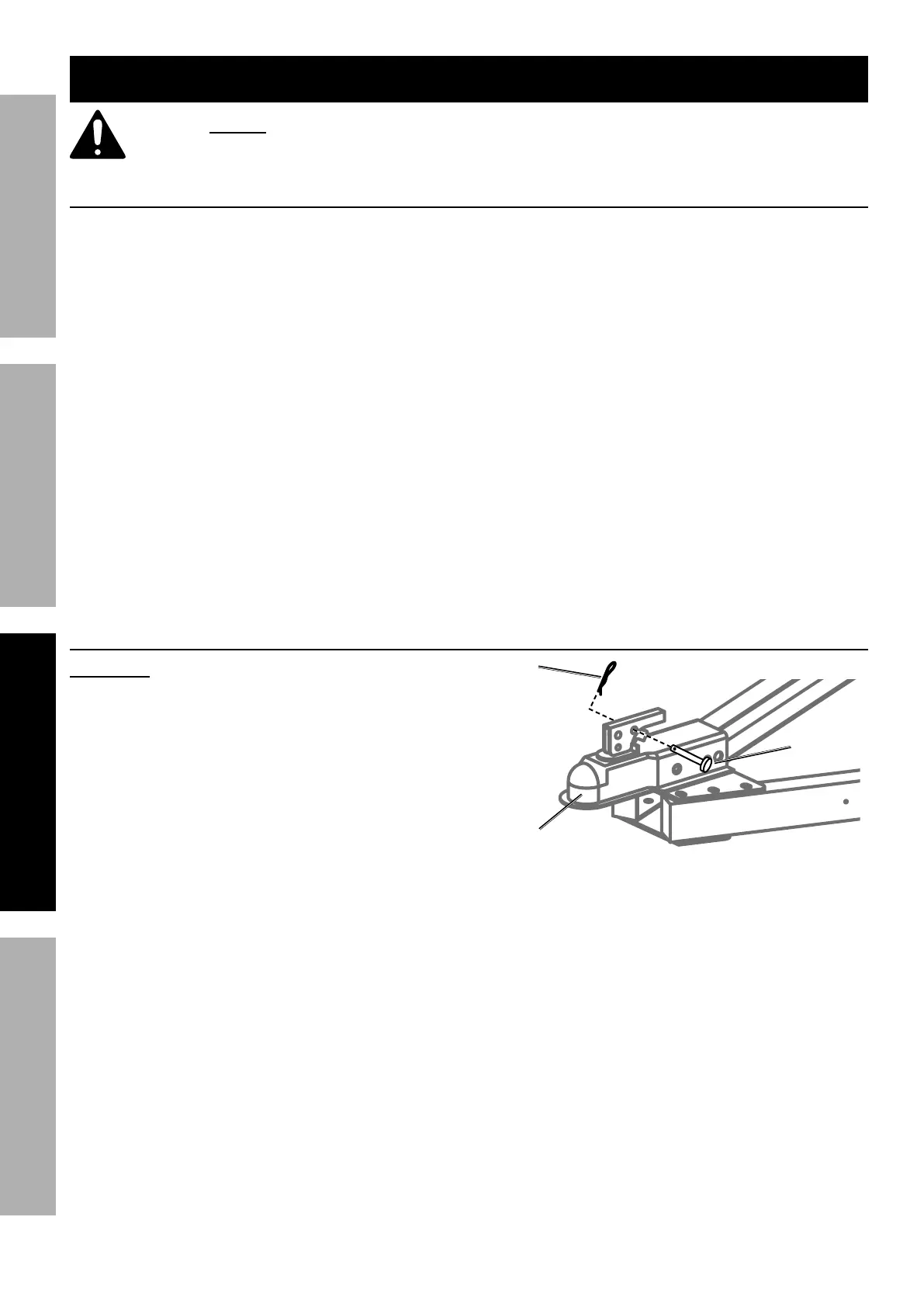
2. Unlock the Coupler Trigger by removing
its R-Clip and Locking Pin.
3. Then, pull up on the Trigger and
lift up on the Handle.
X"$4.%
O&'/7*(
Q&4["83%
J"8
K?O7"/
;"3'(*%F-%%K*5&V*%K?O7"/%,89%Q&4["83%J"8


 To Next Page