Avoid leakage. Be sure gaskets, banjo bolt(s), brake line
and master cylinder bore are clean and undamaged before
assembly. (00322a)
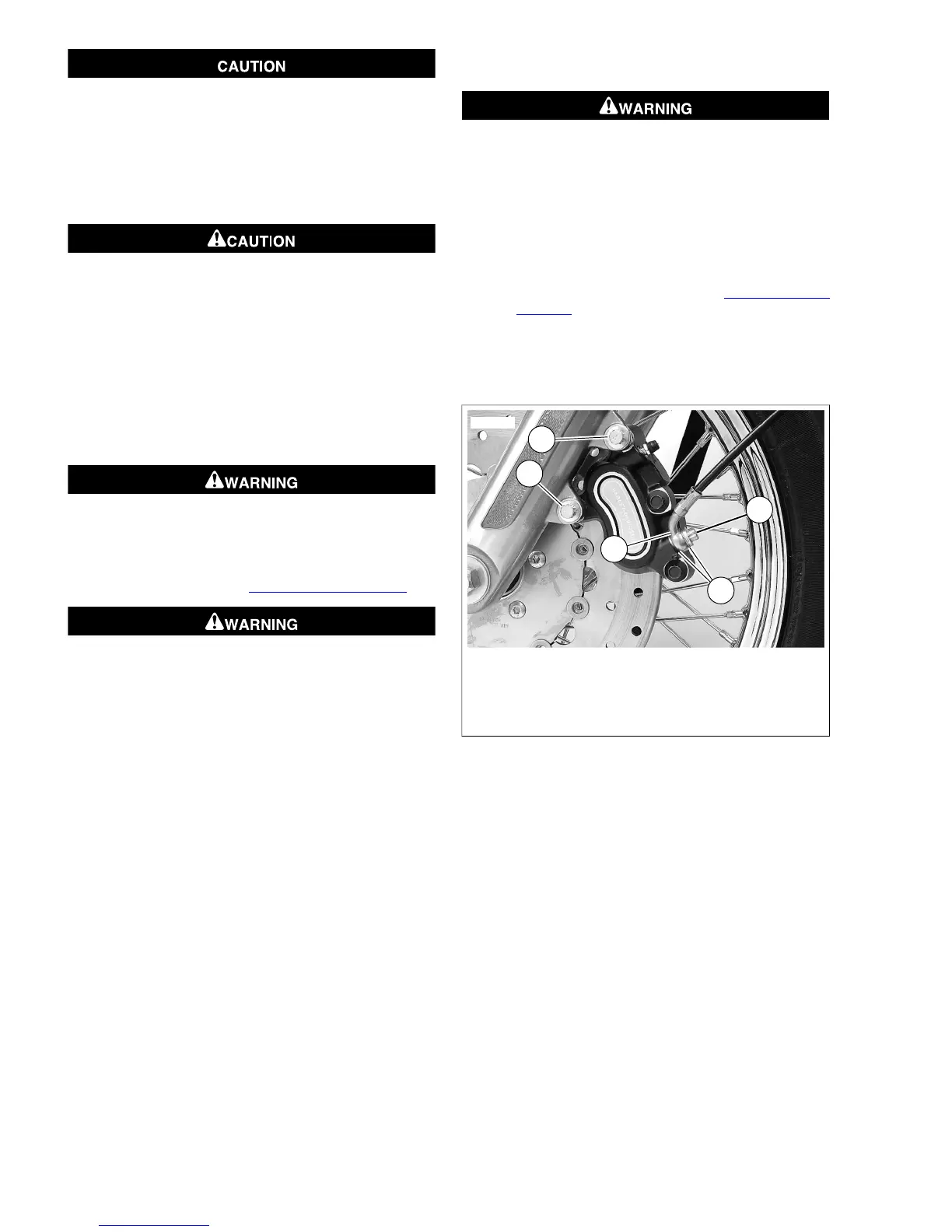
2. Lubricate new steel/rubber washers with D.O.T. 4 BRAKE
FLUID. Connect the brake line (3) to caliper using two
new steel/rubber washers (2) and banjo bolt (1).Tighten
to 21-25 ft-lbs (28.5-33.9 Nm).
Direct contact of D.O.T. 4 brake fluid with eyes can cause
irritation. Avoid eye contact. In case of eye contact flush
with large amounts of water and get medical attention.
Swallowing large amounts of D.O.T. 4 brake fluid can cause
digestive discomfort. If swallowed, obtain medical atten-
tion. Use in well ventilated area. KEEP OUT OF REACH OF
CHILDREN. (00240a)
3. Remove cover from front brake master cylinder. Fill master
cylinder with D.O.T. 4 BRAKE FLUID.Verify that fluid level
is 1/8-1/4 in. (3.2-6.4 mm) below top of reservoir with
master cylinder in a level position.
After servicing brakes and before moving motorcycle,
pump brakes to build brake system pressure. Insufficient
pressure can adversely affect brake performance, which
could result in death or serious injury. (00279a)
4. Bleed brake system. See 1.15 BLEEDING BRAKES.
A plugged or covered relief port can cause brake drag or
lock-up, which could lead to loss of control, resulting in
death or serious injury. (00288a)
5. Verify proper operation of the master cylinder relief port.
Actuate the brake lever with the cover removed. A slight
spurt of fluid will break the surface if all internal compon-
ents are working properly.
6. Install gasket and cover on master cylinder.Tighten cover
screws to 6-8 in-lbs (0.7-0.9 Nm).
After repairing the brake system, test brakes at low speed.
If brakes are not operating properly, testing at high speeds
can cause loss of control, which could result in death or
serious injury. (00289a)
7. Test brake system.
a. Turn ignition switch ON. Pump brake hand lever to
verify operation of the brake lamp.
b. Test ride the motorcycle. If the brakes feel spongy,
bleed the system again. See 1.15 BLEEDING
BRAKES.
NOTE
Avoid making hard stops for the first 100 miles (160 km).This
allows the new pads to become conditioned to the brake discs.



 To Next Page