
 Need help?
Do you have a question about the Harman Kardon 100+ and is the answer not in the manual?
Guides on obtaining customer service and repairs.
Information on fuses and speaker load requirements.
Guidance on positioning and wiring speakers for optimal sound.
Setup instructions for 4-channel sound reproduction.
Setup instructions for stereo sound reproduction.
Function of STEREO/4-CH, MUTING, and THRESHOLD controls.
Description of POWER, HEADPHONE, and SPEAKER switches.
Comprehensive overview of front panel switches, knobs, and jacks.
Information on obtaining warranty service and contacting the factory.
Details on power output, distortion, and frequency response.
FM/AM sensitivity, rejection, and separation metrics.
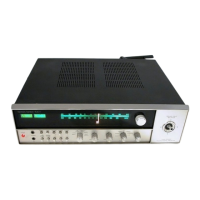
The Harman/Kardon Model 100+ is a multichannel receiver designed for high-fidelity audio reproduction, capable of operating in both stereophonic and quadriphonic modes. It aims to deliver clean, articulate sound and create a spacious, three-dimensional listening experience, whether filling a room with sound or immersing the listener in a concert-like ambiance.
The Model 100+ functions as an AM/Stereo FM multichannel receiver, processing various audio sources for output through multiple speaker systems. It supports both two-channel stereo and four-channel quadriphonic operation, allowing users to configure their listening environment for different audio experiences.
For stereo operation, the receiver can drive two pairs of front speakers, delivering double power to them when configured in the STEREO mode via a rear panel switch. In this mode, the back speakers are inoperative.
In quadriphonic operation, the receiver supports up to two pairs of front speakers and two pairs of back speakers. This setup is designed to create a surround sound field, where audio appears to emanate from all directions, recreating the depth and breadth of a live performance. The receiver includes a STEREO/4-CH switch on the rear panel to select between these modes.
The receiver features a comprehensive set of controls on its front panel. The FUNCTION switch allows selection of various program sources, including PHONO 1, PHONO 2, STEREO FM, FM, AM, DISCRETE FM/AUX, and DISCRETE PHONO/AUX. The PHONO positions are used for mono, stereo, or SQ matrix records, with specific SQ MATRIX 1 and SQ MATRIX 2 modes for different separation relationships between speakers. The DISCRETE FM/AUX and DISCRETE PHONO/AUX positions are intended for use with external 4-channel decoders or as additional high-level inputs.
Tuning for FM and AM broadcasts is managed by a TUNING knob and guided by a SIGNAL STRENGTH METER and FM TUNING METER, which helps achieve optimal reception and minimum distortion. A STEREO INDICATOR light illuminates when a stereo FM broadcast is being received.
The VOLUME control is a four-section control that simultaneously adjusts the signal level across all channels, ensuring identical relative volume levels. The SOUND FIELD BALANCE control is a unique four-channel continuously variable control that allows users to balance the output across all speakers, compensating for variations in channel efficiency or room acoustics to achieve an optimal sound stage.
BASS and TREBLE controls are provided to adjust the tonal balance of the system. These controls feature inner knobs for front speakers and outer knobs for back speakers, allowing for simultaneous or individual adjustment of low and high frequencies.
Speaker selection is managed by MAIN SPEAKER SWITCHES (FRONT and BACK) and REMOTE SPEAKER SWITCHES (FRONT and BACK), enabling users to activate different speaker pairs or listen through headphones. Headphone jacks (FRONT and BACK) are always active, allowing private listening by turning off the speakers.
Additional front panel switches include TAPE MON 1 and EXT DOLBY NR/TAPE MON 2. TAPE MON 1 facilitates monitoring of tapes during recording with a 4-channel tape recorder or can serve as an additional set of stereo or 4-channel high-level inputs. EXT DOLBY NR/TAPE MON 2 is used with an external Dolby processor for decoding Dolby-encoded FM programs or as a 2-channel tape monitor.
The CONTOUR switch compensates for the Fletcher-Munson effect, enhancing bass and treble at low listening levels for a fuller sound. The FM MUTING switch reduces interstation noise during tuning, and a MUTING ADJUSTMENT CONTROL on the bottom panel allows fine-tuning of the muting level. HIGH CUT and LOW CUT switches provide filters to reduce high-frequency noise (like record scratch or tape hiss) and low-frequency rumble (from turntables or FM stations), respectively.
The Model 100+ offers flexible speaker placement options, with diagrams illustrating various configurations for optimal sound dispersion and surround sound. Users are encouraged to experiment with speaker positioning, especially for back speakers, to achieve their desired ambiance for classical or contemporary music.
The receiver is designed for ease of connection, with clearly marked terminals for speakers and audio inputs. It accommodates speakers with impedances ranging from 4 to 16 ohms, and for simultaneous use of two pairs of speakers, an impedance of 8 ohms or more is recommended for each.
A logging scale on the dial helps users pinpoint and recall their favorite radio stations, complementing the frequency scale.
The STEREO/4-CH switch on the rear panel is protected by a safety latch to prevent accidental switching while the unit is powered on, emphasizing the importance of turning off the receiver before changing this setting.
The receiver's design prioritizes sound quality, featuring ultrawideband frequency response and low distortion. It automatically detects and switches between monophonic and stereophonic FM broadcasts, simplifying operation. For weak stereo signals, users can switch to FM mode to listen monophonically and reduce noise.
The manual provides detailed instructions for connecting various accessory equipment, including mono and stereo record players, stereo record players with decoders, and 4-channel tape recorders, illustrating typical operating conditions for each setup. It also explains how to connect two stereo or two 4-channel tape recorders simultaneously.
The receiver is protected by five fuses located on the rear panel: one for the entire power supply (4A-3AG) and four for the output stages (4A-3AG LEFT, RIGHT, FRONT, and BACK). In case of fuse failure, users are instructed to replace them ONLY with the same type and rating to prevent damage.
The manual emphasizes the importance of proper ventilation, recommending leaving the back of the cabinet open or providing adequate holes for airflow. A minimum clearance of two inches on the sides and rear, and three inches above, is advised. Accessories should not obstruct ventilation.
Users are cautioned to connect speakers carefully, avoiding shorts, especially when the power is on. Repetitive shorting can damage the output devices.
The manual provides troubleshooting advice for hum and noise issues, suggesting steps like disconnecting components, reversing AC line cords, and ensuring proper grounding of record player chassis. It also warns against using defective connecting cables or running them too close to strong AC fields.
For service, the manual directs users to contact Harman/Kardon's Customer Service Department within the two-year warranty period, providing instructions on how to obtain authorization before returning the unit. It highlights that the warranty does not cover damage from misuse, neglect, or unauthorized repairs, nor does it apply if the serial number has been altered or removed.
 Power
Power| power output | 57.5/57.5 watts RMS, both channels driven simultaneously into 8 ohms, 20-20kHz |
|---|---|
| power output 4-CH | 4x 24 watts RMS into 8 ohms, 20-20kHz |
| power bandwidth | From less than 10 to beyond 40kHz into 8 ohms, all channels driven |
| total harmonic distortion | Less than 0.5 ¼ at any power rating from 0.1 watt to full rated power |
| intermodulation distortion | Less than 0.15 ¼ at rated output |
 Tuner Specifications
| FM sensitivity | 1.9 microvolts, IHF |
|---|---|
| ultimate signal to noise ratio | 70dB |
| capture ratio | 2.2dB |
| image rejection | -50dB |
| spurious response rejection | -80dB |
| multiplex separation | 35dB at 1 kHz |
| AM rejection | -55dB |
| AM sensitivity | 200 microvolts/meter |
| image frequency rejection | Better than 55dB |
| IF rejection | Better than 55dB |
| selectivity | Better than 34dB |
Audio Specifications| frequency response | From below 4 Hertz to beyond 70kHz, ± 0.5dB at normal power levels |
|---|---|
| square wave tilt | Less than 1 0 ¼ at 20 Hertz |
| square wave rise time | Better than 2 microseconds |
| stability | Absolutely stable with any type load |
| phono overload | Greater than 75 + millivolts |
| bass and treble tone control | ± 12dB bass boost and cut at 50 Hertz |
| control action | ± 12dB treble boost and cut at 10kHz |
| hum and noise | Better than 85dB below rated output (unweighted) in stereo or 4-CH mode |
| damping factor | 40:1 at 4 and 8 ohms |
 Weight and Dimensions
| width | 18 ¾" |
|---|---|
| depth | 15 ¼" |
| height | 5" |



 To Next Page