Need help?
Do you have a question about the Harman dbx DJdi and is the answer not in the manual?
Welcomes the user and introduces the dbx DJdi Direct Box and its purpose.
Lists the main features and technical highlights of the DJdi Direct Box.
Details how to use the DJdi for various live sound and recording applications.
Explains connecting instruments like bass guitar or guitar directly to a PA system.
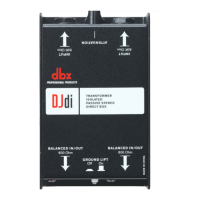
The dbx DJdi DIRECT BOX is a 2-channel passive direct injection box designed as a versatile tool for various audio applications, including live sound and recording. This device efficiently converts unbalanced signals into balanced outputs, making them suitable for connection with mixers, PAs, recording consoles, and other professional audio equipment. Its passive design ensures clean, quiet, and uncolored operation without requiring external power, which simplifies setup and reduces potential noise.
One of the primary functions of a direct box like the DJdi is to convert an audio signal from an unbalanced source, such as a guitar, into a balanced audio signal. This conversion is crucial for transmitting signals over longer distances without significant degradation, a common issue with unbalanced signals. In professional audio, balanced signals are preferred because the receiving end, typically a mic pre-amp input on a mixing console, employs a "differential amplifier." This amplifier is designed to "accept" the audio portion of the input signal while "rejecting" the noise portion. Noise, often referred to as "common-mode noise," is induced onto both the positive (+) and negative (-) conductors of a balanced cable in a roughly similar fashion due to external electromagnetic fields. Since the conductors are typically in a "twisted pair" configuration, they experience the same noise field. The ability of a balanced input to reject this common-mode noise is measured by its "common-mode rejection ratio" (CMRR), ensuring a cleaner signal transmission.
Beyond signal balancing, the DJdi also addresses impedance conversion. It transforms a high-impedance output from an instrument, such as an electric guitar with passive pickups, into a low-impedance output. High-impedance cables are more susceptible to signal loss and noise pickup over longer runs compared to low-impedance cables. By converting to a low-impedance output, the DJdi further enhances the ability to run longer cables without compromising signal integrity, providing a more robust and reliable connection.
A key component at the heart of the DJdi is its isolation transformer. This transformer enables complete "galvanic" isolation between the equipment connected to either end of the direct box. This isolation is particularly effective in eliminating hum and buzz that often plague audio systems due to ground loops. Ground loops occur when there are multiple ground paths in an audio system, leading to unwanted noise. By breaking these loops, the DJdi helps maintain a pristine audio signal. The ground lift switch on the rear panel allows users to disconnect the internal connection to the output pin 1, further isolating the DJdi's grounding system from the rest of the system and effectively resolving many hum or buzz problems.
The DJdi features dual channels, each equipped with a 1/4" 50k Ohm TS input. These inputs are designed to accommodate a wide range of unbalanced signal sources. Each channel also includes a continuously variable input attenuator, which allows users to reduce high signal levels if necessary. This flexibility ensures that the DJdi can handle various input sources without clipping or distortion. The outputs consist of two XLR transformer-isolated 600 Ohm connectors, providing balanced signals suitable for professional use.
In terms of usage, the DJdi is highly versatile. For live sound applications, it is invaluable for directly inserting instruments into a PA system. For instance, bass guitars, which produce low frequencies that are difficult to mic effectively, greatly benefit from a DI box. By connecting a bass guitar's output to the DJdi's input and then the DJdi's XLR output to the PA mixer, a clean, direct signal can be sent to the front-of-house engineer. This setup allows the engineer to adjust the signal without affecting the musician's stage sound. Similarly, acoustic guitars with pickups or those using guitar signal processors can be directly connected to the PA system via the DJdi, ensuring a clear and consistent sound. When making connections, it is recommended to mute or turn down the volume/gain on the mixer first. After connecting the instrument to the DJdi's 1/4" input and the DJdi's XLR output to the PA mixer, the mixer's volume/gain can be adjusted to the desired level.
The DJdi is also highly effective in studio environments or on stage for converting the output of unbalanced devices like keyboards, DJ equipment, sub-mixers, and effects processors. Many keyboards, for example, have low output signal levels. By connecting their unbalanced outputs to the DJdi, the signal can be transmitted cleanly over long distances, benefiting from the low-noise common-mode rejection provided by the DJdi's balanced low-level output. This ensures that the signal arriving at the main PA or recording mixer is robust and free from interference.
Maintenance of the DJdi is minimal due to its passive design. There are no active components that require power or regular servicing. The robust construction is designed to withstand the rigors of live performance and studio use. For any technical support or service needs, users are advised to contact dbx Technical Support. It is important to have the serial number of the device ready, which is printed on a sticker attached to the chassis. Before returning a product for service, users should refer to the manual to ensure correct installation and operating procedures have been followed. A Return Authorization Number must be obtained from dbx Technical Support before sending any product back to the factory. If the product is under warranty, dbx will cover return shipping. For out-of-warranty service, a reasonable charge will be applied for parts, labor, and packing, with the user responsible for transportation charges to the factory. Using the original packing material and insuring the package properly is recommended for safe transit.
In summary, the dbx DJdi DIRECT BOX is a robust, dual-channel passive direct injection box that offers essential signal conversion, impedance matching, and ground isolation capabilities. Its user-friendly design, combined with its ability to deliver clean and reliable audio signals, makes it an indispensable tool for audio professionals seeking to optimize their sound systems in both live and studio settings.
 General
| USB | No |
|---|---|
| Phono Preamp | No |
| Output Connectors | Dual RCA unbalanced |
| Maximum Input Level | +21 dBu |
| Frequency Response | 20 Hz - 20 kHz |
| Type | Direct Box |
| Inputs | 2 |
| Outputs | 2 |
| Maximum Output Level | +21 dBu |

 To Next Page