Vol. II-1-10 Harris Stratex Networks
Chapter 1. System Overview
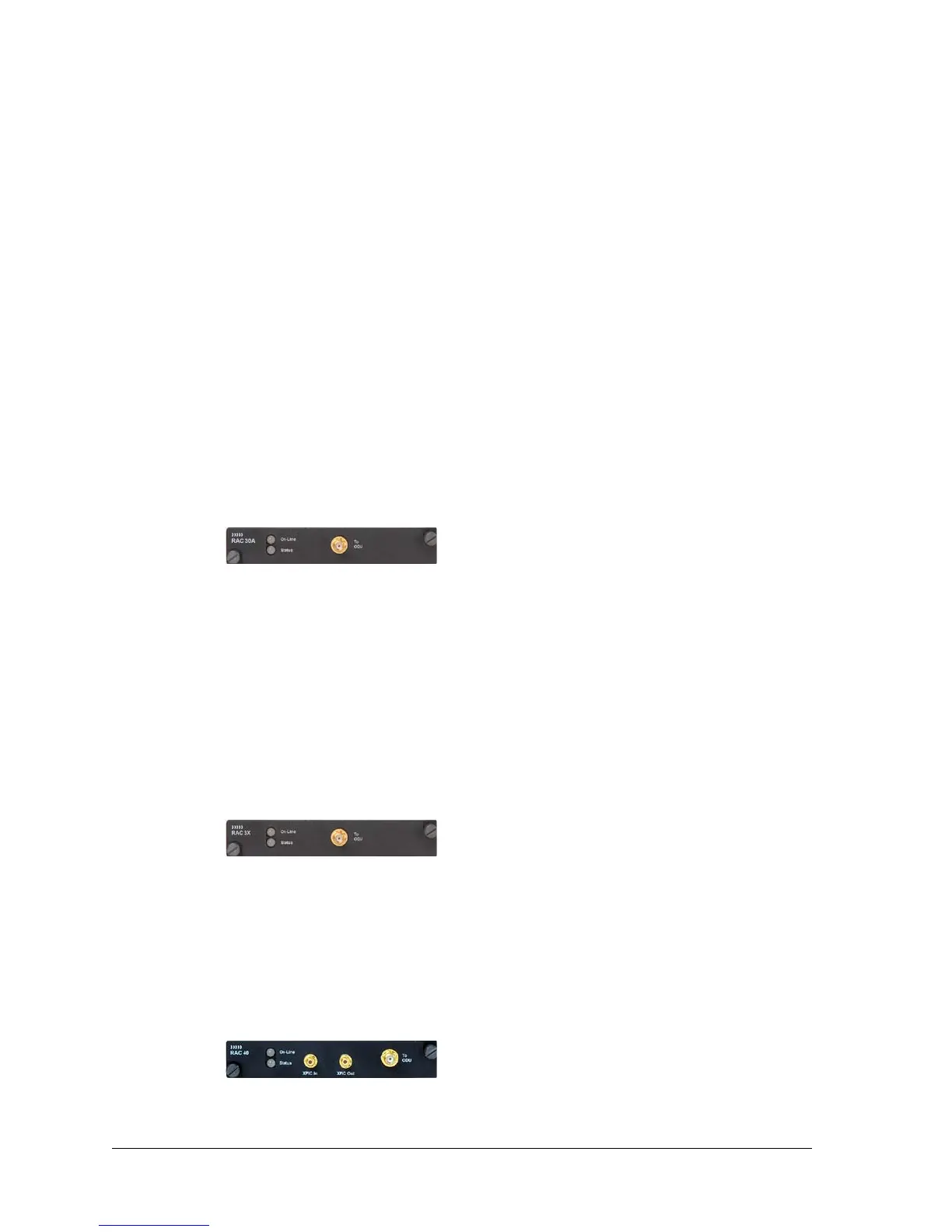
RAC 30A
RAC 30A supports adaptive and non-adaptive modulation options.
For adaptive modulation it uses one of three automatically and dynamically switched
modulations - QPSK, 16 QAM or 64 QAM so that for a given RF channel bandwidth of
7, 14 or 28 MHz, a twofold improvement in data throughput is provided for a change
from QPSK to 16 QAM, and a threefold improvement to 64 QAM. Modulation switching
is hitless for priority traffic.
Adaptive modulation capacity options extend over:
•10 to 130 Mbps Ethernet
• 5x to 63xE1
• 8x to 84xDS1
For non-adaptive modulation operation, its capacity options are the same as RAC 30v3.
RAC 30A interfaces to an ODU 300hp/ep/sp for ETSI channel bandwidths to 28 MHz,
or with ODU 300hp/ep for ANSI channel bandwidths to 30 MHz.
RAC 30A is compatible with RAC 30v3 or RAC 30v2 for non-adaptive operation.
Figure 1-14. RAC 30A
RAC 3X
RAC 3X interfaces to an ODU 300hp or ep for channel bandwidths from 28 to 56 MHz
(ETSI), or 30 to 50 MHz (ANSI), for capacity options of:
•50 to 300 Mbps Ethernet
•64/75/93/106xE1
• 32/70/84/100xDS1
•4xDS3
• 1/2xSTM1/OC3
Figure 1-15. RAC 3X
RAC 40
RAC 40 interfaces to an ODU 300hp or ep to support co-channel XPIC operation for:
• Two 100, 130, or 150 Mbps Ethernet links on one 28 MHz or 30 MHz channel.
• Two STM1, 75xE1, 64xE1 or 52xE1 links on one 28 MHz channel.
• Two OC3, 100xDS1, 84xDS1 or 70xDS1 links on one 30 MHz channel.
Figure 1-16. RAC 40



 To Next Page