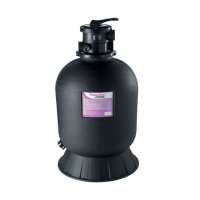
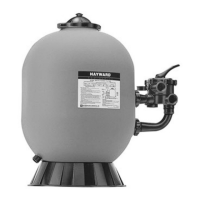
The Hayward ProSeries™ High Rate Sand Filter is a high-performance, corrosion-proof filtration system designed to provide clear, sparkling pool water with minimal maintenance. This filter utilizes special filter sand as its permanent dirt-removing medium.
Function Description
The core function of the ProSeries filter is to remove suspended dirt particles from pool water. Pool water, containing these particles, is pumped through the piping system and automatically directed by a patented filter control valve to the top of the filter tank. As the water flows through the sand bed, dirt particles are trapped, and the filtered water is returned from the bottom of the tank, through the control valve, and back to the pool. This continuous and automatic process ensures total recirculation of pool water through the filter and piping system.
Over time, accumulated dirt in the filter creates resistance to flow, diminishing the flow rate. This indicates it's time to clean (backwash) the filter. During backwashing, the control valve reverses the water flow, directing it to the bottom of the tank, up through the sand, flushing trapped dirt and debris out through the waste line. After backwashing, the control valve is manually sequenced to "Rinse" and then "Filter" to resume normal operation.
Usage Features
The filter is designed for ease of operation with a Vari-Flo® filter control valve (or a Slide Control Valve for some models) that allows for multiple functions:
- FILTER: This is the standard setting for normal filtering and regular vacuuming.
- BACKWASH: Used for cleaning the filter. When the pressure gauge reading rises 6-8 PSI (0.41-0.55 BAR) above the initial "clean" pressure, the pump should be stopped, the valve set to BACKWASH, and the pump restarted. Backwashing typically takes about 2 minutes or until the water in the sight glass is clear.
- RINSE: After backwashing, this setting is used to ensure all dirty water is rinsed out to waste, preventing it from returning to the pool. The pump is operated for about 1/2 to 1 minute, then stopped, and the valve is set back to FILTER.
- WASTE: This setting bypasses the filter, allowing for draining the pool, lowering the water level, or vacuuming heavy debris directly to waste.
- RECIRCULATE: This function circulates water through the pool system without passing it through the filter.
- CLOSED: This position shuts off the flow from the pump to the filter.
- VACUUMING: Vacuuming can be performed directly into the filter. For heavy debris loads, the valve can be set to WASTE to bypass the filter.
For initial start-up, the filter sand media is loaded through the top opening of the filter tank. It's recommended to fill the tank halfway with water before adding sand to cushion the underdrain laterals. A sand shield is provided to prevent sand from entering the internal diffuser elbow pipe. Once the sand is loaded and leveled, the sand shield is removed, and the top closure dome is secured with a clamp.
The filter system should be installed on a level surface, not more than 6 feet above the pool water level, ensuring convenient access to piping connections, the control valve, and the winter drain. It's crucial to always shut off the pump before switching filter control valve positions to prevent unnecessary strain on the piping system and valves.
Maintenance Features
The ProSeries filter is designed for continuous operation, though the actual schedule can be adjusted based on pool size and usage to achieve at least one complete turnover of pool water daily.
Regular maintenance includes:
- Backwashing: Performed when the pressure gauge indicates a rise of 6-8 PSI (0.41-0.55 BAR) above the clean pressure.
- Cleaning Pump Strainer and Skimmer Baskets: This should be done regularly to prevent damage to the pump and filter and ensure proper system operation.
- Checking for Restrictions: Periodically inspect intake and discharge lines for any blockages.
- Checking for Air Leaks: Look for bubbles returning to the pool, which could indicate an air leak in the intake line.
- Monitoring Pool Chemistry: Maintaining a free chlorine level of 1 to 3 ppm and a pH range of 7.2 to 7.6 is essential for effective sanitation and to prevent algae and bacteria growth, which can hinder the filter's ability to clean the water. If algae is present, superchlorination may be required.
- Inspecting Filter Sand: Check the surface of the filter sand for crusting or caking. If necessary, remove about 1 inch of sand.
- Winterization: For winterization, the tank should be completely drained by unscrewing the drain cap. The Vari-Flo control valve handle should be depressed and rotated to a position between any two settings to allow water to drain from the valve. The pump should also be drained and winterized according to its instructions.
The filter is designed for durability, with components warranted to be free from defects in materials and workmanship. Regular inspection of suction outlet components is crucial, as damaged, broken, cracked, missing, or unsecured parts can pose a significant entrapment hazard. These components have a finite life and should be replaced at least every ten years or immediately if found to be damaged.


 To Next Page
 General