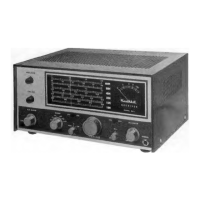
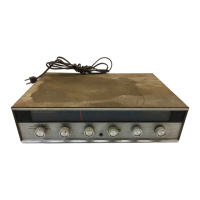
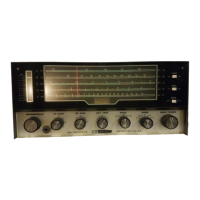
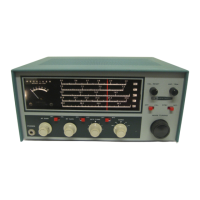
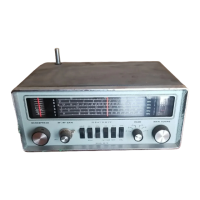
wampus”. Some of the soldering was a bit
messy, but no cold solder joints stood out. The
radio “let out no smoke” when I first turned it
on, and it worked on the AM broadcast band. A
quick check with a signal generator showed
all the bands were receiving, though an
alignment is needed. Figure 7 and Figure 8
show internal views of the radio.
The tuning knob physically sticking out far-
ther than it should was caused by the shaft
bushing being installed backwards; that I
fixed but then the main tuning dial required
restringing; that’s one of the tasks I really try
to avoid.
There are a few common problems with this
receiver that users have experienced. Sug-
gested fixes are available on the web
5
. One
problem is the tendency for the bandspread
tuning to slip when being turned clockwise.
This radio experiences that problem and the
fix was tried when the front panel was re-
moved to correct the main tuning shaft bush-
ing. It seemed to work for awhile but is slip-
ping again. The whole bandspread dial sys-
tem is another sign the radio was compro-
mised by cost-cutting. Instead of using pul-
leys, as the main tuning does, the dial string
is strung around three fixed posts, and
enough friction is created to cause the vernier
drive of the bandspread capacitor to slip. The
published solution is to stretch the dial spring
slightly to reduce the tension and thus the
friction. Obviously it wasn’t stretched enough
on the first try. Another problem is oscillation
on the high end of band D, This radio is not
experiencing that problem. A simple capacitor
change is supposed to solve it. The third prob-
lem is distorted audio. I find the audio a bit
muffled so I will try that modification.
Some users have complained of hum from the
speaker, even with the volume control at min-
imum
6
. The fix is to add an additional RC fil-
ter network to the power supply. I have to lis-
ten hard to hear any hum and this SW-717
doesn’t seem to have a hum problem.
Summary:
For casual SW listening the SW-717 makes a
nice beginner’s receiver. Unfortunately, there
is less and less English broadcasting to listen
to on the shortwave bands.
The SW-717 would not make an acceptable
receiver for ham radio; it lacks features that
one would need, even if they were operating
as a novice back in the sixties. Still it is a kit
with which a beginning kit builder could ac-
quire confidence and enjoy playing with. A
ham could use it as a simple SWL receiver.
Also, a receiver like this is great on the test
bench to check that oscillators are working.
73, from AF6C
NOTES:
1. For instance the GR-54 has a 1682 kHz I-F so it is de-
signed NOT to receive frequencies between 1550 and
2000 kHz
2. It may have been introduced in a later 1971 catalog that
is not in my catalog collection.
3. The GRA-72 came with 75’ of antenna wire, 30’ of lead-in
and all insulators and hardware.
4. A copy of the SW-717 schematic is available on the
W6ZE website at:!
http://www.w6ze.org/Heathkit/Sch/SW717Sch.jpg
5. For modification info see Bill Wilkinson’s webpage at: !
http://ww_heco.home.mindspring.com/heco_fix.html!
and scroll down to SW-717 near bottom.
6. For hum solution see:!
https://people.ohio.edu/postr/bapix/SW-717.htm


 To Previous Page
 Loading...