Getting Started
1. Caution – Safety Comes First
There is no substitute for safety. Always exercise ex-
treme caution, care and good judgments when working
on or around a roof or pool area.
• Please take care to avoid hazards such as over-
head electrical wires or loose shingles or roof
tiles.
• Be sure to secure ladders so they will not slip
or fall.
• Do not allow extension cords to lie in the pool
or in standing water.
• Wear shoes with proper tread to prevent slip-
ping on the ladder or sloped roof areas.
• Disconnect all power to the pool equipment
when installing an automatic control system.
2. Always consult with the proper authorities or check
with your local building department for the permit re-
quirements and codes applicable before you start your
job. Some installers prefer to use white pipe and ttings
on the roof, then paint the pipe and ttings a color that
closely matches the roof. The paint should be outdoor
rated and UV resistant. Painted pipes and ttings will
require additional maintenance. Most building depart-
ments require permits for installing solar pool heaters, a
practice strongly supported by Heliocol.
3. Before starting any work, determine the location of
your system and prepare a schematic drawing of the
installation area. Include the location of the feed and
return lines in this drawing. Roof areas often times look
bigger than they really are, so be sure to measure the
available area before making your schematic. Be sure
the planned placement of the collectors will allow the
collectors to drain when the pool pump shuts off.
4. To ensure a trouble-free system, don’t take short-
cuts. Whenever possible, collectors should be installed
so that they are accessible without being walked on.
Walking on the collectors should only take place when
absolutely necessary.(Never walk on collectors when
they are wet as they present a signicant slip hazard)
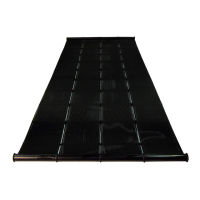
5. Familiarize yourself with all of the Heliocol com-
ponents and plumbing materials that you will need
to complete the installation. Here is a list of materials
most commonly used:
Pipe
Use pressure rated Schedule 40 PVC pipe. You may
prefer to use black, as opposed to white, PVC pipe on
the roof for aesthetic reasons. But because black PVC
can be difficult to nd, some installers have inquired
about the use of black ABS pipe instead. DO NOT USE
ABS PIPE. ABS pipe does not have the UV inhibitors
that PVC pipe has, causing ABS pipe to become brittle
and to crack after several years of exposure.
Pipe Fittings
Use PVC Schedule 40 pressure-rated ttings to match
your PVC pipe. Be sure NOT TO USE “plumbers” t-
tings or DWV ttings (drain, waste and vent). Because
black PVC ttings are difficult to nd, some installers
use spray paint to paint them black. Should you do so,
it is necessary to use a high-quality paint, preferably
with UV inhibitors. Do not use inexpensive “discount
store” brands as these will fade and peel very quickly.
PVC Cleaner and Cement
It is important to both CLEAN and CEMENT each PVC
joint. Use a quality, brand-name product and refer to
the product’s label for specic directions for use. Before
applying cement, be sure to clean each tting and pipe
end with the PVC Cleaner or “primer.” Soon after clean-
ing each part, apply ample cement rst to the tting
and then to the pipe end. Insert the pipe end into the
tting with a slight twisting motion until it seats to evenly
distribute the glue. Hold it in this position for 5 to 10
seconds to allow the joint to set up. Finally, wipe excess
cement off of the joint and pipe. When gluing CPVC
ttings to PVC pipe, such as the Heliocol 117 Pipe
Connector, it is necessary to use a good quality CPVC
all-purpose cement.
Note: Cold weather slows the set-up process for PVC
glue. If installing in colder climates, refer to the PVC
glue manufacturer’s charts for curing times.
Miscellaneous
Depending upon your specic job, you will need other
Before you begin your installation, here are a few important tips:
3


 To Next Page