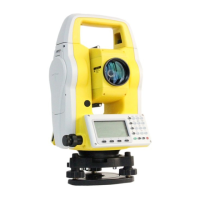
HTS-420R Maintenance Manual
14
3) Adjust the tangent screws to make both crosshairs coincide again and then press【Ok】. When the screen
display the massage ‘’F1 down 3’”, adjust the leveling screw to tilt the instrument down by 6’ from the
target horizontal line (the compensator axis is actually tilted down 3’ from the horizontal plane).
4) Adjust the tangent screw to make both crosshairs coincide again then press 【Ok】. The screen will
display message’’F2 up 3’”.
5) Adjust the leveling screw to Tilt the instrument up 3’ (9 grids by 1 grid=20”) to level the instrument again
and then turn it to Face 2. Do the same thing as done on Face 1. Finally, check if the value of Cok and Coz is
respectively within the qualified range of -1< Cok <1 and -30<Coz<30.
6) When both values are qualified, note the electronic bubble offset X(Face 1) and turn 180° to get X(Face 2)
then calculate X(Face 1)+X(Face 2). If the result of X (Face 1) + X (Face 2) is within -30 to 30, the calibration
is successful, otherwise repeat the calibration.
Y compensator:
Do the same thing as done on X compensator, but every time before pressing 【Ok】, turn the instrument
anticlockwise by 90°.
8. Laser plummet alignment
1) Remove the plummet cover at the bottom of the pedestal. Set up the tripod and mount the instrument
on, and then level it. Turn on the laser and place a paper reticle where the laser spot is. Rotate the
instrument and check if the laser spot is drawing circle. If it is, continue the following steps to align the
plummet.
2) Place the cross point of the reticle to the center of the laser spot track. Slightly loosen the plummet
screw of the laser spot side and tighten the one on the opposite side to push the laser spot as close to the
center as possible. Check the offset of the laser spot again, then tighten or loosen the third screw to center
the laser spot.
3) Repeat adjusting paper retical and screws until the laser spot is cast right on the center of the cross.
Tilting process of X compensator



 To Next Page
 Loading...