Need help?
Do you have a question about the Hoffman ELG-4 and is the answer not in the manual?
Emphasizes reading and understanding manual instructions for safe operation and maintenance.
Explains the use of NOTES, CAUTIONS, and WARNINGS for critical instructions.
Lists built-in safety features like relief valves, pressure gauges, and low water cutoff.
Provides general safety precautions applicable during all phases of operation.
A table listing common problems, their possible causes, and corrective actions.
Guidance on how to adjust the steam pressure using thermostat controls.
Detailed steps for adjusting the thermostat to set steam pressure.
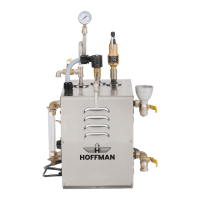
The Hoffman Electric Steam Generators, specifically the JEL/ELG Series 2-Gallon models, are designed for small steam usage requirements, offering a robust and efficient solution for various applications. These generators are engineered with a strong emphasis on quality, performance, operator safety, and energy efficiency, promising a long operational life with proper care.
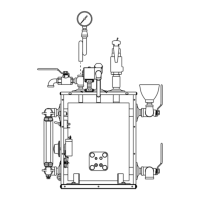
At its core, the Hoffman Electric Steam Generator produces high-pressure steam, making it suitable for tasks requiring powerful and consistent steam output. The device is composed of several key components: a pressure vessel, a safety valve, associated piping, a heating element, and a comprehensive control system, all housed within a protective enclosure.
The pressure vessel, constructed from high-strength steel or cast bronze, is rated for up to 100 pounds per square inch (psi) of steam pressure. Its design, along with the safety valve and piping, adheres to or exceeds the stringent standards set by the American Society of Mechanical Engineers Boiler and Pressure Vessel Code, ensuring safe operation. Many assemblies within the JEL/ELG series are also UL and/or CUL listed, further attesting to their safety and quality.
The heating element is a flange-mounted immersion type, recognized for its energy efficiency. By directly contacting the water, it effectively transfers all necessary energy to convert water into steam. This direct contact minimizes energy loss, contributing to the generator's overall efficiency.
Steam pressure regulation is achieved through a control system. Some models utilize a thermostat controller, which senses the temperature and adjusts the current supplied to the heating element to maintain the desired steam output. For larger generators within the series, pressure switch controllers are employed for regulation. The relationship between steam pressure and temperature is direct: higher pressure corresponds to higher temperature.
The JEL/ELG Series generators are versatile and find application in various settings. They are commonly used for jewelry steam cleaning, dental lab steam cleaning, and auto trim work. Additionally, they are effective for furrier glazing of garments and can be integrated with steam irons. While capable of producing high-pressure steam, it is crucial to note that these units are not intended for applications requiring low-pressure steam unless specific provisions are made to limit the steam pressure, such as in autoclaves or steam bath applications. The machines are also not designed for space heating purposes.
Operating the Hoffman Electric Steam Generator involves a straightforward process, beginning with initial setup and filling. Users must first ensure the gauge glass valves are open and the drain valve is closed. Filling the boiler varies slightly depending on the model. For manual water feed models, the water fill valve is opened, and the boiler is filled until the water reaches the "Full" mark, which is approximately three-and-a-half times the height of the sight glass. It is recommended to open the steam outlet valve during filling to allow air to escape, preventing air-bound systems. Distilled water is recommended for optimal performance, and overfilling should be avoided to prevent wet steam or the discharge of dirt particles. For automatic water feed models with a Watts Water Feeder, connecting the water line and turning on the supply will allow the feeder to fill the boiler, provided the water supply pressure is higher than the generator's operating pressure. Models with a pump-based automatic water feed system will fill the boiler once the power is turned on.
Once filled, the ON/OFF switch is turned to the "ON" position. For thermostat-controlled units, the black dial should be set to "10" to allow the generator to reach maximum pressure. Lower settings enable operation at reduced pressures. Pressure switch-controlled units are factory set and typically do not require adjustment. Models equipped with a low water cutoff with manual reset require the user to push the reset switch after the boiler is filled and powered on. This action energizes the heating element, turning off the low water light and illuminating the heating light. The boiler then builds pressure, and the heating light will turn off once the desired pressure is reached.
The steam pressure can be adjusted on thermostat-controlled units. After powering the boiler and setting the thermostat to "10," the boiler is allowed to reach pressure. The dial is then removed from the thermostat, and a small screwdriver is used to turn an internal screw. Turning it clockwise reduces pressure, while counter-clockwise increases it. Adjustments should be made in half-turn (90-degree) increments, allowing time for the unit to heat or cool until the heating light goes out, indicating the final high pressure. A dab of nail polish can be used to secure the screw, and the dial is then replaced. The maximum pressure setting is 90 psig; attempting to exceed this will cause the relief valve to vent.
Maintaining the Hoffman Electric Steam Generator is crucial for its longevity and trouble-free operation. The manual outlines several key maintenance procedures, including cleaning the boiler, sight glass, and strainer, as well as blowing down the boiler.
Cleaning the Boiler: This procedure should be performed regularly. First, the thermostat is turned to "OFF," and the boiler is allowed to cool, confirmed by opening the steam valve. The boiler is then drained, and the drain valve is closed. A cleaning solution, typically three parts water to one part vinegar, is used to fill the boiler to the "Full" mark or halfway up the sight glass. The boiler is brought up to pressure and allowed to heat for 30-60 minutes. Afterward, the boiler is blown down as per the specific instructions. This process should be repeated if necessary.
Cleaning the Sight Glass: To clean the sight glass, the thermostat is turned "OFF," and the boiler is allowed to cool. The boiler is drained, leaving the drain valve open. If equipped, the petcock at the bottom of the sight glass is opened. The sight glass is then removed and cleaned with a plastic bristle brush; metal wire brushes are not recommended as they can scratch the glass. After cleaning, the sight glass is reinstalled.
Blowing Down the Boiler: This procedure is vital for removing mineral buildup and should be performed at startup and at least once a week if the water is clean. In areas with high mineral content or rusty water, daily blow-down is recommended. The boiler should also be flushed with a cleaning solution at least twice a year. To blow down, the pressure is allowed to reach 2 to 3 psig, and then the power is turned off. A critical safety warning emphasizes that the water in the steam generator is very hot, and the drain valve must be piped to a drain to prevent burns. The drain valve is then opened to drain the boiler, and subsequently closed.
Cleaning the Strainer: This involves turning off the power and allowing the boiler to cool. The boiler is drained with the valve open. The strainer cap is removed, the screen is cleaned, and the cap is replaced.
Troubleshooting and Servicing: The manual provides a comprehensive troubleshooting table to address common issues such as the unit not heating up, shutting off at lower than normal pressure, safety valve leaking, or fill valve leaking steam. It also details procedures for replacing various components, including the thermostat, gauge sight glass, heating element, low water switch, electric foot switch and/or cord, ON/OFF switch, and electric solenoid valve. These replacement procedures often require the expertise of a licensed electrician or plumber, highlighting the importance of professional service for complex repairs. For instance, replacing the heating element involves disconnecting power, draining the boiler, removing the front cover, disconnecting wires, removing bolts, and then installing the new element with a new gasket and gasket sealer. For models with thermostatic control, it is crucial to install the new element with the thermowell tubes in the top position. After replacement, the boiler is refilled, powered on, and checked for leaks.
The Hoffman Electric Steam Generators are designed for ease of maintenance, but adherence to the outlined procedures and safety warnings is paramount to ensure safe and efficient operation. Always use approved Hoffman replacement parts when servicing the machine.


 To Next Page

 General