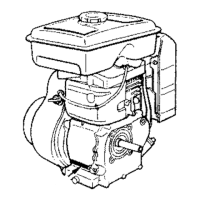
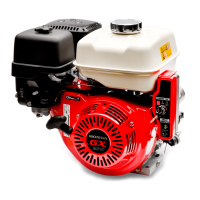
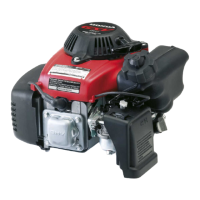
This document serves as an owner's manual for the Honda G150/G200 General Purpose Engine, providing essential information for safe operation, pre-operation checks, starting, stopping, and maintenance. It is designed to guide users through the proper use and care of their Honda engine, ensuring longevity and reliable performance.
Function Description
The Honda G150/G200 is a general-purpose engine, designed to power a wide range of equipment. As a versatile power unit, it is suitable for various applications, from powering lawn and garden machinery to construction equipment and generators. The engine operates on a 4-cycle principle with a side valve arrangement, indicating a design focused on reliability and ease of maintenance. Its primary function is to convert fuel into mechanical energy, providing the necessary power output for the attached equipment. The manual emphasizes the importance of proper handling and maintenance to ensure the engine performs optimally and safely in its intended applications.
Usage Features
The manual outlines several key usage features and safety precautions to ensure the engine is operated correctly and safely.
Safety Precautions:
- Proximity to Objects: Always keep the engine at least 3 ft. (1 meter) away from buildings or other equipment during operation to prevent overheating and fire hazards.
- Flammable Materials: Do not place flammable objects such as gasoline, matches, or other combustibles near the engine while it is running.
- Gasoline Handling: Gasoline is highly flammable and explosive.
- Always stop the engine and avoid smoking or open flames/sparks when refueling.
- Do not overfill the fuel tank; leave space in the filler neck.
- Wipe up any spilled fuel completely before starting the engine.
- Ensure the filler cap is securely closed after refueling.
- Operating Surface: Operate the engine only on a level surface. This prevents fuel spillage from the tank and ensures adequate engine lubrication.
- Spark Arrestor: This engine is not equipped with a spark arrestor. Operating it on forest, brush, or grass-covered land may be illegal in some states. Users are advised to check local laws and regulations before operation in such environments.
- Exhaust Gas: Engine exhaust contains poisonous carbon monoxide gas. Avoid inhaling exhaust gases and never run the engine in a closed garage or confined area to prevent carbon monoxide poisoning.
Starting the Engine:
- Fuel Cock: Turn the fuel cock to the "ON" position.
- Engine Switch: Turn the engine switch to "ON."
- Throttle Lever: Raise the throttle lever slightly.
- Choke Lever: Move the throttle lever down fully, then close the choke lever.
- Recoil Starter: Pull the starter grip briskly and return it slowly.
- Warm-up: As the engine warms up, gradually open the choke lever.
- Throttle Speed: Set the desired engine speed by tightening the thumb screw on the throttle.
Stopping the Engine:
- Throttle Lever: Move the throttle lever down fully.
- Engine Switch: Turn the engine switch to "OFF."
- Fuel Cock: Turn the fuel cock to "OFF."
Maintenance Features
The manual provides a comprehensive maintenance schedule to ensure the engine remains in optimal condition, categorized by operating hours.
First 20 Hours Operating:
- Change Engine Oil: Replace the engine oil.
- Change Reduction Gear Oil: Replace the reduction gear oil.
- After hand tightening the oil filler cap, tighten it with a lever.
Every 50 Hours Operating:
- Clean Air Cleaner Element:
- Clean more frequently if operating in dusty areas.
- Wash part "A" (element) in cleaning solvent, dry it, soak in oil, and squeeze out the excess.
- Wash parts "B" and "C" in cleaning solvent, dry them, and refill with clean engine oil up to the oil level mark.
Every 100 Hours Operating:
- Change Engine Oil: Replace the engine oil.
- Clean Fuel Strainer:
- Wash removed parts in solvent, dry them thoroughly, and install securely.
- Clean Spark Plug and Check Gap:
- The standard gap should be 0.6–0.7 mm (.024–.027 in.) for non-CDI types and 0.9–1.0 mm (.035–.040 in.) for CDI types.
- Use NGK B-4H or BR-4HS for non-CDI types, and NGK BP-4HS or BPR-4HS for CDI types.
- Adjust Ignition Timing:
- Adjust contact breaker points to open when the "F" mark on the flywheel aligns with the mark on the crankcase.
- Ignition timing: 20° BTDC. (CDI Type cannot be adjusted.)
- Adjust Tappet Clearance:
- Measure at TDC on the compression stroke when the engine is cold.
- Standard clearance: 0.04–0.12mm (.0016–.0047in.).
- If clearance is less than the standard limit, grind the valve stem or replace the valve.
- Adjust Carburetor Screws:
- Start the engine and adjust the idling speed by turning the throttle stop screw.
- Rated idling speed: 1,400 rpm.
Pre-Operation Check:
- Fuel Tank: Fill the fuel tank with low or non-lead gasoline.
- Air Cleaner: Check the air cleaner for dirt or obstruction of the element.
- Oil Level: Check the engine oil level and condition.
- Reduction Gear Oil Level: Check the reduction gear oil level.
- Sump: Fill the sump with SAE 10-30 or 10W-40 engine oil.
Before Extended Storing:
- Pull the recoil starter rope until it is hard to turn, then align mark "A" with mark "B."
- Drain gasoline from the fuel tank and carburetor.
- Change engine oil and reduction gear oil.
- Cover the engine with a plastic sheet.
- Store the engine in a dry, dust-free area.
Check Fuel Tube:
- Check the fuel tube for cracks or leaks every 300 hours. Replace if necessary.
This detailed manual ensures that users can effectively operate and maintain their Honda G150/G200 General Purpose Engine, promoting safe use and extending the life of the product.

 Need help?
 General

 To Next Page