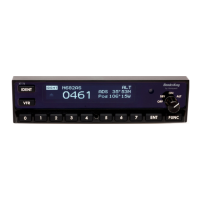
B ATCRBS TRANSPONDER KT 76C
Rev 3, May 2004 IM 006-10545-0003.dwd Page 1-2
1.3 TECHNICAL CHARACTERISTICS
1.3.1 KT 76C PHYSICAL CHARACTERISTICS
Table 1-1 KT 76C Technical Characteristics
TSO Compliance: C74c Class 1A
Environmental - See TSO Appendix
Software - Criticality Level “D”
Physical Dimensions: See Figure 2-3, Dwg No. 155-06039-0000.
Weight: See Figure 2-3, Dwg No. 155-06039-0000.
Applicable Documents: TSO-C74c (Technical Standard Order ATC
Transponder Equipment)
RTCA DO-160C (Environmental Conditions and Test
Procedures)
RTCA DO-178B (Software Considerations in Airborne
Systems)
Mounting: Panel Mounted
Temperature: -20 °C to +55 °C
Altitude: 35,000 feet
Cooling: No forced air cooling required, but recommended.
Vibration: Constant total excursion of 0.2 in. from 5 to 17 Hz
From 17 to 38 Hz - 3.0 g-pk
From 38 to 500 Hz - 1.5 g-pk
From 500 to 2000 Hz - 1.0 g-pk
Shock: Rigid mounting 6 G operational 15 G crash safety.
Power Input: Watts maximum
0.7 Amperes @ 27.50 Vdc
1.6 Amperes @ 13.75 Vdc
Standby current:
0.400 A @ 28 Vdc
0.758 A @ 14 Vdc
Lighting current:
55 +/- 17 mA @ 28 Vdc
110 +/- 34 mA @ 14 Vdc
Receiver Characteristics:
Sensitivity Variation with Frequency: The RF input level required to produce 90% replies will
not vary by more than 1 dB between modes and will at
no time exceed a level of -69 dBm for standard
ATCRBS interrogations in the frequency range
between 1029.8 and 1030.2 MHz.
Bandwidth: A standard ATCRBS interrogation signal below 1005
MHz and above 1055 MHz will be at least 60 dB
stronger than that required to produce the same reply
efficiency at 1030 MHz.


 To Next Page