2 Rev. 2.4 (3/05)
Honeywell Analytics CM4 Protocol Manual
Glossary
The following terms are used in this manual:
Byte: A byte is a collection of 8 bits (or pieces) of information used in the
communication process. A byte refers to these 8 bits as a single entity.
Each bit has a value of either 0 or 1.
Communication: The act or process of passing digital information
between two points.
Data: Information that is transferred between the equipment and the CM4
monitor. Data refers to the information contained within a packet (see
Packet). This information may be gas concentration, date, or other
information.
Equipment: This term is used to refer to the master device which is used
to communicate with the CM4 monitor(s). The equipment can be a
personal computer (PC) or other device capable of performing the digital
communications described in this protocol.
Handshake: The process of acknowledging a communication has been
received. The CM4 monitor uses ACK/NAK responses.
Hexadecimal: A type of numbering system with a base of 16. In this
numerical system, numbers 10 through 15 are represented by the letters
A through F respectively. The shortened version of the word hexadecimal
is generally "Hex," as in "Hex 42." "0x" is the notation used in this manual
for hexadecimal (e.g. 0x42).
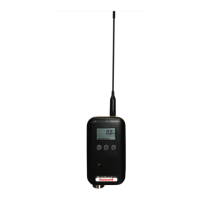
Instrument: This term is used to refer to the CM4 four-point continuous
monitor.
Master: Another computer which communicates with slaves using the
CM4 protocol.
Packet: A block of information that is passed between the instrument and
the equipment. A packet is made from many bytes of information.
Protocol: The manner in which data is transferred and the format used
for the transfer. CM4 protocol refers to the packets of transferred data the
CM4 instrument recognizes.
Slave: The MDA Scientic CM4 gas monitor. A network may have several
slaves.
Time-Out: The maximum amount of time allowed between the time the
last byte of a packet is sent from the “master” device to the time the
“slave” device responds. The time-out period for this protocol is one
second.








 To Next Page