
 Need help?
Do you have a question about the Honeywell TOUCHDOWN and is the answer not in the manual?
Steps to take before beginning the product assembly, including checking parts.
Instructions for cleaning and maintaining the fan's motor housing and blades.
Lists all included fan components with corresponding numbers for verification.
Crucial safety advice before installation and operation, including power disconnection.
Highlights critical risks like electrical shock, fire, and installation hazards.
Details standard, angled, and closemount installation types for different ceilings.
Notes on downrod length, blade clearance, and angle limits for proper installation.
Instructions for attaching the mounting bracket securely to the outlet box.
Loosening set screws and preparing the downrod for assembly.
Installing the downrod and preparing lead wires for electrical connection.
Installing the downrod ball into the mounting bracket slot for stability.
Securing the canopy to the motor housing and hanging the fan for wiring.
Cautions on grounding and connecting fan wires to supply wires correctly.
Connecting a second wire for separate control of the light kit.
Lifting and rotating the canopy to secure it with mounting bracket screws.
Steps for attaching blades to blade arms and arms to the motor housing.
Connecting light kit wires and securing it to the upper switch housing.
Attaching shades, installing bulbs, and setting up pull chains.
Using the reverse switch for seasonal airflow and energy efficiency.
Lists replacement parts with descriptions and contact info for ordering.
Guides for fixing fan movement, noise, wobbling, and light issues.
Details coverage, exclusions, and how to obtain warranty service.
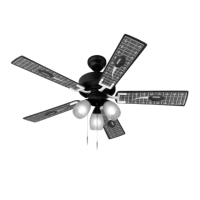
This document describes the Honeywell Touchdown 48" Ceiling Fan, Model #50205. It serves as a comprehensive guide for assembly, installation, operation, and maintenance.
The Honeywell Touchdown 48" Ceiling Fan is designed to provide air circulation and illumination in indoor spaces. It features a reversible motor for seasonal performance optimization, allowing for downward airflow in warmer weather to create a wind chill effect, and upward airflow in cooler weather to help move hot air off the ceiling. The fan can be installed with or without a light kit, offering flexibility based on user preference. It supports three mounting options: standard, angled, and closemount, to accommodate various ceiling heights and angles.



 To Next Page
 General