EasyManua.ls Logo

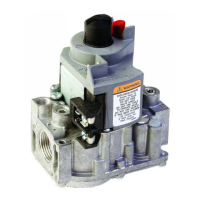
Honeywell VR8300 - User Manual

Honeywell VR8300
10 pages
Print Icon
To Next Page IconTo Next Page
Loading...
1 69-0624—2
J.H. • Rev. 9-94 • ©Honeywell Inc. 1994 • Form Number 69-0624—2
VR8300/VR8301
Continuous Pilot Combination
Gas Control
Application
These continuous pilot gas controls are used in gas-fired
appliances with capacities up to 200 cu ft/hour at 1 in. wc
pressure drop [5.7 cu m/hour at 0.25 kPa] on natural gas.
They include a manual valve, safety shutoff, single auto-
matic operators, and a pressure regulator. See Table 3 for
temperature ranges and regulator types.
BODY PATTERN: Straight-through body pattern.
INLET X OUTLET SIZES AVAILABLE: 1/2 x 1/2 in., 1/2 x
3/4 in., and 3/4 x 3/4 in. (factory-installed inlet flange).
ADAPTERS: Adapters available for 1/2 and 3/4 inch straight
and angle connections. Refer to Table 4.
ELECTRICAL RATINGS:
Voltage and Frequency: 24 Vac, 50/60 Hz.
Current Draw: 0.70A.
CAPACITY: See Table 1.
TABLE 1: CAPACITY OF VR8300/VR8301
Size
(Inlet x Outlet)
Capacity (at 1 in. wc
pressure drop)
a
Minimum
Regulated Capacity
Maximum
Regulated Capacity
1/2 x 1/2 180 cu ft/hr
[5.1 cu m/hr]
30 cu ft/hr
[0.8 cu m/hr]
225 cu ft/hr
[6.4 cu m/hr]
1/2 x 3/4 190 cu ft/hr
[5.4 cu m/hr]
30 cu ft/hr
[0.8 cu m/hr]
290 cu ft/hr
[8.2 cu m/hr]
3/4 x 3/4 200 cu ft/hr
[5.7 cu m/hr]
30 cu ft/hr
[0.8 cu m/hr]
300 cu ft/hr
[8.5 cu m/hr]
a
Capacity based on 1000 Btu/cu ft, 0.64 specific gravity natural gas at 1 in. wc pressure drop [37.3 MJ/cu m, 0.64 specific
gravity natural gas at 0.25 kPa pressure drop.
Model Number Ambient Temperature Range Regulator Type
VR8300A 0° F to 175° F [-18° C to +79° C] Standard-opening
VR8300C 0° F to 175° F [-18° C to +79° C] Step-opening
VR8300H 0° F to 175° F [-18° C to +79° C] Slow-opening
VR8300K -40° F to 175° F [-40° C to +79° C] Slow-opening
VR8300M -40° F to 175° F [-40° C to +79° C] Standard-opening
VR8300P -40° F to 175° F [-40° C to +79° C] Step-opening
VR8301 0° F to 175° F [-18° C to 79° C] Standard-opening
TABLE 3—TEMPERATURE RANGES AND REGULATOR TYPES.
Use conversion factors in Table 2 to convert capacities
for other gasses.
TABLE 2—GAS CAPACITY
CONVERSION FACTORS.
Gas
Specific
Gravity
Multiply Listed
Capacity By
Manufactured 0.60 0.516
Mixed 0.70 0.765
Propane 1.53 1.62
TABLE 4—FLANGE PART NUMBERS.
Part Number
Inlet/Outlet
Pipe Size
Flange
Type
Without
Hex
Wrench
With
Hex
Wrench
1/2 inch NPT Straight 394599-6 393690-16
Elbow 394599-3 393690-13
3/4 inch NPT Straight 394599-4 393690-14
Elbow 394599-5 393690-15
NOTE: Flange kits include one flange with attached O-ring
and fan mounting screw.
Question and Answer IconNeed help?

Do you have a question about the Honeywell VR8300 and is the answer not in the manual?

Summary

Application Overview

Product Description and Specifications

Details product use, body pattern, sizes, electrical ratings, and capacity.

Installation Procedures

Converting Between Natural and LP Gas

Guides conversion between natural and LP gas types using kits.

Installing Adapters and Fittings

Covers flange and bushing installation, including swing radius solutions.

Gas Control Location and Piping

Instructions for choosing location and installing piping.

Gas Control Mounting and Connections

Steps for mounting the control and connecting pilot tubing and thermocouple.

Electrical Wiring Connections

Details on wiring the control for 24V systems.

Start-up and Checkout

Gas Control Knob Settings and Operation

Explains knob settings (OFF, PILOT, ON) and basic operation.

Pilot Burner Flame Lighting and Adjustment

Step-by-step guide to lighting and adjusting the pilot flame.

Main Burner Operation and Gas Input Adjustment

Procedures for lighting the main burner and adjusting gas input.

Safety, Maintenance, and Service

Safety Shutdown Performance Testing

Critical procedure to test safety shutdown functionality.

Maintenance Guidelines

Recommendations for regular preventive maintenance.

Service and Troubleshooting

Guidance for diagnosing and resolving common issues.

Homeowner Instructions

Pilot Burner Flame Lighting

Manual steps for lighting the pilot burner flame.

Appliance Shutdown Procedures

Instructions for turning off the appliance for vacation or complete shutdown.

Summary

Application Overview

Product Description and Specifications

Details product use, body pattern, sizes, electrical ratings, and capacity.

Installation Procedures

Converting Between Natural and LP Gas

Guides conversion between natural and LP gas types using kits.

Installing Adapters and Fittings

Covers flange and bushing installation, including swing radius solutions.

Gas Control Location and Piping

Instructions for choosing location and installing piping.

Gas Control Mounting and Connections

Steps for mounting the control and connecting pilot tubing and thermocouple.

Electrical Wiring Connections

Details on wiring the control for 24V systems.

Start-up and Checkout

Gas Control Knob Settings and Operation

Explains knob settings (OFF, PILOT, ON) and basic operation.

Pilot Burner Flame Lighting and Adjustment

Step-by-step guide to lighting and adjusting the pilot flame.

Main Burner Operation and Gas Input Adjustment

Procedures for lighting the main burner and adjusting gas input.

Safety, Maintenance, and Service

Safety Shutdown Performance Testing

Critical procedure to test safety shutdown functionality.

Maintenance Guidelines

Recommendations for regular preventive maintenance.

Service and Troubleshooting

Guidance for diagnosing and resolving common issues.

Homeowner Instructions

Pilot Burner Flame Lighting

Manual steps for lighting the pilot burner flame.

Appliance Shutdown Procedures

Instructions for turning off the appliance for vacation or complete shutdown.

Overview

This document describes the Honeywell VR8300/VR8301 Continuous Pilot Combination Gas Control, a device designed for use in gas-fired appliances.

Function Description

The VR8300/VR8301 is a continuous pilot gas control used in gas-fired appliances with capacities up to 200 cu ft/hour (5.7 cu m/hour) at 1 inch water column (0.25 kPa) pressure drop on natural gas. It integrates several key functions: a manual valve, a safety shutoff mechanism, single automatic operators, and a pressure regulator. These controls are designed to manage the flow of gas to both the pilot and main burners, ensuring safe and efficient operation of the appliance. The device includes features for lighting the pilot flame, adjusting the pilot and main burner flames, and performing safety shutdown tests.

Important Technical Specifications

  • Capacity:
    • 1/2 x 1/2 inch: 180 cu ft/hr (5.1 cu m/hr)
    • 1/2 x 3/4 inch: 190 cu ft/hr (5.4 cu m/hr)
    • 3/4 x 3/4 inch: 200 cu ft/hr (5.7 cu m/hr)
    • Minimum Regulated Capacity: 30 cu ft/hr (0.8 cu m/hr) for all sizes
    • Maximum Regulated Capacity: 225-300 cu ft/hr (6.4-8.5 cu m/hr) depending on size
    • Capacity is based on 1000 Btu/cu ft, 0.64 specific gravity natural gas at 1 in. wc pressure drop (37.3 MJ/cu m, 0.64 specific gravity natural gas at 0.25 kPa pressure drop). Conversion factors for other gases (Manufactured, Mixed, Propane) are provided.
  • Body Pattern: Straight-through.
  • Inlet x Outlet Sizes Available: 1/2 x 1/2 in., 1/2 x 3/4 in., and 3/4 x 3/4 in. (factory-installed inlet flange).
  • Adapters: Available for 1/2 and 3/4 inch straight and angle connections. Flange part numbers are provided for various configurations (e.g., 1/2 inch NPT Straight: 394599-6, 393690-16; 3/4 inch NPT Elbow: 394599-5, 393690-15).
  • Electrical Ratings:
    • Voltage and Frequency: 24 Vac, 50/60 Hz.
    • Current Draw: 0.70A.
  • Ambient Temperature Range (Model Dependent):
    • VR8300A, VR8300C, VR8300H, VR8301: 0° F to 175° F (-18° C to +79° C)
    • VR8300K, VR8300M, VR8300P: -40° F to 175° F (-40° C to +79° C)
  • Regulator Types: Standard-opening, Step-opening, Slow-opening (model dependent).
  • Pressure Regulator Specifications (Nominal Inlet Pressure Range):
    • Natural Gas: 5.0 - 7.0 in. wc (1.2 - 1.7 kPa)
    • LP Gas: 12.0 - 14.0 in. wc (2.9 - 3.9 kPa)
    • Factory Set Nominal Outlet Pressures and Adjustment Ranges are provided for both in. wc and kPa.
  • Thermocouple Compatibility: Q340A and Q309A thermocouples are mentioned, with tables detailing maximum length of supplementary limit leadwires for various AWG gauges.

Usage Features

  • Installation:
    • Requires a trained, experienced service technician.
    • Power supply must be disconnected before wiring.
    • Gas supply must be turned off before installation and a gas leak test performed afterward.
    • Sediment trap must be installed in the gas supply line.
    • Gas control can be mounted 0-90 degrees from the upright position, with gas flow in the direction of the arrow on the bottom.
    • Pipe threading must be precise to avoid valve distortion.
    • Use of pipe compound (not Teflon tape) is specified, leaving two end threads bare. For LP installations, compound resistant to LP gas must be used.
    • Flanges and bushings are used for connecting piping, with specific instructions for tightening screws and applying pipe compound.
    • Adapters can resolve swing radius problems during installation.
  • Wiring:
    • All wiring must comply with applicable electrical codes and ordinances.
    • Connect control circuit to gas control terminals (TH/TR for VR8300, MV/MV/PV/PV for VR8301).
    • Thermostat heat anticipator must be adjusted to 0.70 rating.
    • Warnings against jumpering terminals are given to prevent damage to the anticipator.
  • Pilot Burner Operation:
    • Gas control knob settings: OFF, PILOT, ON.
    • Lighting the pilot flame involves turning the knob to PILOT, pushing down, holding for one minute after ignition, then releasing.
    • Pilot flame adjustment is crucial: it should envelop 3/8 to 1/2 inch (10 to 13 mm) of the thermocouple tip.
  • Main Burner Operation:
    • Light main burner by setting thermostat above room temperature.
    • Gas input to main burner must be checked and adjusted using either a meter clocking method or a manometer.
    • Pressure regulator adjustment involves removing a cap screw and turning an inner adjustment screw to increase or decrease gas pressure.
    • For step-opening regulators, main burner lightoff at step pressure must be checked for smooth ignition without flashback.
  • Safety Precautions:
    • Warnings against forcing the gas control knob or using tools.
    • Instructions for handling gas leaks (soap and water solution, tightening connections, turning off gas supply).
    • Procedures for handling gas odors (turn off gas, evacuate, call supplier/fire department).
    • Emphasis on not disassembling the gas control.
    • Do not apply a jumper across or short valve coil terminals to prevent burning out the heat anticipator.

Maintenance Features

  • Safety Shutdown Performance Check:
    • Place the gas control knob in PILOT position (main burner off, pilot lit).
    • Extinguish pilot flame; pilot gas flow should stop within 2-1/2 minutes.
    • Relight pilot burner and operate system through one complete cycle.
  • Preventive Maintenance:
    • Regular maintenance is important, especially in commercial/agricultural/industrial applications with heavy cycling (100,000 to 200,000 cycles per year).
    • Exposure to water, dirt, chemicals, and heat can damage the control.
    • Maintenance program should include regular checkout as outlined in the Start-up and Checkout section.
    • Frequency Considerations:
      • Appliances cycling 100,000 times annually should be checked monthly.
      • Intermittent use appliances should be checked before shutdown and before next use.
      • Systems with high consequences of unexpected shutdown should be checked more often.
      • Systems in dusty, wet, or corrosive environments require more frequent checks.
  • Replacement Criteria:
    • Replace the gas control if it does not perform properly during checkout or troubleshooting.
    • Replace if the gas control knob is hard to turn or push down, or fails to pop back up.
    • Replace if the gas control has operated for more than 200,000 cycles.
    • Replace in case of physical damage, tampering, bent terminals, missing/broken parts, stripped threads, or evidence of heat exposure or flooding.
  • Troubleshooting:
    • Pilot Burner Flame Will Not Light: Check gas supply, adjustment screw, compression fitting for leaks, and pilot burner tubing/orifice for clogs.
    • Pilot Burner Flame Goes Out When Knob Released: Check holding time, flame adjustment, thermocouple wiring/connection, thermocouple output voltage, and power unit resistance.
    • Main Burner Will Not Come On: Check gas control knob position, thermostat setting, and voltage across terminals.
    • Main Burner Is Overfiring: Adjust pressure regulator. If adjustment is not possible and supply pressure is normal, replace the control.

Honeywell VR8300 Specifications

General IconGeneral
BrandHoneywell
ModelVR8300
CategoryController
LanguageEnglish

Related product manuals