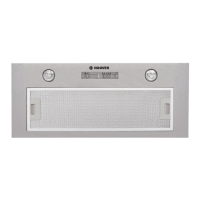
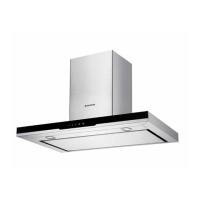
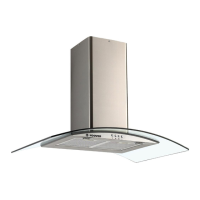
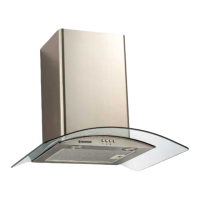
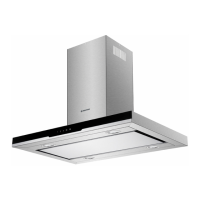
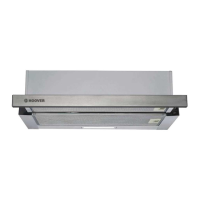
This document serves as an instruction manual for the HBG750X, HBG175NX, HBG520S, and HBG152NS Cooker Hood models. It provides comprehensive guidance on installation, operation, maintenance, and troubleshooting to ensure safe and efficient use of the appliance. The manual emphasizes the importance of reading all instructions carefully, even for users familiar with the product, and recommends keeping it in a safe place for future reference. It also states that these instructions will be available in alternative formats, such as on a website or DVD, upon request.
Function Description
The cooker hood is designed to extract cooking fumes, odors, and steam from the kitchen environment, improving air quality and preventing the buildup of grease and moisture. It operates by drawing air through grease filters, which trap airborne grease particles, and then either expelling the air outside (extraction mode) or recirculating it back into the room after purification through carbon filters (recirculation mode, if carbon filters are installed). The appliance is intended for domestic use only.
Usage Features
The cooker hood features a toggle switch for controlling both the lighting and the motor speed.
- Lighting Control: The lamp switch has two positions: "O" to switch off the light and "I" to switch on the light.
- Motor Speed Control: The motor has three speed settings, allowing users to select the appropriate level of extraction based on cooking intensity:
- "O" switches off the motor.
- Low (I) speed is suitable for light frying and boiling.
- Medium (II) speed is recommended for frying, wok cooking, and heavy boiling.
- High (III) speed is for grilling, intensive frying, and wok cooking.
- Power Activation: The cooker hood is powered on by sliding out the drawer and powered off by sliding it in.
The manual provides important safety instructions that must be followed during use:
- Always switch off the electricity supply at the mains during installation and maintenance.
- Ensure adequate ventilation in the room, especially when the cooker hood is used simultaneously with other gas or fuel-burning appliances. The negative pressure in the room must not exceed 4 Pa (4 x 10⁻⁵ bar) when the cooker hood and non-electric appliances are in operation.
- Always put lids on pots and pans when cooking on a gas cooker to minimize the release of steam and odors.
- Do not operate the cooker hood without grease filters or with excessively greasy filters.
- Avoid installing the hood above a cooker with a high-level grill.
- Never leave frying pans unattended, as overheated fats or oils can catch fire.
- Do not leave naked flames or flambé under the cooker hood.
- Accessible parts of the appliance may become hot during operation; exercise caution to avoid touching heating elements.
- Do not store items on cooking surfaces due to fire risk.
- Never attempt to extinguish a fire with water; instead, switch off the appliance and cover the flame with a lid or fire blanket.
- The air must not be discharged into a flue used for exhausting fumes from other gas or fuel-burning appliances.
- Children aged 8 years and above, and persons with reduced physical, sensory, or mental capabilities, or lack of experience and knowledge, can use the appliance if supervised and instructed on safe use and understanding of hazards. Children should not play with the appliance, and cleaning/user maintenance should not be performed by children without supervision.
- The minimum distance between the supporting surface for cooking vessels on the hob and the lowest part of the cooker hood must be at least 75 cm for gas cookers, 65 cm for electric cookers, and 75 cm for coal or oil cookers.
- Ensure ducting has no bends sharper than 90 degrees to maintain efficiency.
- The cooker hood removes odors but not steam.
Maintenance Features
Regular maintenance and cleaning are crucial for the cooker hood's longevity and efficient operation.
- General Cleaning: Always disconnect the unit from the power source before any maintenance or cleaning. Clean the appliance when it is cold. Avoid using alkaline or acid substances (e.g., lemon juice, vinegar) on surfaces. Use neutral detergents and avoid harsh cleaning chemicals, strong household detergents, or abrasive products, as these can damage the appliance's appearance and void the warranty.
- Stainless Steel Surfaces: Stainless steel should be cleaned regularly (e.g., weekly) with a clean, soft cloth. A specialized stainless steel cleaning fluid may be used. Always wipe along the grain of the stainless steel to prevent crisscross scratching patterns.
- Control Panel Surface: The inlay control panel can be cleaned with warm soapy water. Ensure the cloth is clean and well wrung, then use a dry soft cloth to remove any excess moisture.
- Grease Mesh Filters: The mesh filters can be cleaned by hand. Soak them for about 3 minutes in water with a grease-loosening detergent, then gently brush with a soft brush. Avoid applying too much pressure to prevent damage. Allow filters to dry naturally out of direct sunlight. Filters should be washed separately from crockery and kitchen utensils; rinse aid is not advisable.
- Installation of Grease Mesh Filters: To install, angle the filter into slots at the back of the hood, push the button on the filter handle, release the handle once the filter fits into a resting position, and repeat for all filters.
- Carbon Filter (not supplied): Activated carbon filters are used to trap odors in recirculation mode. They should typically be changed every three to six months, depending on cooking habits.
- Installation of Carbon Filter: First, detach the aluminum filter by pressing the lock and pulling it downward. Then, remove the old carbon filter by rotating it anti-clockwise. Replace with a new carbon filter. Ensure the filter is securely locked to prevent it from loosening and causing danger. Note that suction power may be lowered when an activated carbon filter is attached.
- Bulb Replacement:
- Always switch off the unit and unplug it before replacing bulbs.
- Wait until the light bulb has cooled down completely before handling.
- Remove the front part with a screwdriver.
- Carefully pull out the LED light and replace it with the same type and rated LED light (2*2W LSD-B LED light). The ILCOS D code for this lamp is DBR-2/65-H-64, which refers to LED modules, self-ballasted, round lamps with a maximum wattage of 2W and a voltage range of AC 220-240V.
- Replace the front part back to the unit with a screwdriver.
- When handling globes, use a cloth or gloves to prevent perspiration from contacting the globe, which can reduce its lifespan.
- The bulb must be replaced by the manufacturer, its service agent, or similarly qualified persons.
Troubleshooting
The manual includes a troubleshooting section to help users identify and resolve common issues:
- Light on, but motor does not work: Check if the fan switch is turned off; if so, select a fan switch position. If the fan switch or motor has failed, contact the service center.
- Light does not work, motor does not work: Check if house fuses are blown; if so, reset/replace fuses. If the power cord is loose or disconnected, refit it to the power outlet and switch the power outlet on.
- Oil leakage: If the one-way valve and outlet are not tightly sealed, take down the one-way valve and seal with sealant. If there is leakage from the connection of the chimney and cover, take down the chimney and seal.
- Lights not working: If globes are broken/faulty, replace them as per the instructions.
- Insufficient suction: If the distance between the cooker hood and the gas top is too far, refit the cooker hood to the correct distance.
- The cooker hood inclines: If the fixing screw is not tight enough, tighten the hanging screw and make it horizontal.
Environmental Protection
The product is marked with a symbol for selective sorting of waste electronic equipment, indicating that it should not be disposed of with household waste. It must be supported by a system of selective collection in accordance with Directive 2012/19/EU for recycling or dismantling to minimize environmental impacts. Electrical and electronic products can be dangerous due to hazardous substances. Users should contact local or regional authorities for more information on proper disposal.
To reduce the total environmental impact (e.g., energy use) of the cooking process, users are advised to:
- Install the cooker hood in a proper place with efficient ventilation.
- Clean the cooker hood regularly to prevent airway blockage.
- Switch off the cooker hood light after cooking.
- Switch off the cooker hood after cooking.
The appliance should not be dismantled by the user in ways not shown in the manual. At the end of its life, the appliance should not be disposed of with household waste. Users should check with their Local Authority or retainer for recycling advice.

 Need help?
 General

 To Next Page