EasyManua.ls Logo

HP 5254C - SECTION III OPERATION; CONTROLS AND INPUTS; MAXIMUM INPUT VOLTAGES

HP 5254C
69 pages
Print Icon
To Next Page IconTo Next Page
To Previous Page IconTo Previous Page
Loading...
Model 5254C
Section
III
SECTION
III
OPERATION
3-1.
INTRODUCTION.
3-2.
The Model
5254C
Frequency Converter
increases
the
range of
an
HP
Electronic
Counter
to.
15
through
3.
0 GHz (150
through 3000 MHz).
As
a general rule
to measure frequency,
always
start with the Mixing
Frequency
Control
below
.
2 GHz
and
tune
upward in
frequency
to obtain first
response
and
tune for a
maximum
reading
in the green
portion of
the
meter
scale.
The
input frequency
is
the
sum of the counter
reading and the
dial
frequency reading.
This
proce-
dure will be valid
whether
there are
responses
in
1,
2,
or 3 consecutive
harmonic
reference
frequencies;
see
Figure
3-1.
If the
input
signal level to the
con-
verter is high, the
second, third and other
harmonics
of this signal
may
be generated.
Therefore,
tuning
Mixing
Frequency
Control
from the
low
end upward
will enable the
input fundamental frequency
to be de-
tected
before
its
harmonics. In
the
5254C,
harmonics
of
the reference-frequency
signals
are held to such a
low level that
regardless
of input
signal level,
their
mixing effects
are
not observable,
avoiding possible
ambiguity.
Figure 3-1
provides a
step-by-step
pro-
cedure to
be used
for measurement
of frequencies
from
.15
to 3.
0 GHz
(150
MHz
to 3000
MHz).
The
only ex-
ception
is if the
first
response occurs
at
• 15 GHz
or
.
25
GHz.
To
avoid
possible
ambiguity in
these
cases,
start from
above . 45
GHz
and tune downward
in
fre-
quency for
the first
response
and subtract the
counter
reading from
the
dial frequency
for the
frequency
of
the
input signal.
Note
If
the
input
frequency
is
known
approximately,
the
Mixing
Frequency
Control
can
be
set a
hundred
megahertz
below
the input
signal. Tune
up
for
the first
response
and add the
counter
reading
to the
dial
frequency.
3-3.
CONTROLS
AND
INPUT.
3-4.
GENERAL.
The
function of the
front
panel
con-
trol,
meter,
connectors,
and retaining
screws
are
discussed in
Paragraphs
3-5
through
3-8.
3-5.
INPUT
CONNECTOR.
Signal
input, 50
ohms
in-
put
impedance,
50 mV (-13
dBm
in 50 ohms)
to 1
V
rms (+13 dBm
in
50 ohms)
into
Type
N
female
connector.
3-6.
MIXING
FREQUENCY
SELECTOR.
Calibrated
from
.
2
to 3. 0
GHz
(200
MHz
to 3000
MHz),
this
con-
trol tunes
the internal
cavity to select a
harmonic
of
50
MHz
to
be heterodyned
with the INPUT
signal.
3-7.
LEVEL
INDICATOR
METER.
The meter
circuit
continuously
monitors
the level
of
the
difference
fre-
quency output
of the converter
to the
counter.
When
meter
reads in the
green
portion of
its
scale,
INPUT
signal
amplitude
is
adequate for
accurate
frequency
measurement.
3-8.
AUX
OUT CONNECTOR.
The 1
MHz
to 50
MHz
video amplifier
output appears
at
AUX
OUT BNC
type
connector.
3-9.
MAXIMUM
INPUT
VOLTAGES.
3-10.
Damage
to the converter
may
result if
an
ac
signal greater than +20
dBm
in 50
ohms
(2.2
V
rms)
or a dc voltage
greater than 100V
is applied
to the
converter INPUT
connector.
3-11.
FREQUENCY
MEASUREMENT
WITH
AMPLITUDE
LESS THAN
50 MV
RMS.
3-12.
The
front
panel level
indicator meter
indicates
in the
green portion
of its scale
only when
converter
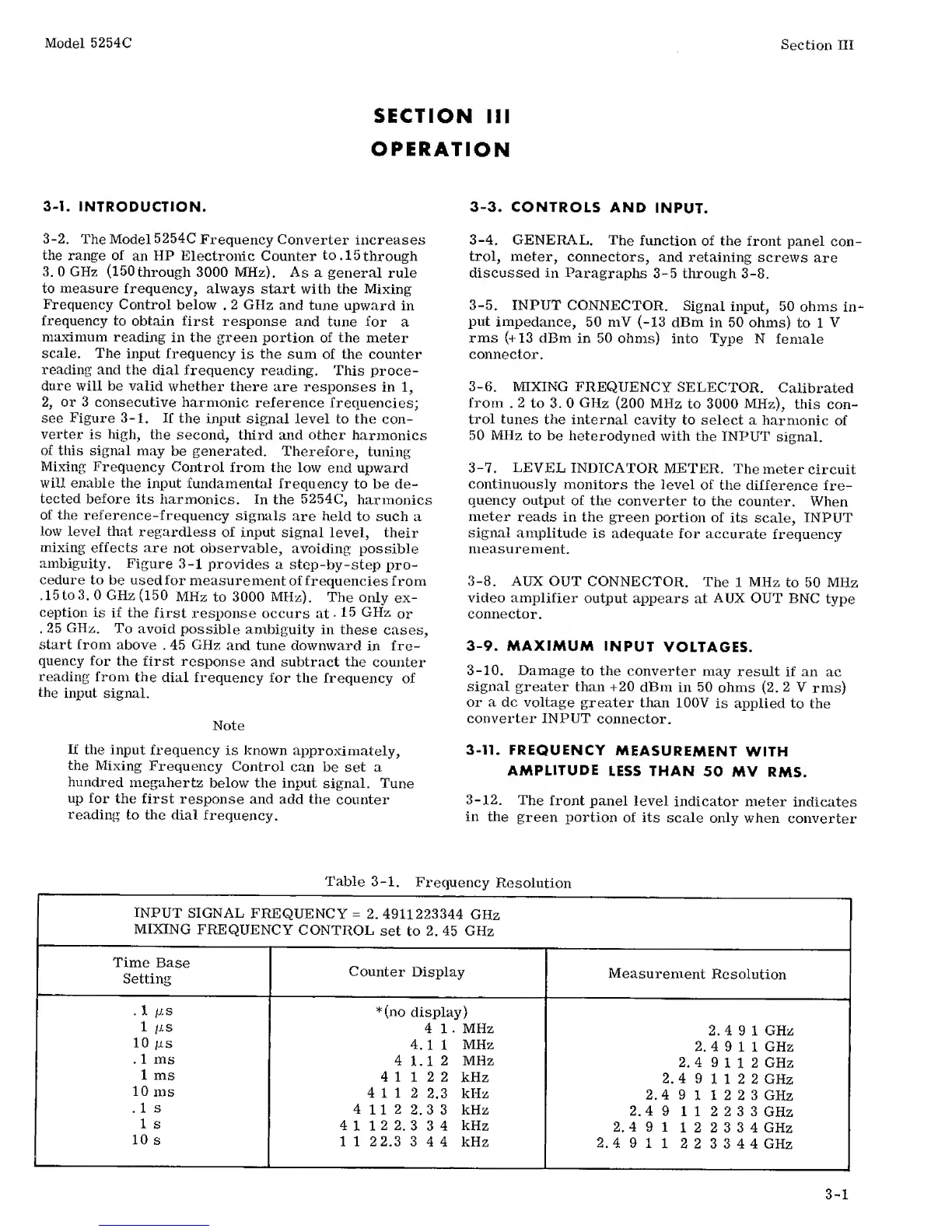
Table 3-1.
Frequency
Resolution
INPUT
SIGNAL
FREQUENCY
=
2.4911223344
GHz
MIXING
FREQUENCY
CONTROL
set to 2. 45 GHz
Time Base
Setting
Counter
Display
Measurement
Resolution
.1
jl s
*(no
display)
1
/IS
4
1
.
MHz
2. 4 9 1 GHz
10
/is
4.11 MHz
2. 4 9 1 1 GHz
.
1
ms
4
1.1
2 MHz
2.
4
9
112 GHz
1
ms
41122
kHz
2.
4
9
1 1 2 2 GHz
10
ms
4 1 1
2
2.3
kHz
2.4
9
1 1 2 2 3
GHz
.
1 s
4
1 1
2
2.3 3 kHz
2.
4 9
1 1 2 2 3
3
GHz
1
s
4
1 1
2
2.
3 3 4
kHz
2.
491
1 2 2334 GHz
10
s
1 1 22.3
3
4 4 kHz
2.491
1 223344 GHz
3-1

Related product manuals