EasyManua.ls Logo

HP 8340b - Page 473

HP 8340b
530 pages
Print Icon
To Next Page IconTo Next Page
To Previous Page IconTo Previous Page
Loading...
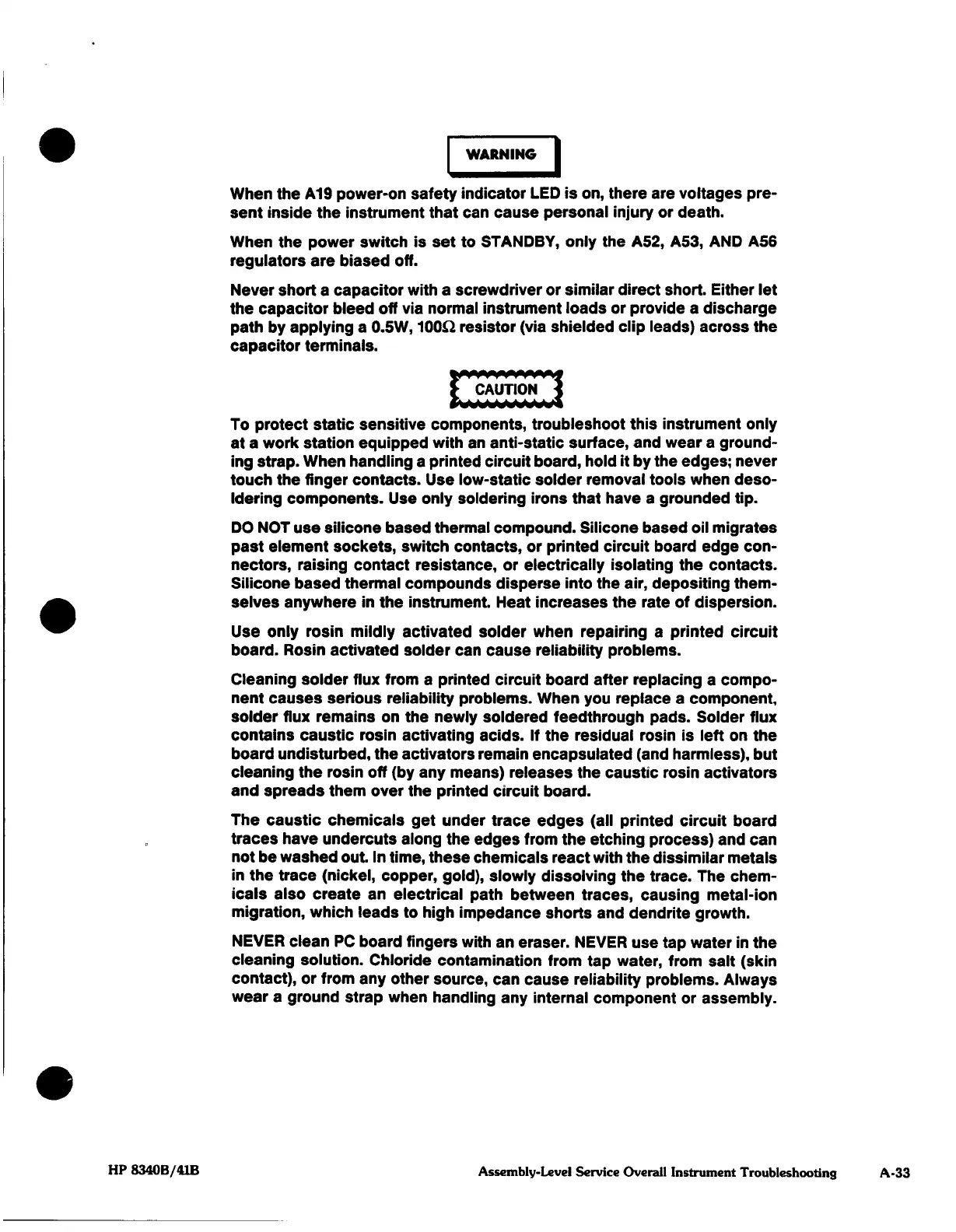
WARNING
|
When the
A19
power-on
safety
indicator
LED
is
on,
there
are
voltages pre¬
sent
inside the
instrument
that
can
cause
personal
injury
or death.
When the
power
switch
is
set
to
STANDBY,
only
the
A52,
ASS,
AND A56
regulators
are
biased off.
Never
short
a
capacitor
with
a
screwdriver or
similar
direct
short.
Either
let
the
capacitor
bleed
off
via
normal
instrument
loads
or
provide
a
discharge
path
by
applying
a
0.5W,
100^2
resistor
(via
shielded
clip
leads)
across
the
capacitor
terminals.
•www^w
C.
CAUTION
3
To
protect
static sensitive
components,
troubleshoot
this
instrument
only
at
a
work
station
equipped
with
an anti-static
surface,
and
wear
a
ground¬
ing
strap.
When
handling
a
printed circuit
board,
hold
it
by
the
edges;
never
touch
the
finger
contacts.
Use
low-static
solder
removal
tools
when
deso-
Idering
components.
Use only soldering irons
that
have
a
grounded
tip.
DO
NOT
use
silicone
based thermal
compound.
Silicone
based
oil
migrates
past element sockets,
switch
contacts,
or
printed circuit
board
edge
con¬
nectors,
raising
contact
resistance,
or
electrically
isolating
the
contacts.
Silicone
based
thermal
compounds disperse
into
the
air,
depositing
them¬
selves
anywhere
in
the
instrument.
Heat
increases
the
rate
of
dispersion.
Use
only rosin
mildly
activated solder
when
repairing
a
printed
circuit
board.
Rosin
activated solder
can
cause
reliability
problems.
Cleaning solder
flux
from
a
printed
circuit
board
after replacing
a
compo¬
nent
causes
serious
reliability
problems.
When
you
replace
a
component,
solder
flux
remains
on
the
newly
soldered
feedthrough
pads.
Solder
flux
contains
caustic
rosin activating
acids.
If
the residual
rosin
is
left
on
the
board
undisturbed,
the
activators remain
encapsulated
(and
harmless),
but
cleaning
the
rosin
off
(by
any
means)
releases
the
caustic rosin
activators
and
spreads
them
over
the
printed circuit
board.
The
caustic chemicals get
under
trace
edges
(all
printed circuit
board
traces
have undercuts
along the
edges
from
the
etching
process)
and
can
not be
washed
out.
In
time,
these chemicals
react
with
the dissimilar
metals
in
the
trace
(nickel,
copper,
gold), slowly dissolving the
trace.
The
chem¬
icals also
create
an
electrical path
between
traces,
causing
metal-ion
migration,
which
leads
to
high
impedance
shorts and dendrite
growth.
NEVER
clean
PC
board
fingers
with
an
eraser.
NEVER
use
tap
water
in
the
cleaning solution.
Chloride
contamination
from
tap
water,
from
salt
(skin
contact),
or
from
any
other
source,
can cause
reliability
problems.
Always
wear
a
ground
strap
when
handling
any
internal
component or
assembly.
HP 8340B/41B
Assembly-Level Service
Overall
Instrument Troubleshooting
A.33

Table of Contents

Other manuals for HP 8340b

Related product manuals