EasyManua.ls Logo

HP 8753D - Page 319

HP 8753D
678 pages
Print Icon
To Next Page IconTo Next Page
To Previous Page IconTo Previous Page
Loading...
Source
Match
Source
match is
dened
as
the
vector
sum
of
signals
appearing
at
the
analyzer
receiver input
due
to the
impedance
mismatch
at
the
test
device
looking
back
into
the
source
,as
well as
to
adapter
and cable
mismatches
and
losses
.
In
a
reection
measurement,
the
source
match
error
signal
is caused
by
some
of
the
reected
signal
from
the
test
device
being
reected
from
the
source
back toward
the test
device
and
re-reected
from
the
test
device
(
Figure
6-29
).
In a
transmission
measurement,
the
source
match
error
signal
is
caused
by
reection
from
the
test
device
that
is
re-reected
from
the
source
.
Source
match
is
most
often
given
in
terms
of return
loss
in
dB:
thus
the
larger
the
number
,
the
smaller
the
error
.
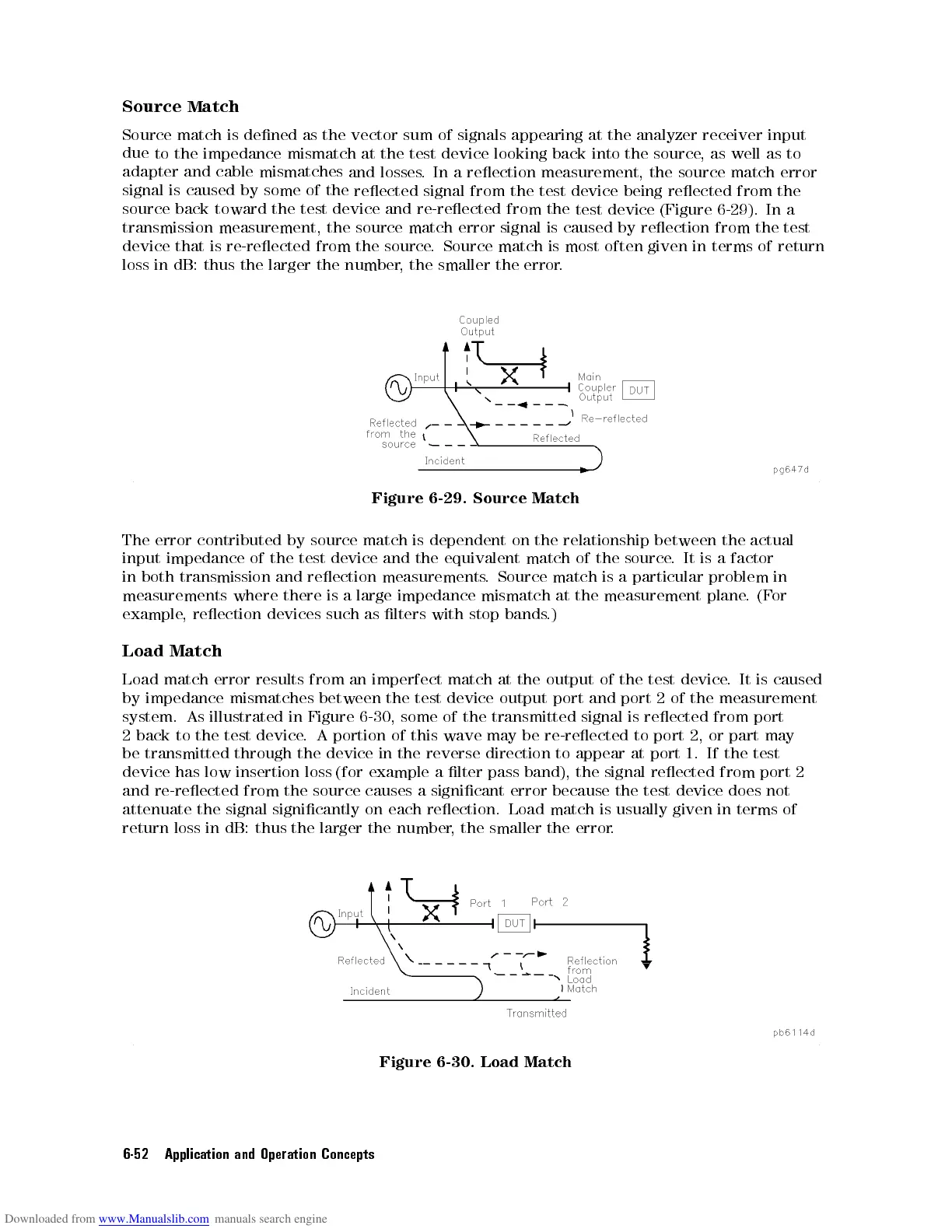
Figure 6-29.
Source
Match
The error
contributed by
source
match
is
dependent
on
the
relationship
between
the
actual
input
impedance
of
the
test
device
and
the
equivalent
match
of
the
source
.
It
is
a
factor
in
both
transmission
and
reection
measurements
.
Source
match
is
a
particular
problem
in
measurements
where
there
is
a
large
impedance
mismatch
at
the
measurement
plane
.
(F
or
example
,
reection
devices
such
as
lters
with
stop
bands
.)
Load
Match
Load
match
error
results
from
an
imperfect
match
at
the
output
of
the
test device
.It
is
caused
by
impedance
mismatches
between
the
test
device
output
port
and
port
2
of
the measurement
system.
As
illustrated
in
Figure
6-30
,
some
of
the
transmitted
signal is
reected from
port
2
back
to
the
test
device
.
A
portion
of
this
wave may
be re-reected
to port
2, or
part
may
be
transmitted
through
the
device
in the
reverse direction
to appear
at
port
1.
If
the
test
device
has
low
insertion
loss
(for example
a lter
pass band),
the signal
reected
from
port
2
and
re-reected
from
the
source
causes a
signicant error
because the
test device
does
not
attenuate
the
signal
signicantly on
each reection.
Load match
is usually
given in
terms of
return
loss
in
dB: thus
the larger
the number
,the
smaller the
error.
Figure 6-30. Load Match
6-52 Application and Operation Concepts