EasyManua.ls Logo

HP 8753D - Page 326

HP 8753D
678 pages
Print Icon
To Next Page IconTo Next Page
To Previous Page IconTo Previous Page
Loading...
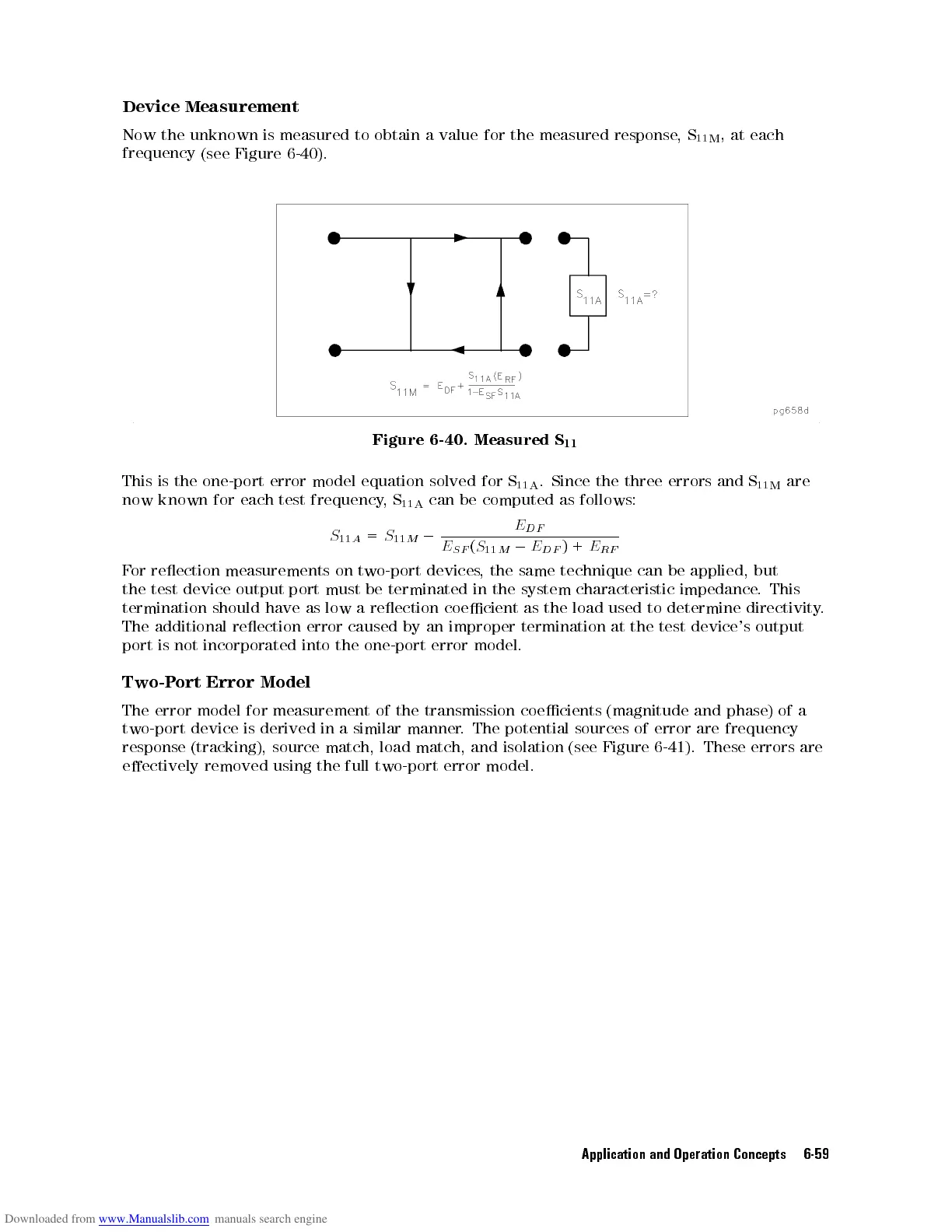
Device
Measurement
Now
the unknown
is
measured
to
obtain
a
value
for
the
measured
response
,
S
11M
,
at each
frequency
(see Figure
6-40
).
Figure
6-40.
Measured
S
11
This
is
the
one-port
error
model
equation
solved
for
S
11A
.
Since
the
three
errors
and
S
11M
are
now
known
for
each
test
frequency
,
S
11A
can
be
computed
as
follows:
S
11
A
=
S
11
M
0
E
D
F
E
S
F
(
S
11
M
0
E
D
F
)
+
E
R
F
F
or
reection
measurements
on
two-port
devices
,
the same
technique
can
be
applied,
but
the
test
device
output
port
must
be
terminated
in the
system
characteristic
impedance
.
This
termination
should
have
as
low
a
reection
coecient
as
the load
used
to
determine
directivity
.
The
additional
reection error
caused
by
an
improper
termination
at
the
test
device's
output
port
is
not incorporated
into
the
one-port
error
model.
Two-P
ort
Error Model
The error
model for
measurement of
the transmission
coecients
(magnitude
and
phase)
of
a
two-port
device
is
derived
in
a
similar
manner
.
The
potential
sources
of
error
are
frequency
response
(tracking),
source
match,
load
match,
and
isolation
(see
Figure
6-41
).
These
errors
are
eectively
removed
using
the
full
two-port
error
model.
Application and Operation Concepts 6-59