Model
8901B
Service
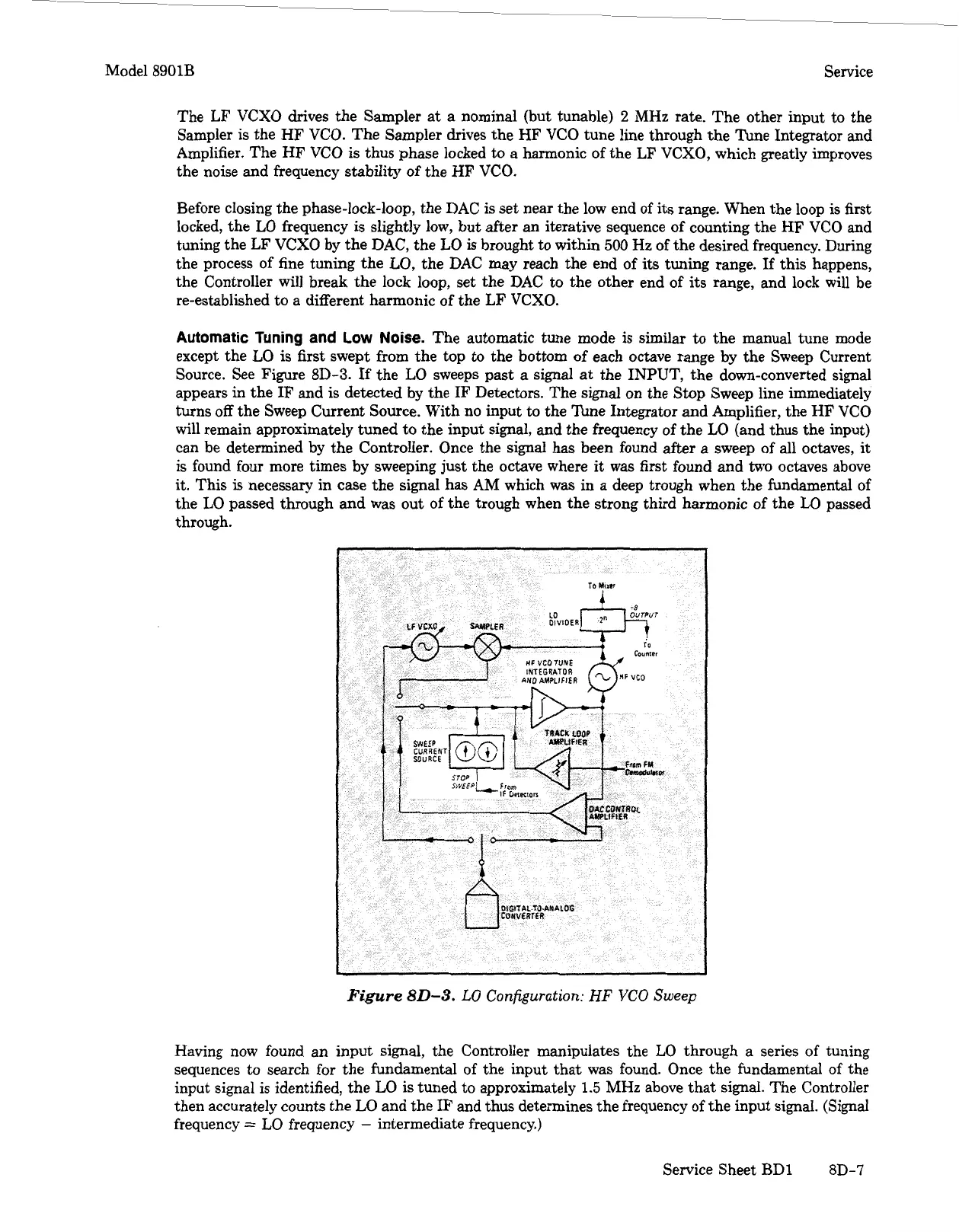
The LF VCXO drives the Sampler at a nominal (but tunable)
2
MHz rate. The other input to the
Sampler is the HF VCO. The Sampler drives the HF VCO tune line through the Tune Integrator and
Amplifier. The HF VCO is thus phase locked to a harmonic of the LF VCXO, which greatly improves
the noise and frequency stability of the
HF
VCO.
Before closing the phase-lock-loop, the DAC is set near the low end
of
its
range. When the loop
is
first
locked, the LO frequency is slightly low, but after
an
iterative sequence of counting the HF VCO and
tuning the LF VCXO by the DAC, the
LO
is brought to within
500
Hz
of
the desired frequency. During
the process of fine tuning the
LO,
the DAC may reach the end of
its
tuning range.
If
this happens,
the Controller will break the lock loop, set the DAC to the other end of its range, and lock will be
re-established to a different harmonic
of
the
LF
VCXO.
Automatic Tuning and
Low
Noise.
The automatic tune mode is similar
to
the manual tune mode
except the
LO
is
first swept from the top
to
the bottom of each octave range by the Sweep Current
Source. See Figure 8D-3.
If
the LO sweeps past a signal at the
INPUT,
the down-converted signal
appears in the IF and
is
detected by the
IF
Detectors. The signal on the Stop Sweep line immediately
turns
off
the Sweep Current Source. With no input to the Tune Integrator and Amplifier, the HF VCO
will remain approximately tuned to the input signal, and the frequency
of
the
LO
(and thus the input)
can be determined by the Controller. Once the signal has been found after a sweep of all octaves,
it
is
found four more times by sweeping just the octave where it was first found and
two
octaves above
it.
This
is
necessary in case the signal has AM which was in a deep trough when the fundamental
of
the
LO
passed through and was out of the trough when the strong third harmonic
of
the LO passed
through.
Figure
80-3.
LO
Configuration:
HF
VCO
Sweep
Having now found an input signal, the Controller manipulates the LO through a series of tuning
sequences to search
for
the fundamental
of
the input that
was
found. Once the fundamental
of
the
input signal
is
identified, the LO
is
tuned to approximately
1.5
MHz above that signal. The Controller
then accurately counts the
LO
and the
IF
and thus determines the frequency
of
the input signal. (Signal
frequency
=
LO
frequency
-
intermediate frequency.)
Service Sheet BD1
8D-7


 To Next Page
 Loading...