EasyManua.ls Logo

HP HP-15C - Part III HP-15 C Advanced Functions

HP HP-15C
224 pages
Print Icon
To Next Page IconTo Next Page
To Previous Page IconTo Previous Page
Loading...
Section
4:
Using
Matrix
Operations
117
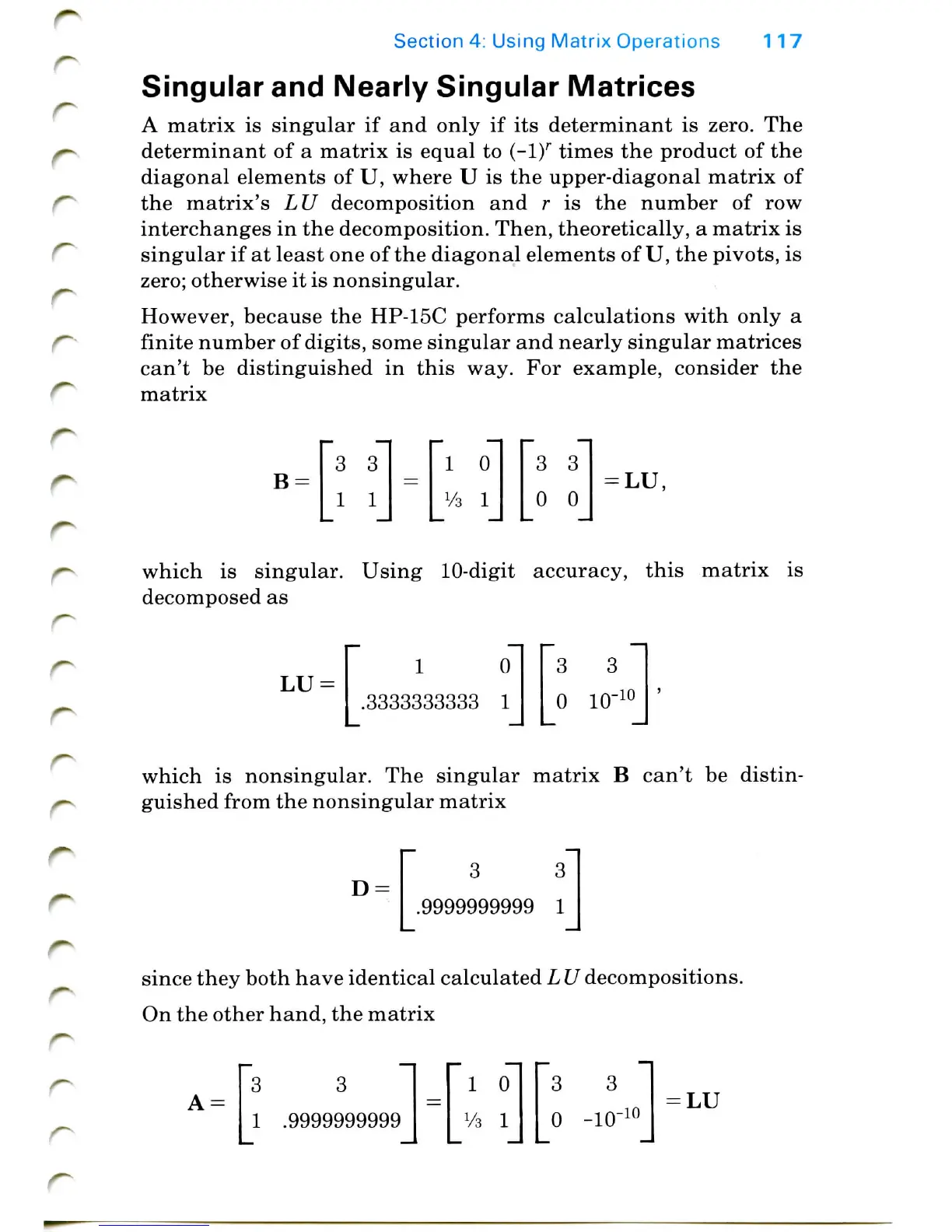
Singular
and
Nearly Singular Matrices
A
matrix
is
singular
if and
only
if its
determinant
is
zero.
The
determinant
of a
matrix
is
equal
to
(-l)r
times
the
product
of the
diagonal elements
of U,
where
U is the
upper-diagonal matrix
of
the
matrix's
LU
decomposition
and r is the
number
of row
interchanges
in the
decomposition. Then, theoretically,
a
matrix
is
singular
if at
least
one of the
diagonal elements
of U, the
pivots,
is
zero;
otherwise
it is
nonsingular.
However,
because
the
HP-15C performs calculations with only
a
finite
number
of
digits, some singular
and
nearly singular matrices
can't
be
distinguished
in
this
way.
For
example, consider
the
matrix
B
=
1 0
3 3
0 0
-LU,
which
is
singular. Using
10-digit
accuracy,
this
matrix
is
decomposed
as
LU
=
.3333333333
1
3 3
0
10-10
which
is
nonsingular.
The
singular matrix
B
can't
be
distin-
guished
from
the
nonsingular matrix
D
=
3 3
.9999999999
1
since they both have identical calculated
L U
decompositions.
On
the
other hand,
the
matrix
A
=
3
3
"I
1
.9999999999
0
-1CT10
= LU

Table of Contents

Other manuals for HP HP-15C

Related product manuals